Post #1 | Post #2 | Post #3 | Post #4 | Post #5
Bhutan
What an enchanting country! Land of the Thunder Dragon, where Gross National Happiness (GNH) is officially more important than gross national production, a land devoted to (mostly Tibetan) Buddhism brought south by the venerated Tibetan Lama Guru Rinpoche in the 8th century CE, but with its own little twists – mainly from the Tibetan Lama Zhabdrung, the founder of the modern nation in the 17th century. These two figures often make a trio of statues, in the Temples here, with the Buddha in the middle.
Here, although there is also clearly some poverty, the country seems better off than Nepal. The roads and the buildings I see beside them certainly give that impression – and everything has a definite Bhutanese style, which is evident the moment one arrives.
1/6/26
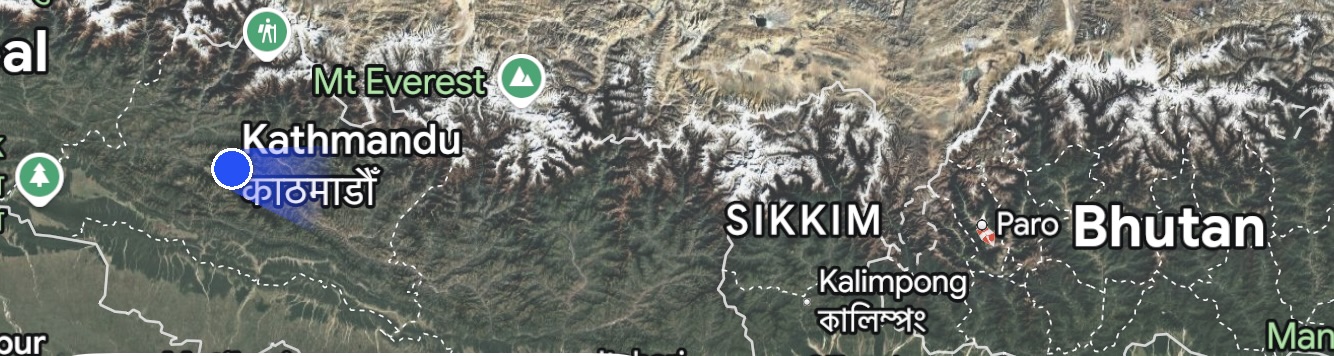
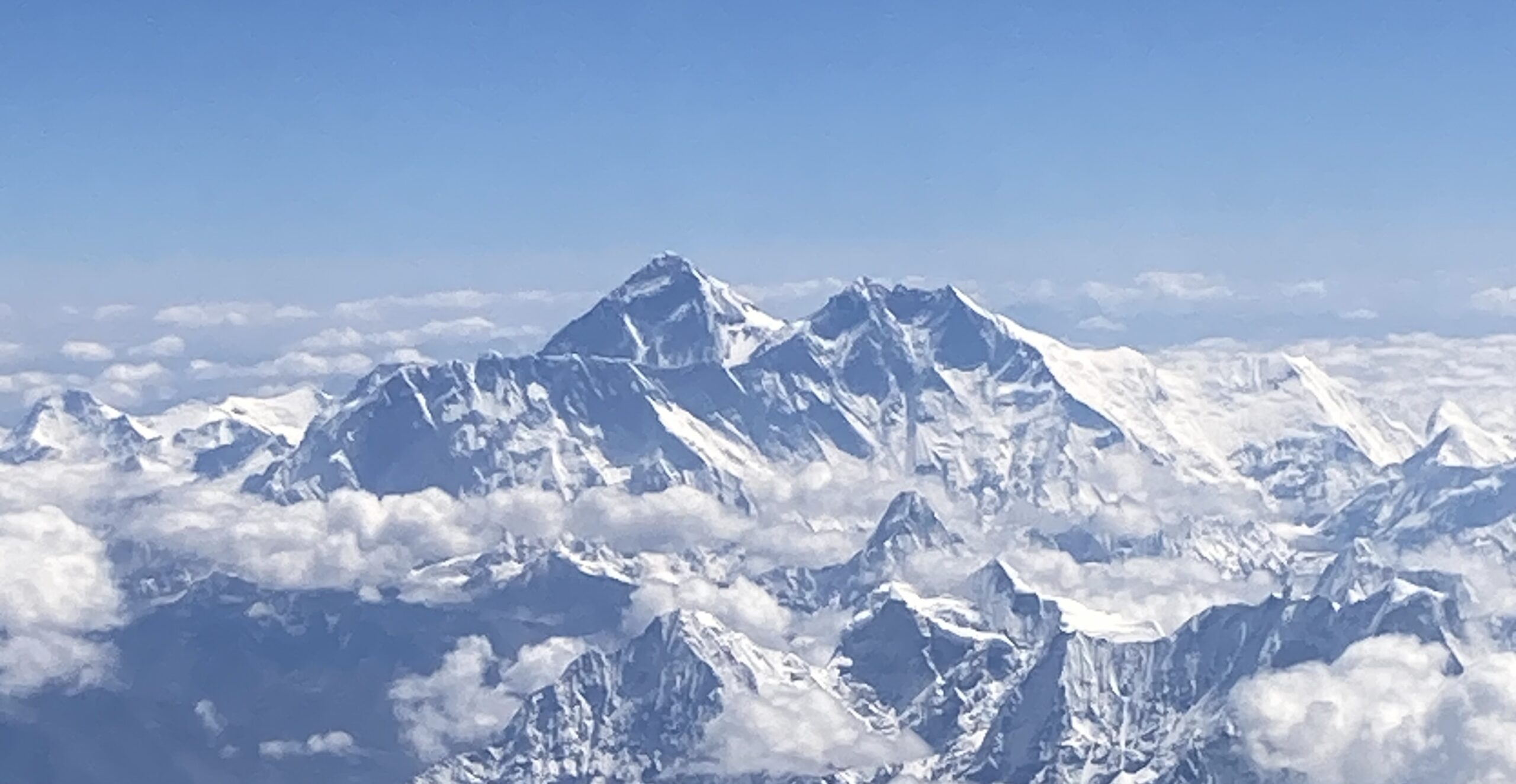
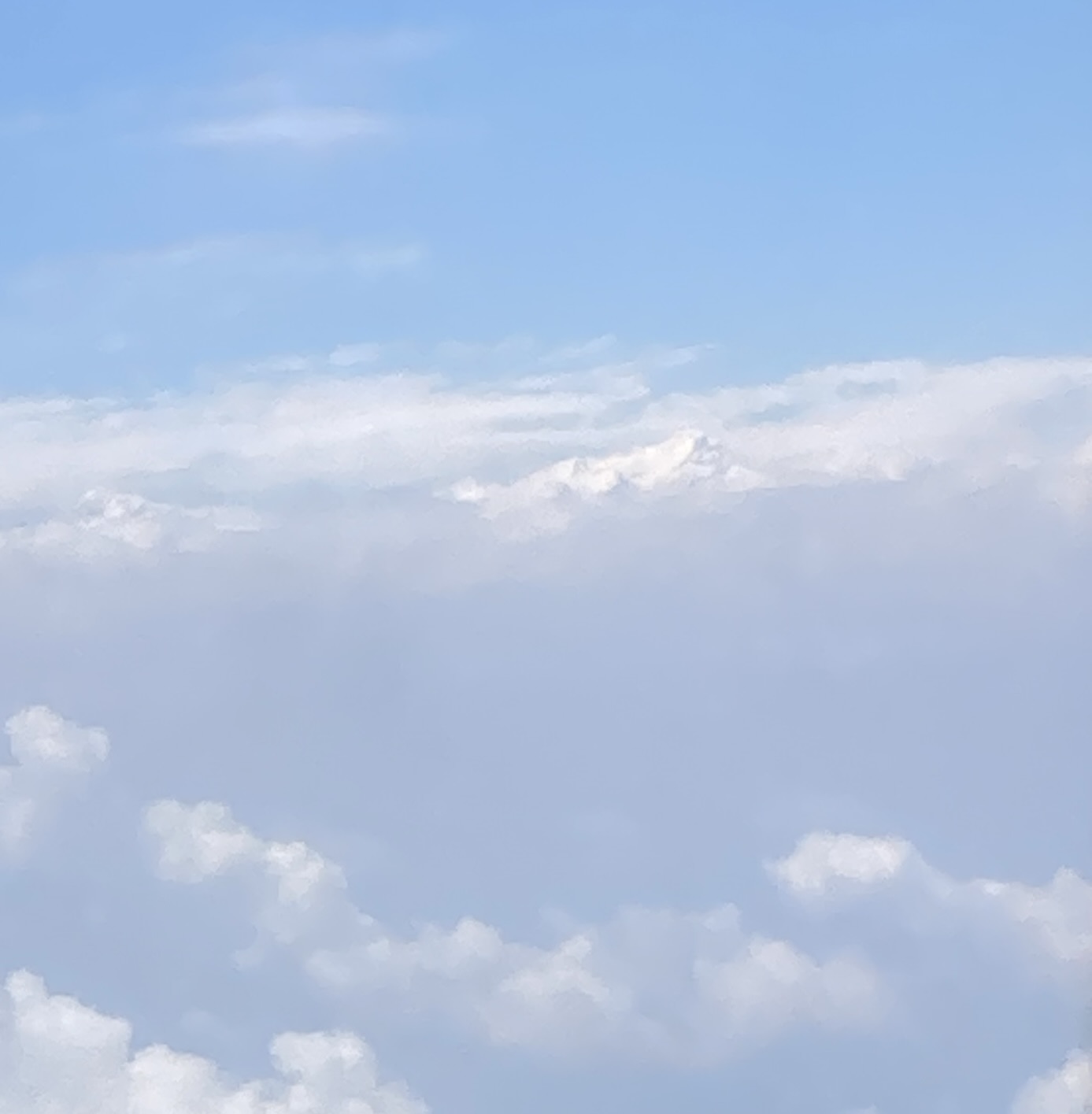
The journey from Kathmandu to Paro – Bhutan’s only International Airport – passes several of the highest mountains in the world, including the iconic Everest. I am truly blessed with a beautiful morning and an extraordinarily good view of the mountain peaks, from my seat on the left-hand side of the plane (arranged by my tour operator!).
The final approach, moreover, is like something out of a movie, where the plane swerves and turns through a series of valleys on its way down to land – fine if you’re in a jet fighter but in a Boeing 737 it was an amazing ride! Apparently there are only about 25 pilots qualified to make this landing at any one time. I’m not surprised!
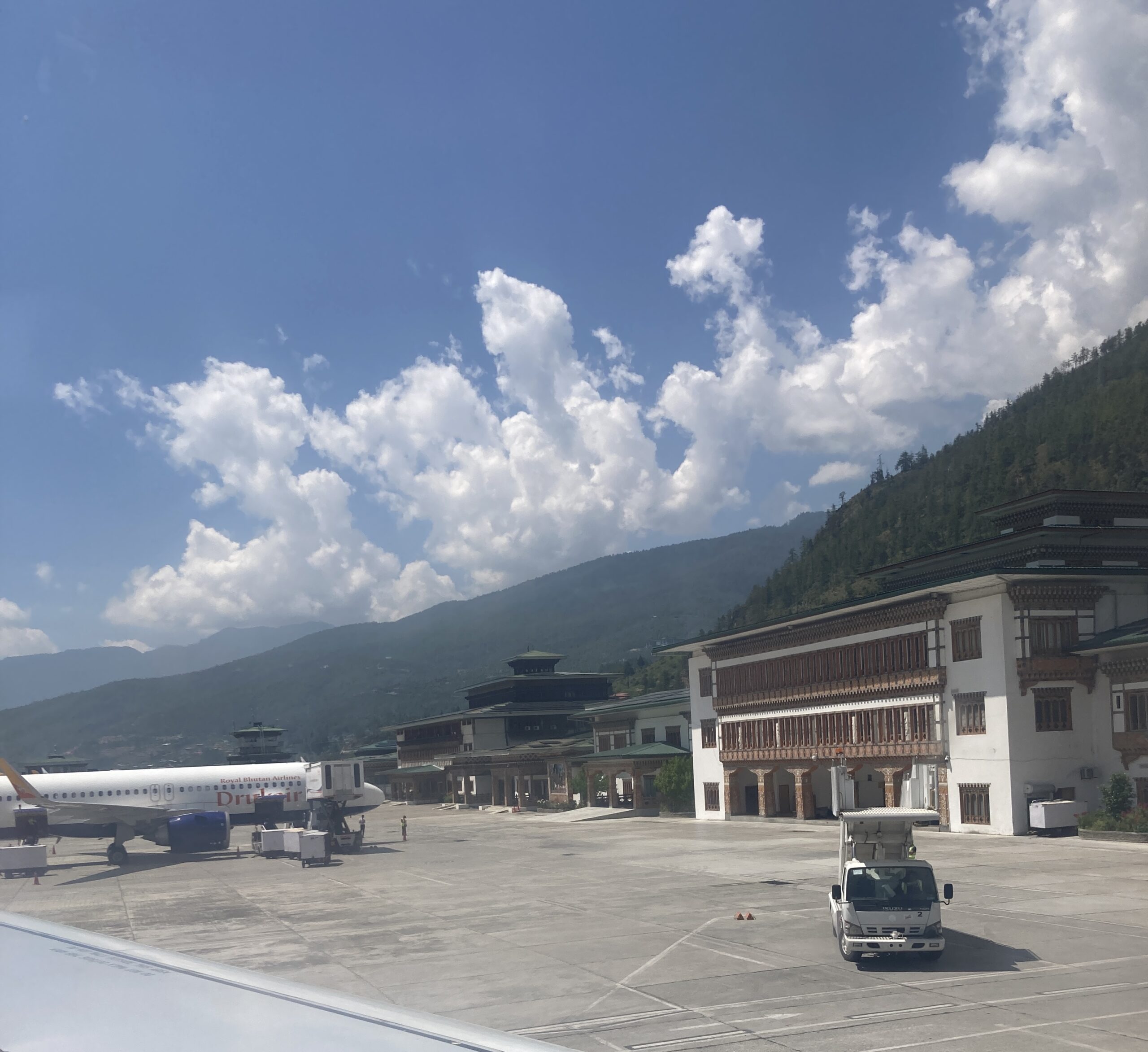
Paro Airport is the introduction to the wonder of Bhutan: as in most developed countries, planning permission and construction standards are required for any new building. Here in Bhutan there is also a requirement to adhere to the national character, with carved wooden facades and everything else (as much as possible) in wood and stone. Although arguably it makes all the buildings look rather similar, it also means that there is little (if any) of the brashness of global branding, ugly concrete blocks, or half-built brick blocks with steel reinforcements sticking out, as is so prevalent across Nepal. It makes for a very beautiful place. When, amongst all the newer buildings, you discover the medieval ones, in the same style, but much older, you appreciate what they have done here. It is also true that fire and earthquake have destroyed some of the medieval buildings, but they have been completely rebuilt in the exact same style. Bhutan’s tourism, moreover, follows a policy of high-value/low-impact. There is a hefty tax all tourists pay just to be here. This keeps out most backpackers, and keeps down the numbers. The places to visit, moreover, could clearly not handle high volume tourism, in any case. It all makes for a sense of an exclusive holiday, and I feel truly fortunate.

Sonam, my guide, tells me a great deal about the country, about its history, and about its religion, the highlights of which I shall try to share in this blog. He and his young driver, Doji, are – like most of the men I see here, attired in the national dress, which is a Gho – a robe which is hitched up in the middle with a tight sash, and arms that fold back on themselves with white cuffs tucked over them. The robe thus makes for a kilt-like feel above the knee, with long black socks below. They look cool and quite practical in the heat here, and on the spur of the moment I include men’s national dress in the short list of souvenirs I tell Sonam I would definitely like to acquire, hopefully with his advice on where best to get good quality examples. I, of course, also want some “organs” as he describes them. For one of things that most fascinates me about Bhutan is that the old religion here, which remained strong right up the 8th century CE when Buddhism arrived, was centred around the Phallus.
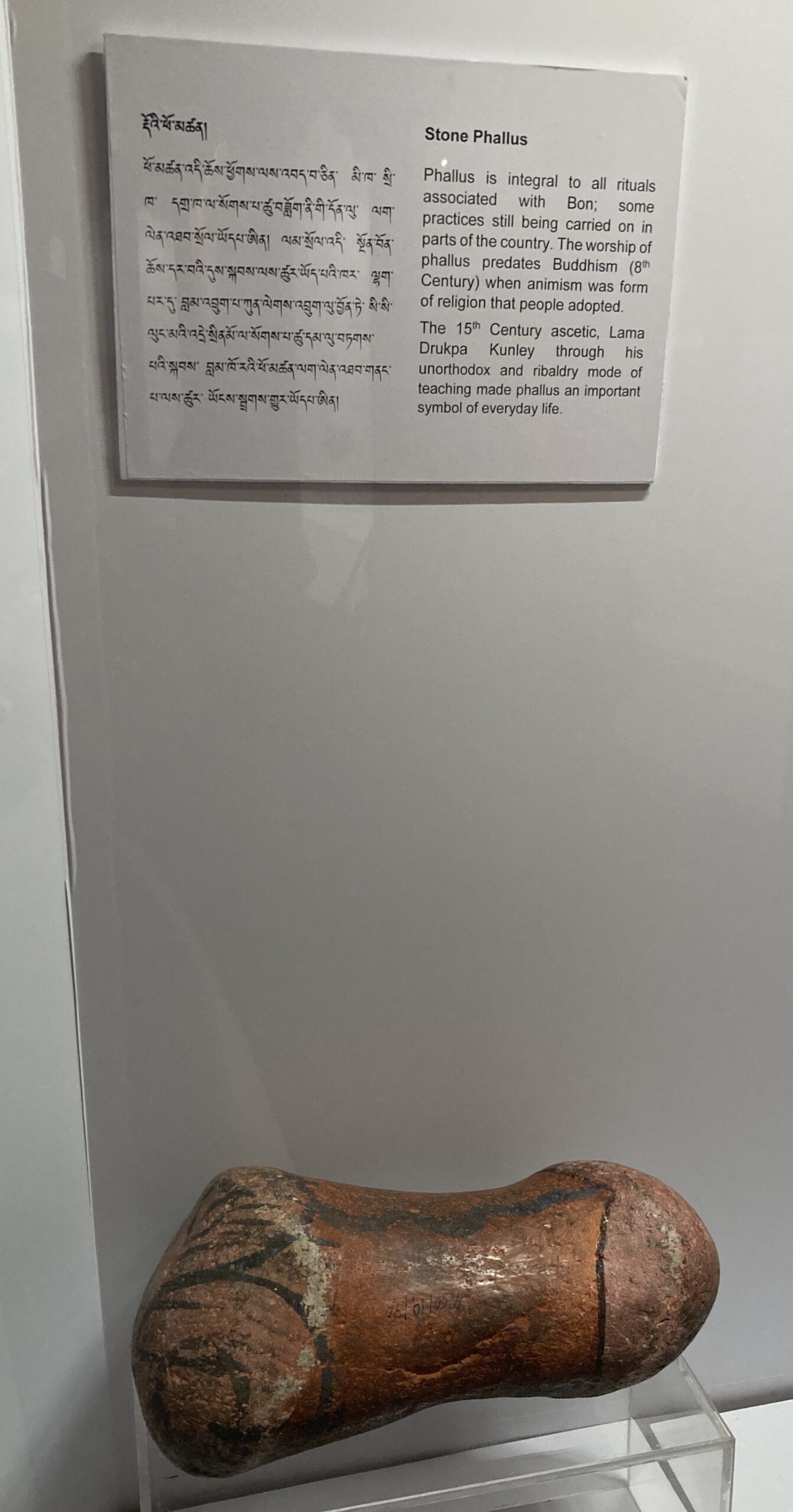
It was called Bon, and Bonpo Buddhism is a not unrelated development out of it. But the Tibetan Lama Drukpa Kunley, who came south to teach here in the c15th CE, brought the fascination with the phallus into Buddhism, too, such that representations of it, in paintings on buildings and in wooden and stone sculptures of it, are absolutely everywhere you look. I love Bhutan. Land of the Thunder Dragon! The white dragon on the national flag signifies purity, with a yellow triangle and an orange triangle signifying the administration of government twinned with the hierarchy of monastic life.
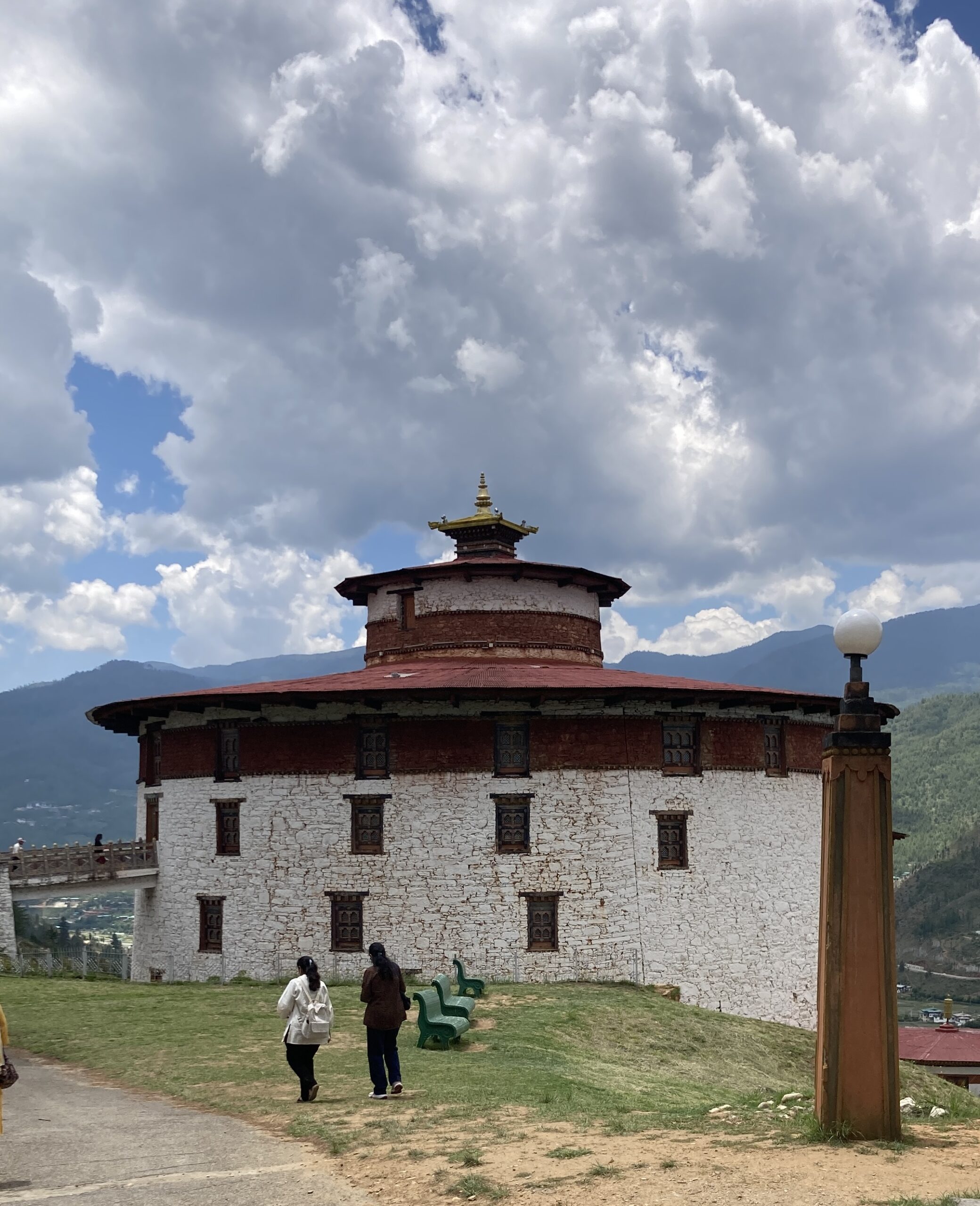
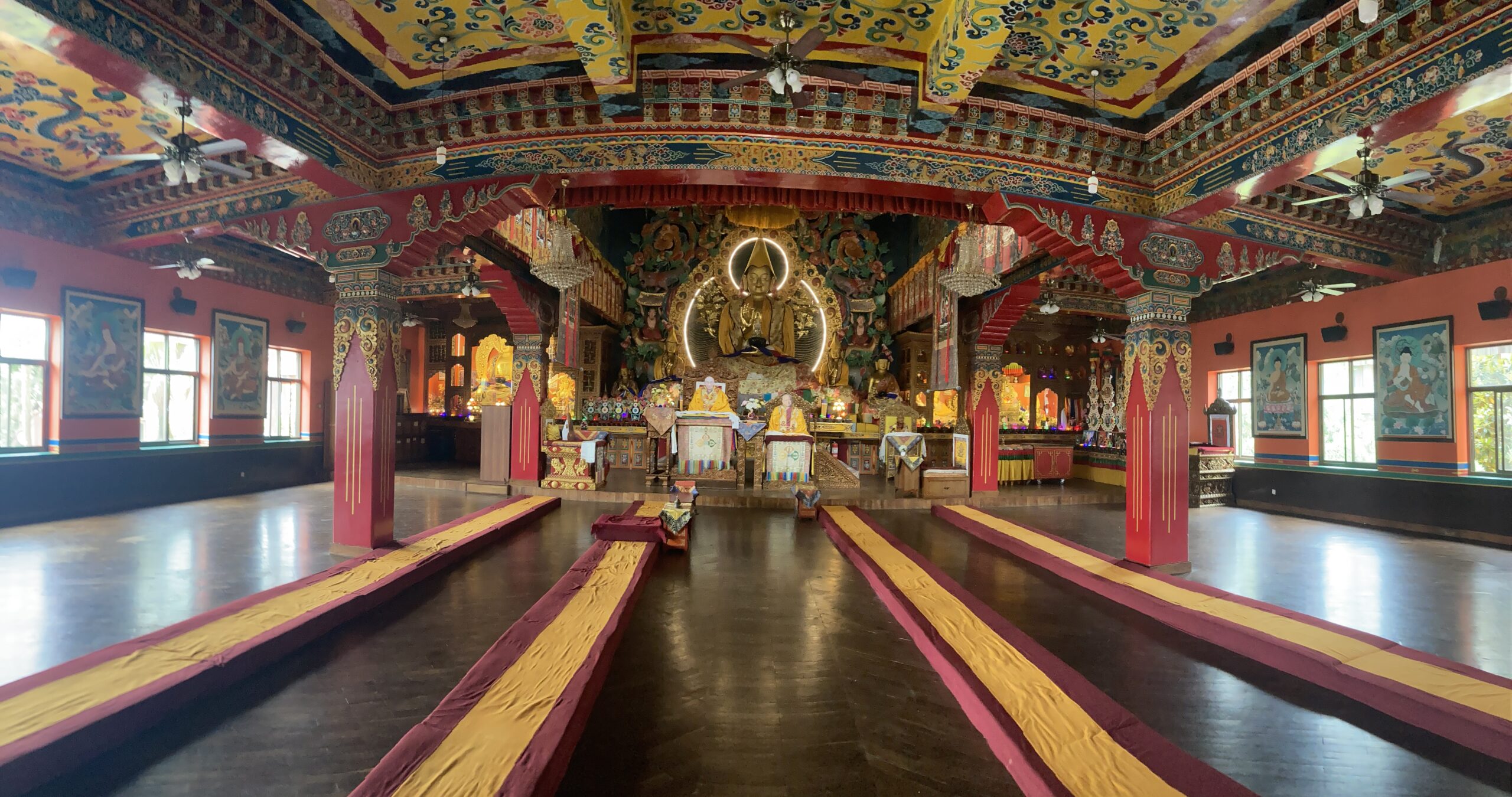
We visit the Taa Dzong (National Museum) first, which is a medieval building on seven floors filled with artefacts and information plaques, and Soram tells me many stories about the things we see. It is a fascinating immersion in Bhutanese history and culture. I am struck by the many Thangka paintings, and delighted by the many varied artefacts we see. I am also – by the end of it – exhausted by all the stairs, up and down, (having been awake since 4.30am, and up since 5.30am, to get here). Below the National Museum, the Rinpung Dzong medieval fortress, converted in modern times into an administrative centre for the Paro district and monastic centre, is a stunning building, with a really lovely Buddhist temple, and Soram takes me through explaining all the various statues and their mudras.
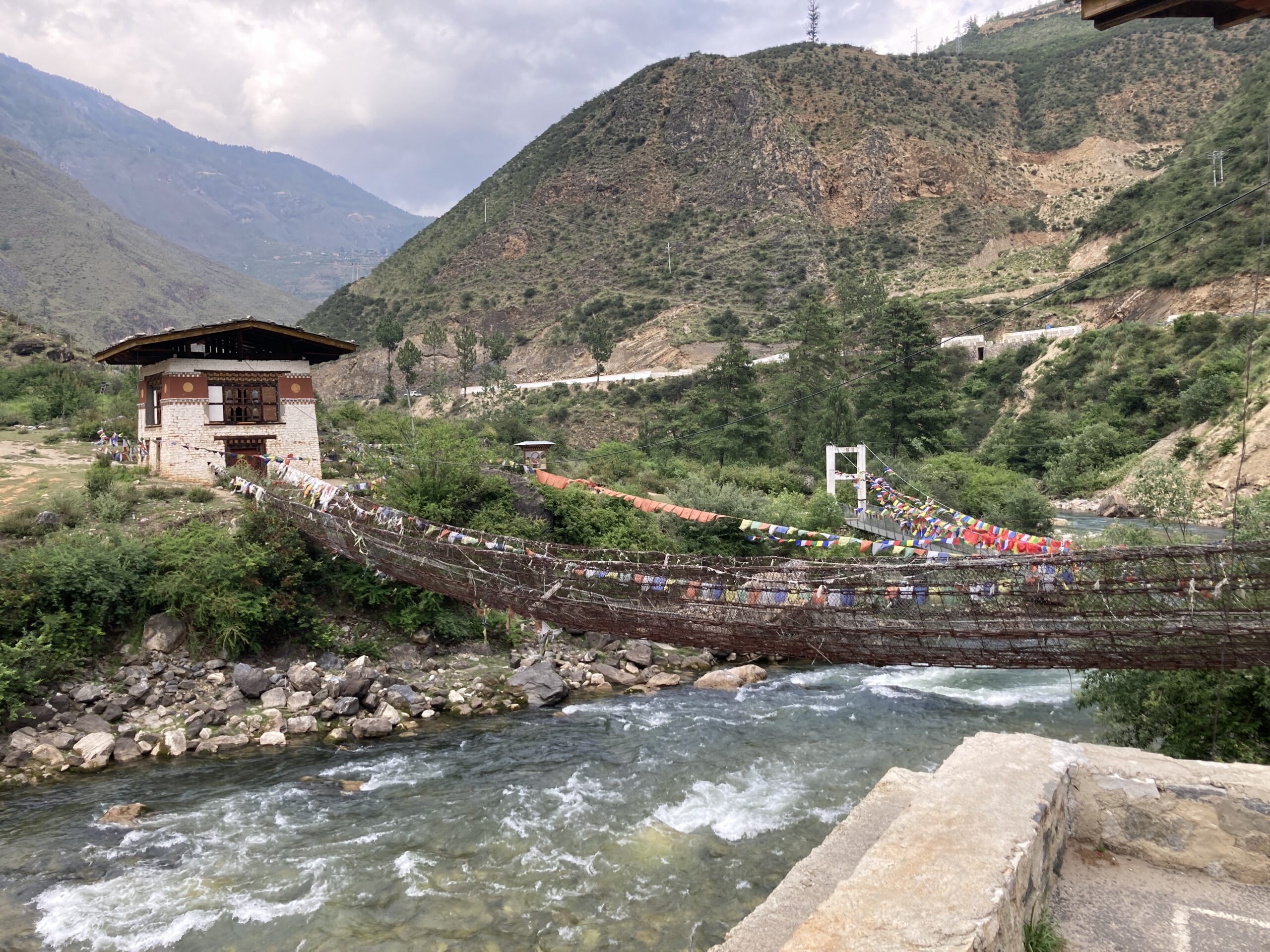
On the drive, then, from Paro to Thimpu, we stop off at two smaller temples – Dungtse Lhakhang and Kyichu Lhakhang. The first is a place where there is a small Buddhist temple inside a stupa – very unusual! Bhutanese Stupas are square with a wide roof, but inside this one is hollow and incorporates four Buddhas facing in each direction. The second is perched on a hillside above where two rivers meet, across an iron-link bridge. The Lama Zhabdrung, who came from Tibet and brought the knowledge of finding iron ore and making iron rings, with which numerous bridges were made across the many rivers, is a very fondly remembered character in Bhutanese history. He was also responsible for building many temples, and fortresses.
2/6/26
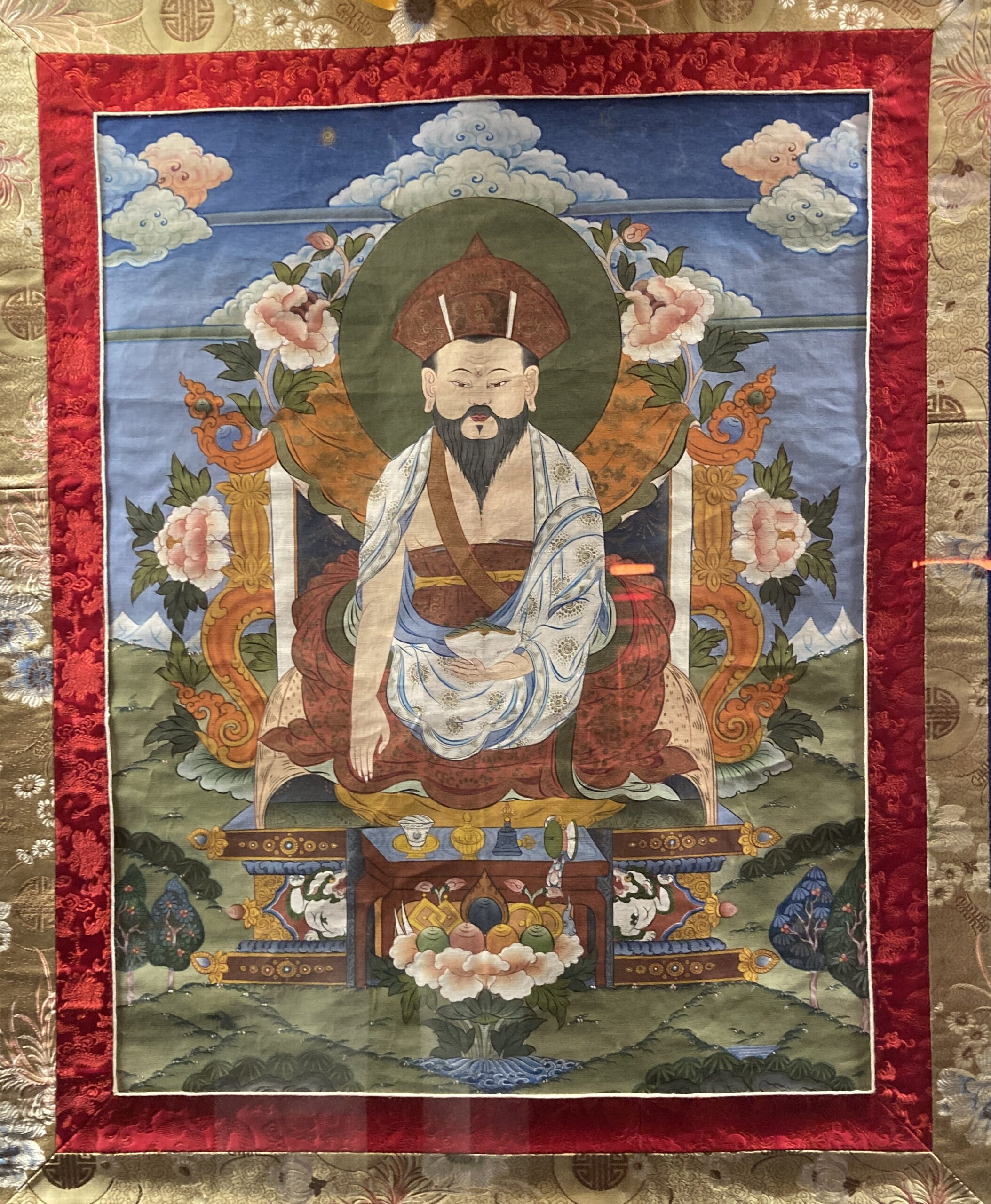
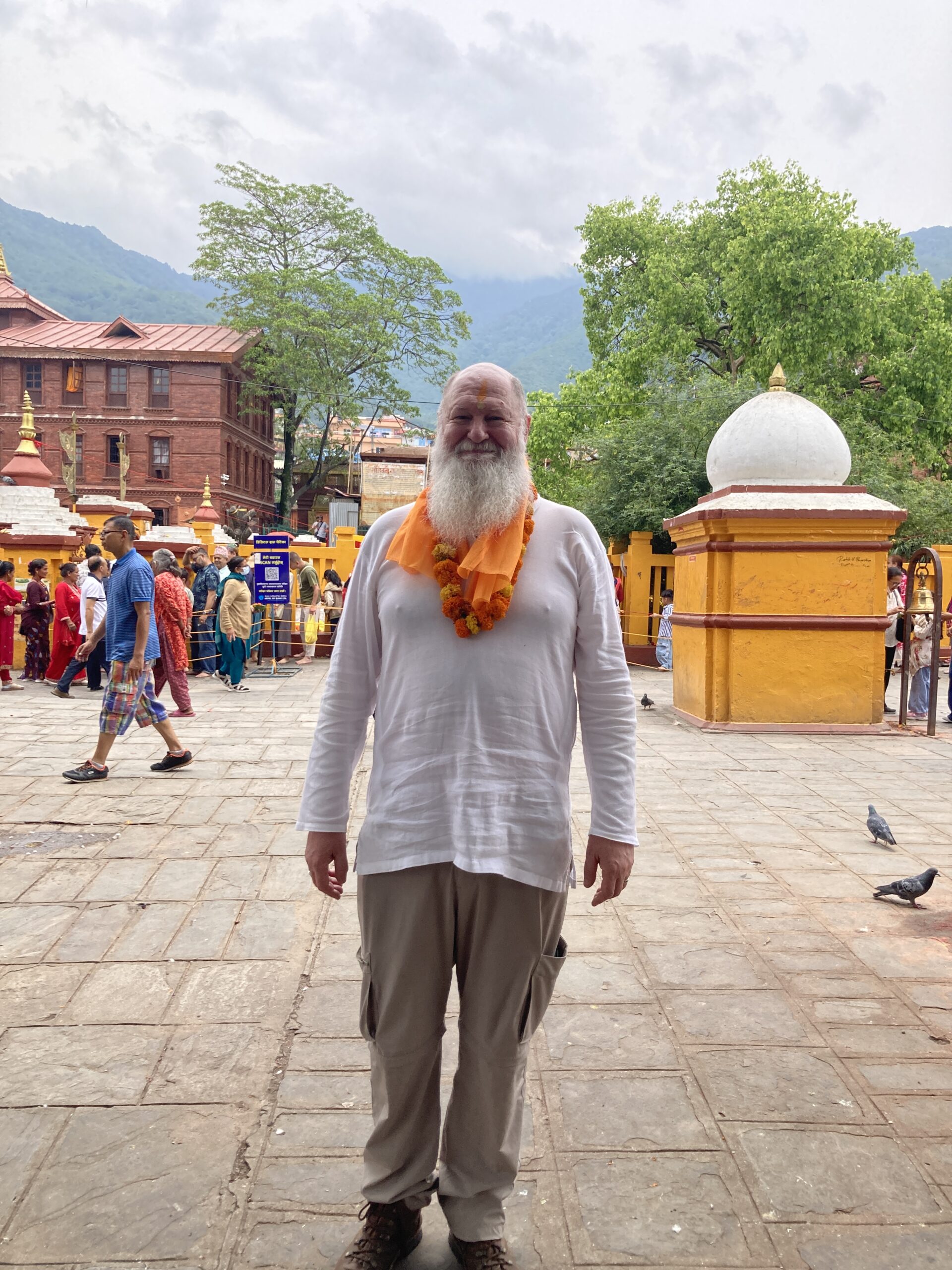
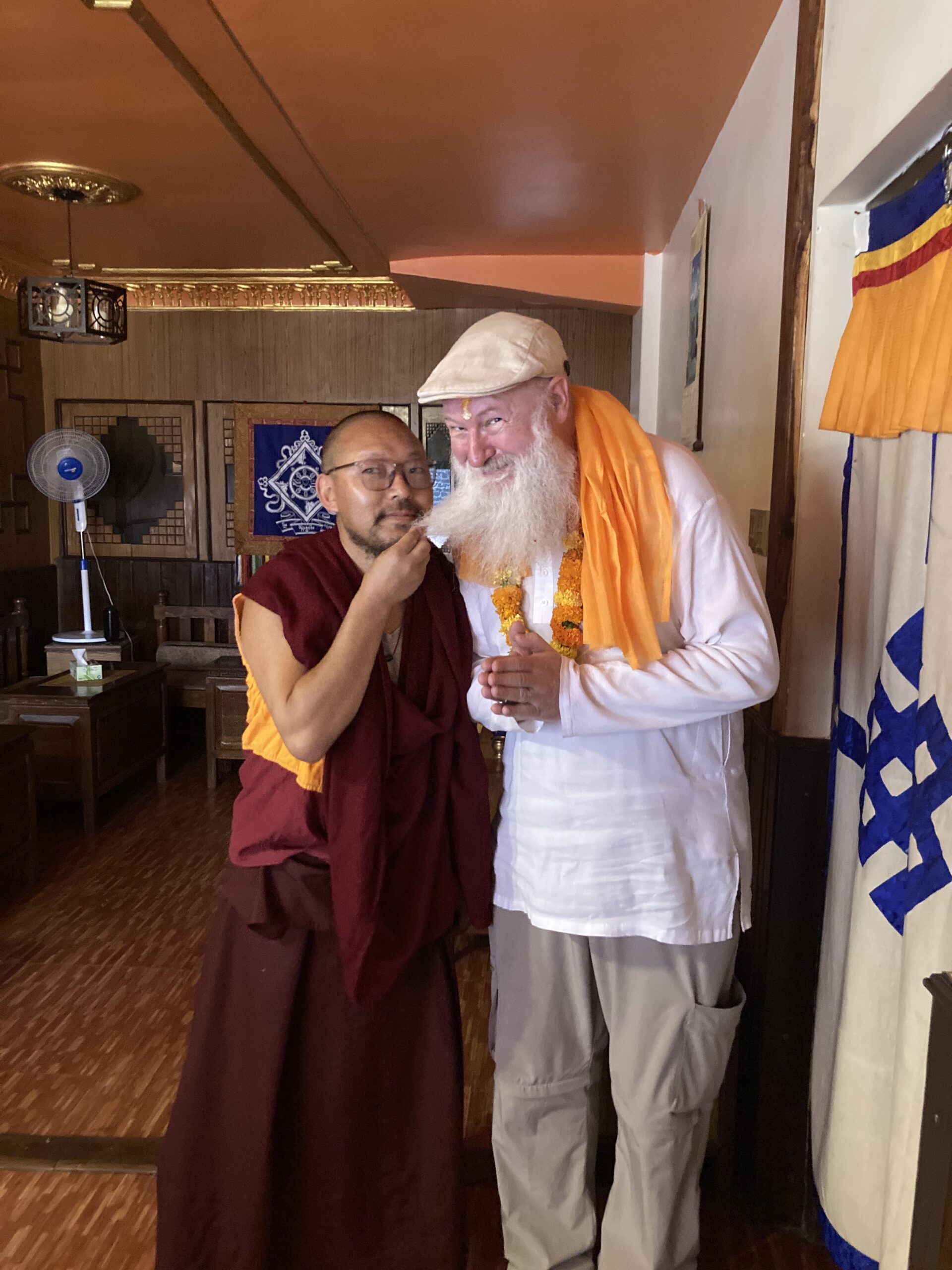
After a lovely stay at Terma Linca Hotel – where I tried some authentic Bhutanese food (very spicy!!) today’s sightseeing took in the Memorial Chorten, the Buddha Dordenma Statue, the Takin Reserve, a Handmade Paper Factory, and the crossing of Dochula Pass. After breakfast, Soram helped me to dress properly in the Bhutanese Gho I bought yesterday, and all day I am complemented with smiles and appreciation both from the Bhutanese and some of the many Indian tourists that we meet along the way. With my long white beard, I am frequently told I resemble closely the highly venerated founder of Bhutan, Zhabdrung. This Lama, my guide tells me, in the 17th century CE, was head of a district of Tibet called Druk, and held that position as a reincarnation of a particular boddhisatva. But the prime minister of Tibet, and a challenger who claimed that he was the reincarnation, and not this Lama, conspired to force him out of his role. To the south, one of the many small chiefdoms in the area that is now Bhutan gave him sanctuary. He then was given the leadership of that chiefdom, and began to fight many battles to gradually unite all the chiefdoms into one, new kingdom. Whilst these battles were underway, however, the usurper of the Druk region of Tibet discovered that the precious relic that was the most sacred possession of that district’s governor had been taken by the Lama when he fled south. With his ally the Tibetan prime minister, he then began to invade south. So as well as fighting battles to unite the chiefdoms, he also had to fight off the Tibetan armies invading from the north. In the end he was successful in both endeavours, and established the new kingdom of Bhutan – which is another word for Druk (the name of his former Tibetan district), which means Dragon. He held this new kingdom – the land of the Thunder Dragon – together for 85 years, including 50 years after he had died, when his immediate circle kept his death a secret, and only the power of his name kept chaos in check. Eventually the truth got out, and, as expected, the kingdom quickly fell apart into separate chiefdoms again. But the precedent had been set, and about another 120 years later, in 1907, a second founder united the kingdom once again and established a new kingdom under the Wangchuk Dynasty – the fifth generation of which is now the ruling monarch. This new kingdom was set up as a dual space, half monarchy, half monastic order – a diarchal system – which, although essentially a Tibetan form of government, is only extant now in Bhutan, with Tibet itself under Chinese control since 1959. The King and the head of the religion sit side by side in matters of state, so in some senses it appears like a theocracy – but perhaps not dissimilar to that of the United Kingdom, where the King is also the Head of the Anglican Church and Bishops sit in the House of Lords. The third king, who modernised Bhutan in the 1960s and 70s, building roads and hospitals and joining the UN, was followed by the fourth and incumbent King who in 2008 stepped back from absolute rule and established the country as a constitutional monarchy, with a democratically elected parliament – and Gross National Happiness as the national measure. But to prevent religious control of the parliament, the monks, nuns and senior clergy are not included in the franchise: they cannot vote. Also to prevent corruption any politician campaigning for office found to have even offered sweets to entice voters can be banned from standing; whole parties can be disqualified if there is a whiff of graft. The result, my guide tells me, is that the tourist taxes we pay don’t end up in people’s pockets, but are spent on the roads and hospitals and education that are all provided for free to the Bhutanese people.
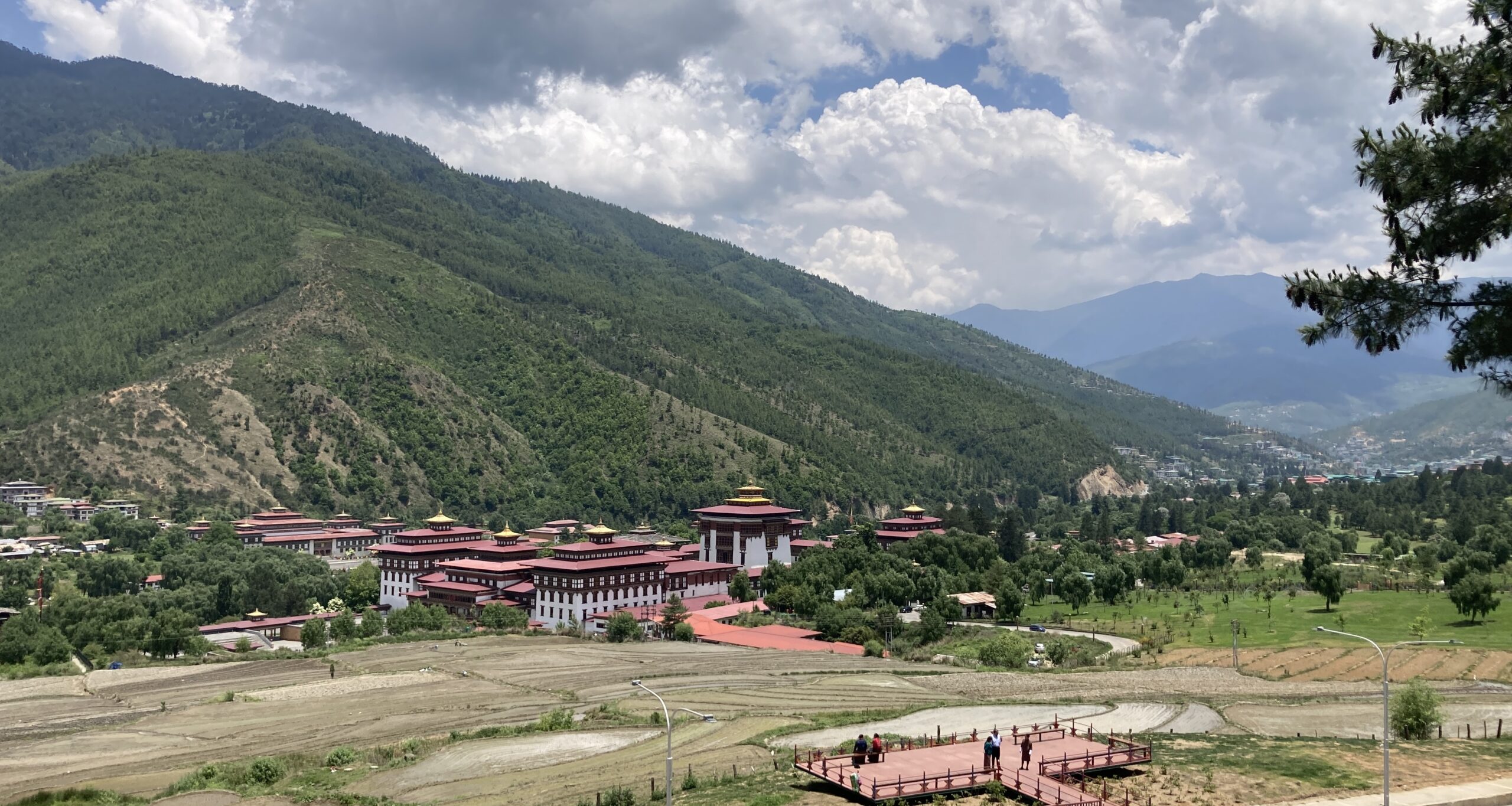
So, in my Bhutanese dress and with my long white beard, looking like the original founder of Bhutan is no bad thing. The Bhutanese love their monarchy. Most of the great fortresses, (Dzongs) that dot the landscape were built by him, in the late 17th and early 18th century, to fend off the Tibetans. At Thimphu (the capital) we stopped to take pictures of the Tashichho Dzong along the way – a huge complex that now incorporates the Royal Residence, the Summer Palace of the head of the religion, the Parliament Building, and the Supreme Court. On our journey we take in some breathtaking views on the way up, at the top, and then on the way down from the mountain pass.
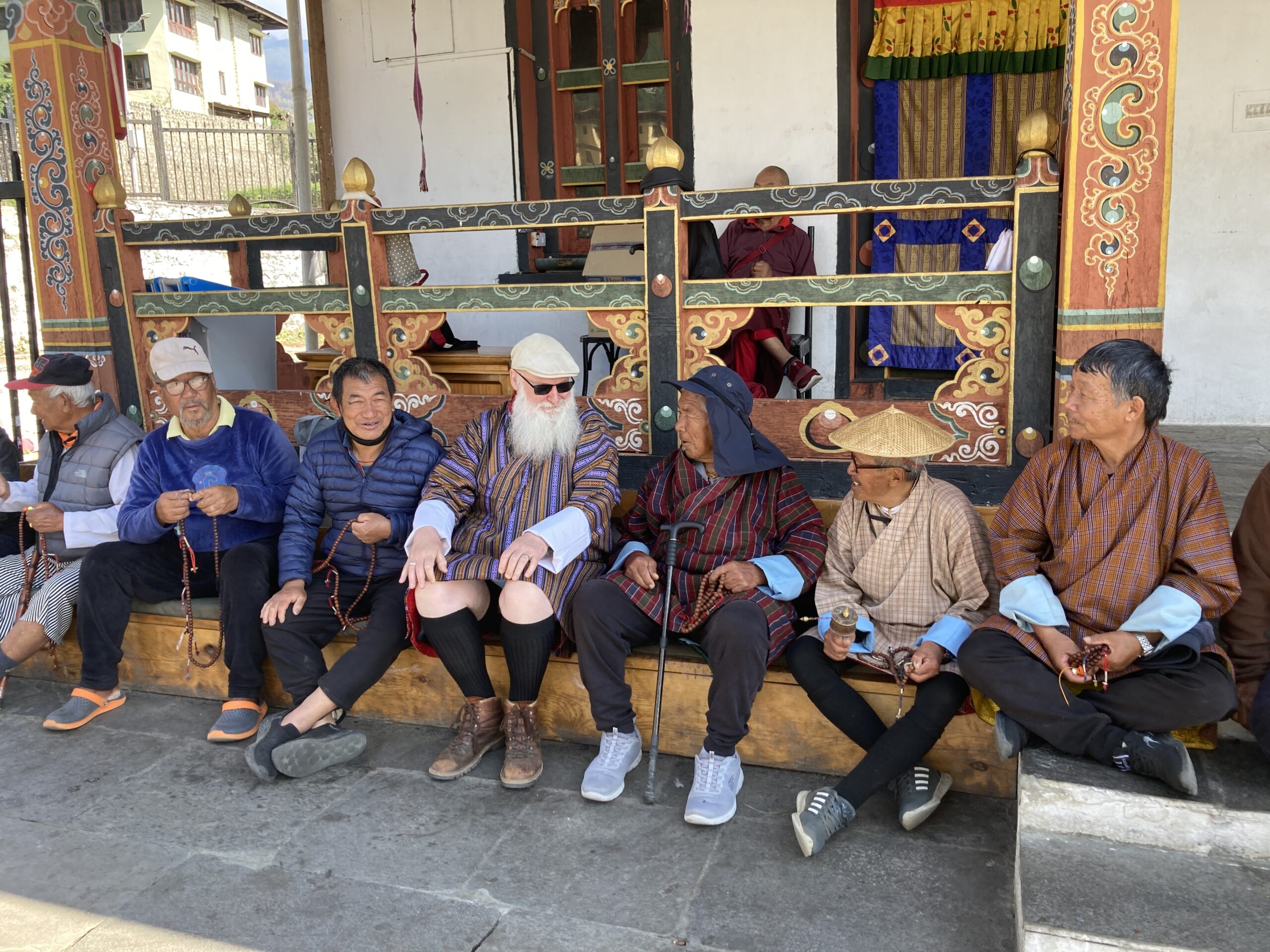
The Memorial Chorten, where we started the day, was built in memory of the 3rd King who died young, and is a place where many of the old folks of Thimphu gather, to sit in the shade during the heat of the day. As everywhere else, it’s no shoes and no photography at these temples, so I am only able to tell you that the artistry, craftsmanship, and incredible stories represented in these places are breathtaking. It is also true that, by now, I must confess I am starting to reach overload: there has been a lot to take in over the past days, first in Nepal and now in Bhutan, and my brain is getting saturated and less able to retain much of the information that I am being given by my very helpful guide. All Bhutanese learn English at school, and speak it well, so Sonam and Doji are able to communicate with me very well, which helps!
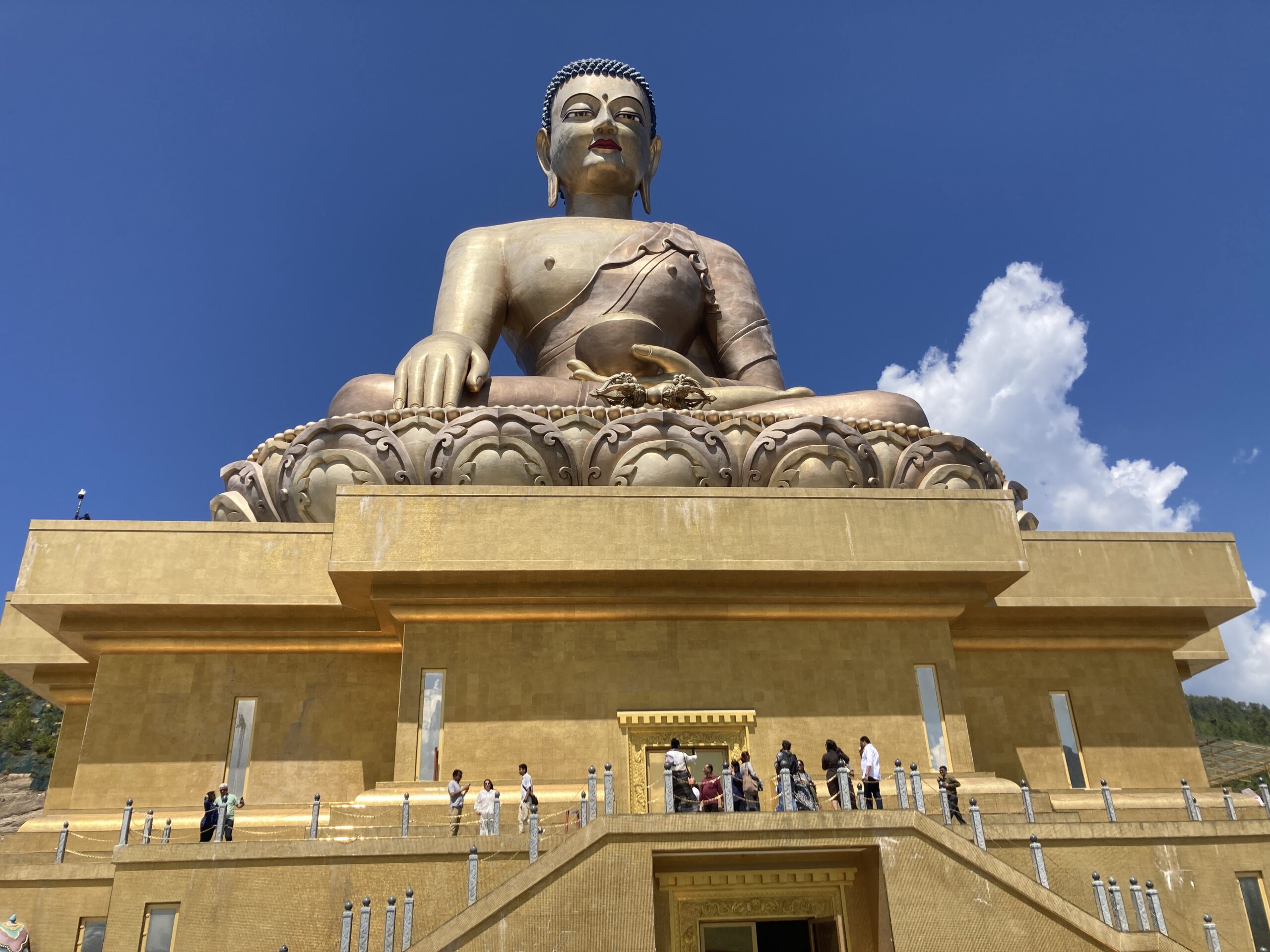
The highlight of the day, for me, however, was the Dordenma Statue – an absolutely huge Buddha, with a Dorje (the thunderbolt of indestruction) at his feet, inside of which is an incredibly ornate temple. The entire project is still unfinished, costing some $100m, with donations from many other Buddhist countries, and this incredible monument sits on a ridge overlooking the capital, Thimphu, a city which snakes from north to south along a wide valley.
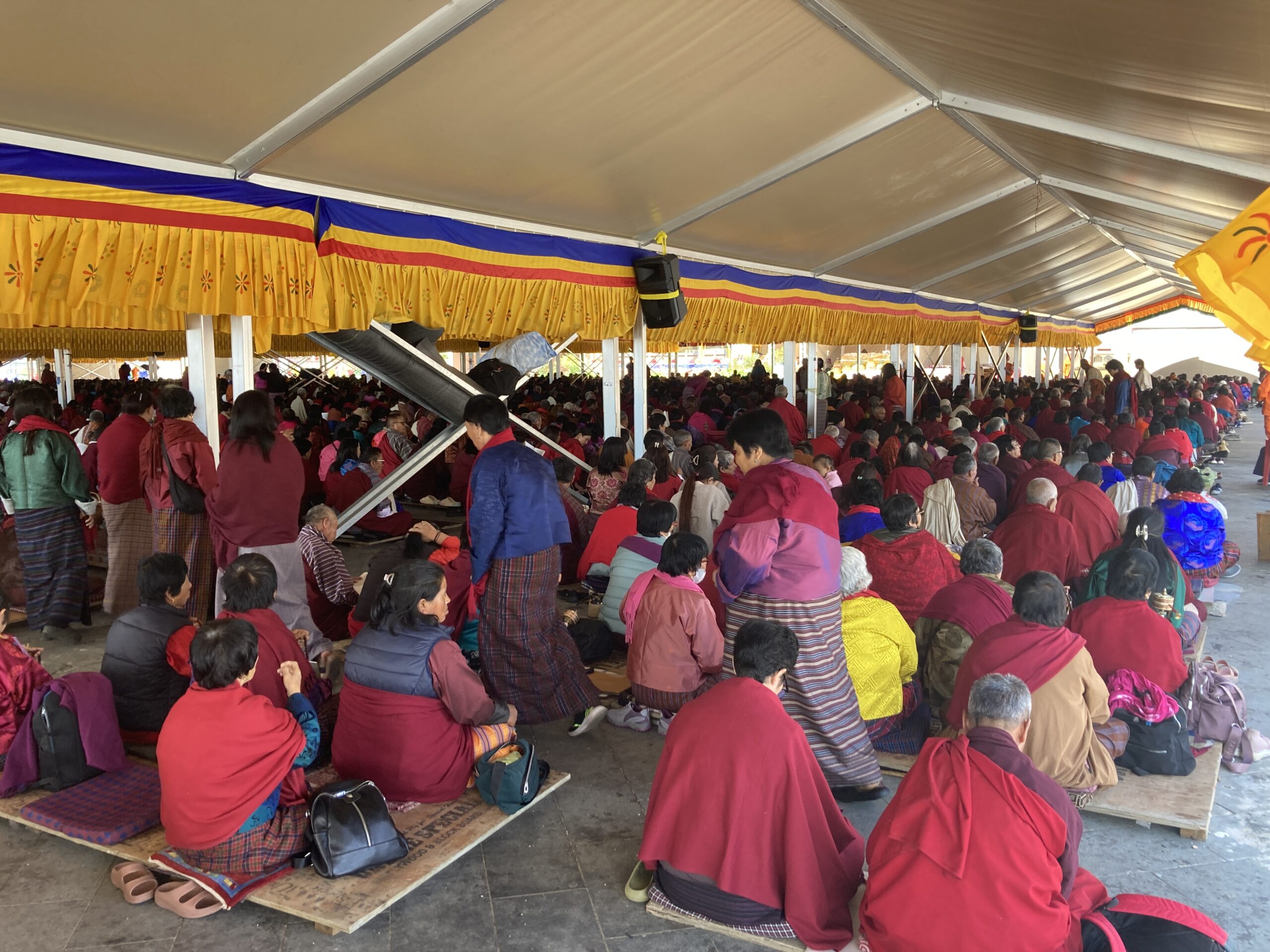
At the giant Buddha, it is a festival day, and we walk in minutes before a member of the royal family arrives in a cavalcade of 4x4s, to be greeted by an array of Bhutanese army officers, and a range of monks – many in the orange robes denoting they are of the highest rank. The VIPs take up their places under a separate group of small marquees to one side of the huge marquee where literally hundreds of devotees are gathered, all sitting on cushions on the floor, under the awnings at the feet of the Buddha.
Over huge loudspeakers, a venerable Lama is intoning mantras: it is an oral transmission, a teaching and blessing from a great master to all who are interested – including, it seems, today, members of the royal family and the military, along with the most senior clergy in the country. I am amazed, frankly, that we are all here without having been thoroughly searched, frisked, vetted, etc, but then that sort of security is clearly not needed here in the wonderful land of Bhutan.
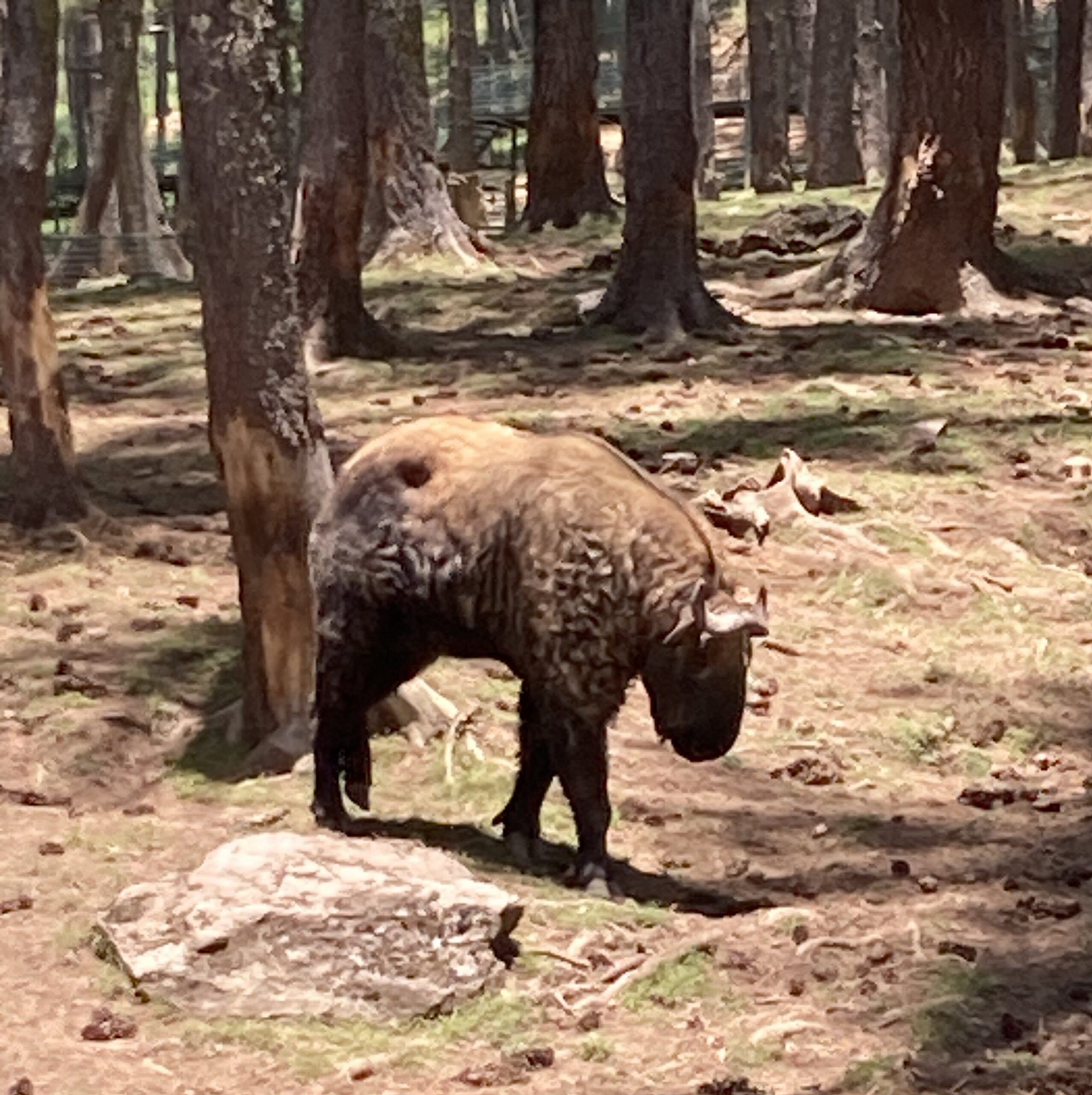
On the way to the pass we stop for a coffee and some mo-mo (delicious little dumplings) in a cafe at a preserve (you couldn’t call it a zoo) where some of the potentially endangered indigenous wildlife of the region are conserved and cared for, including the national animal of Bhutan, the Takin. I hadn’t ever heard of one either. It’s a kind of a cross between a cow and a goat, and has a low rumble that is neither a low nor a bleat. There are also Yak and local deer and some very colourful birds here.
The high Dochula Pass (over 3000m) is cool – very welcome after the 23’ heat of Thimphu, and especially welcome as the temperature at Punackha, where we are headed, is likely to be around 30’. It is 2000 metres below the pass, whereas Thimphu was only 1000 below.
3/6/26
Today – the last proper day of sightseeing – began early at a nunnery only minutes from the hotel. I was delighted that in fact we arrived at breakfast time, and all the nuns were in the temple, intoning the mantras, banging the drums, blowing the clarinets, and being served butter tea and rice. Invited in to sit quietly in a corner, it was such a privilege to witness this at the same time homely and devout ceremony. The nuns ranged in age from toddlers to middle-aged. Teenagers served the tea and food. Older women supervised. On the secondary throne (not the empty one reserved for the head of the religion) the Principal sat, leading the mantras. This – apart from myself and my guide – was the only man in the room. At the end of the breakfast, he stood and walked over to the altar side of the temple, and gave a little lecture to the assembled females. There were titters and some laughter – obviously whatever he had to say he was doing so with humour. My guide explained to me afterwards that he was telling the women that the ritual cakes they made as offerings should be uniform in shape, and that the tray offered up this morning included quiet a variety of shapes and sizes. Many of the guides bringing tourists here, he told them, grew up as monks and they will be able to tell; and besides these are offerings to the Buddha and to the Boddhisatvas, and this should be done properly. For all the criticism it was all clearly done with compassion and humour. The intoning of the mantras, and the banging of the big drums, and the piping of sacred clarinets, made for a mesmerising and very peaceful start to the day.
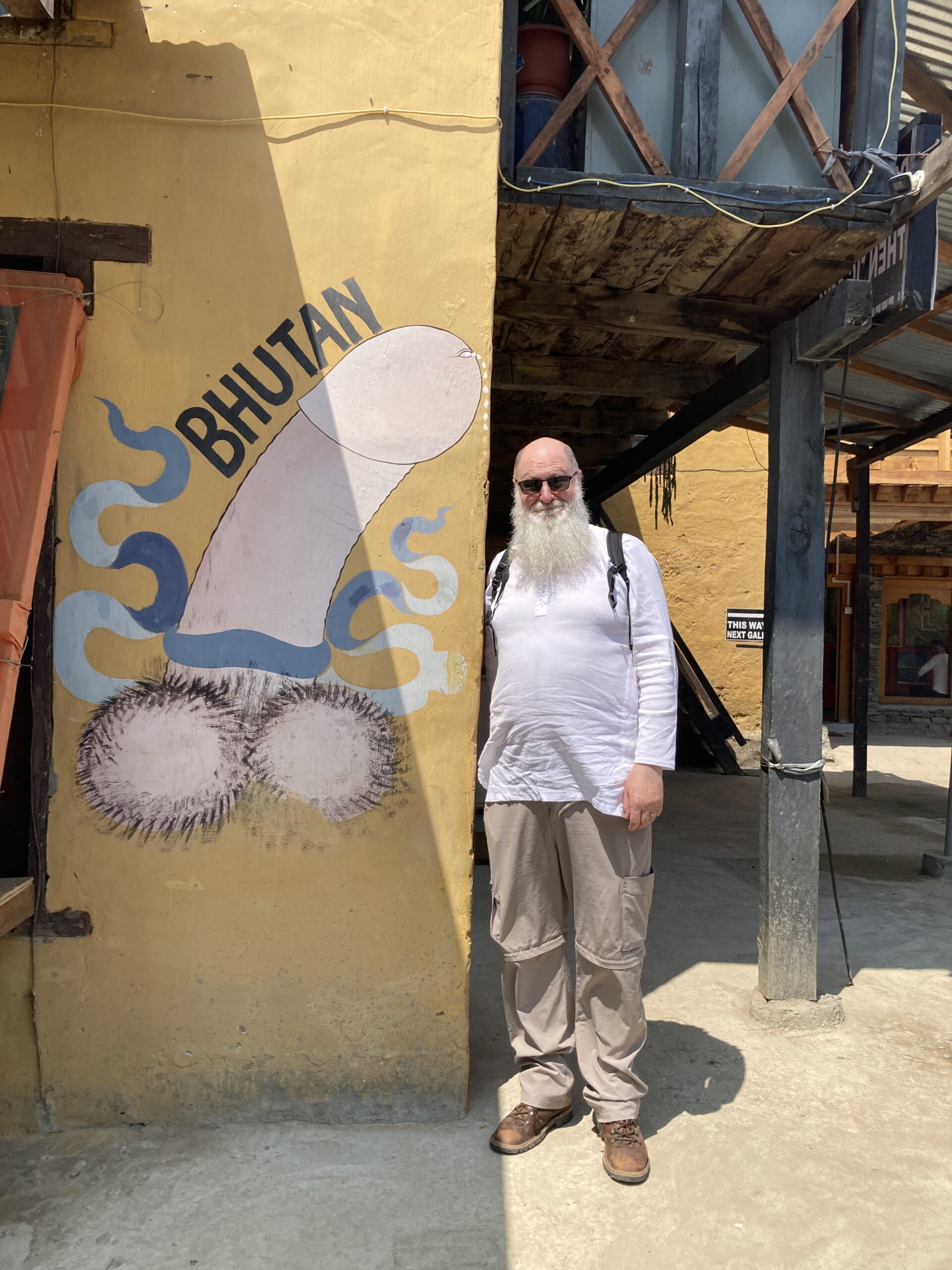
We then drove to Chimi Lakhang, and the little village of Sopsoka – the beating heart of Bhutan’s famous fascination with the erect penis: the phallus. Readers of this blog may remember that 10 years ago I visited a Phallophoria at Tyrnavos in Greece, and witnessed their celebrations of Clean Monday, where the whole village came out sporting big phalli, the baker made phallic loaves, and there were phalluses everywhere. I wrote a long blog-post about the Phallus around the world, through history, much of which was later published as a chapter in a book about the Phallus, including many photographs that I had taken in various parts of the world.
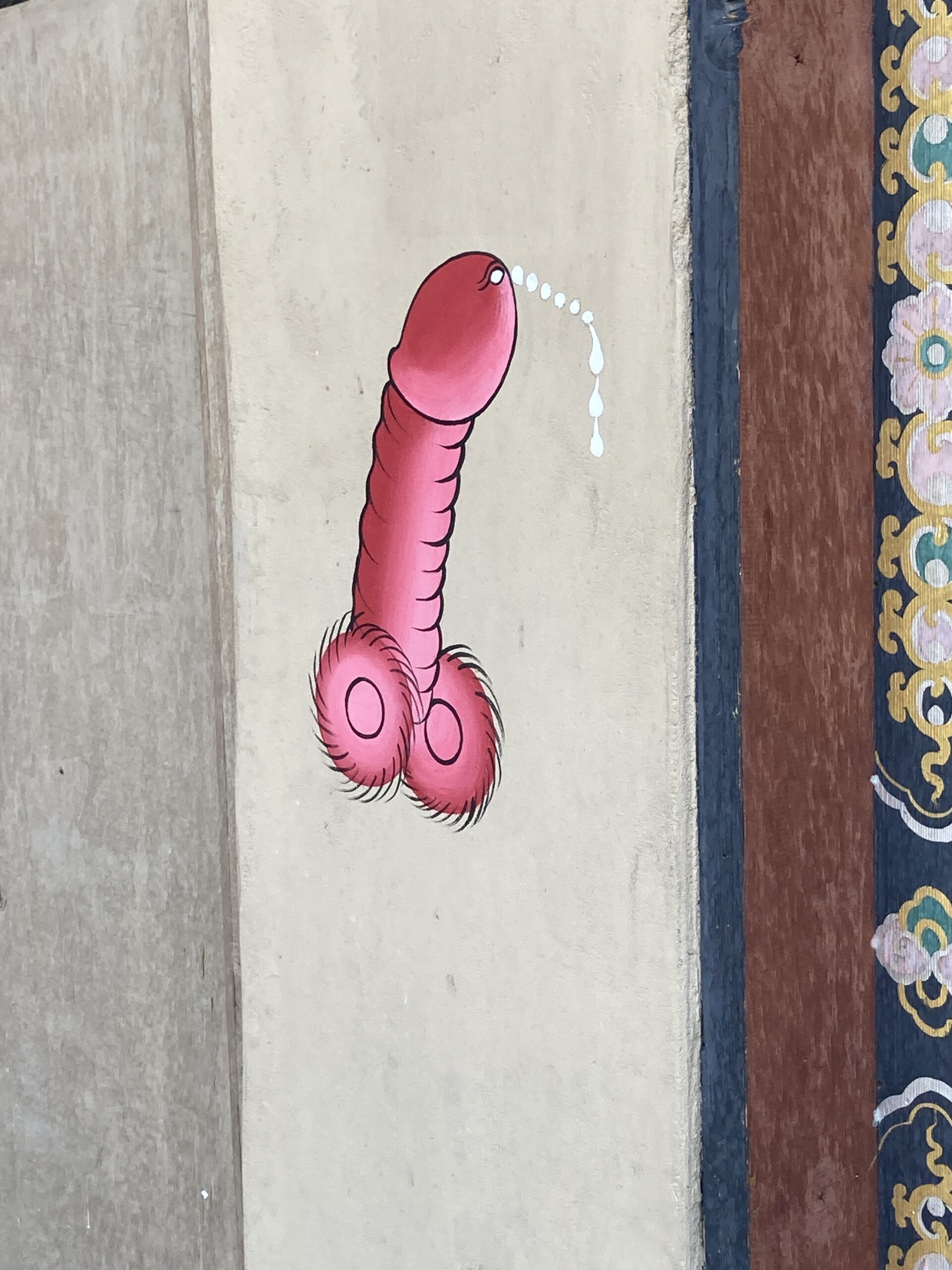
One place that was not represented, which, although dimly aware of it, I did not mention because I had not been myself, was Chimi Lakhang, here in Bhutan. It is very wonderful to finally be here. Almost every building here -rather than one here and there in the rest of Bhutan – has one or more large colourful phallus paintings on it. Many have wooden phalli hanging from the top corners of the roofs. As you walk into the village, you realise quickly that this is a big high street of Chimi Lakhang ‘tatt’ – a veritable Glastonbury High Street of sacred items, a bit like Paro outside the airport, here.
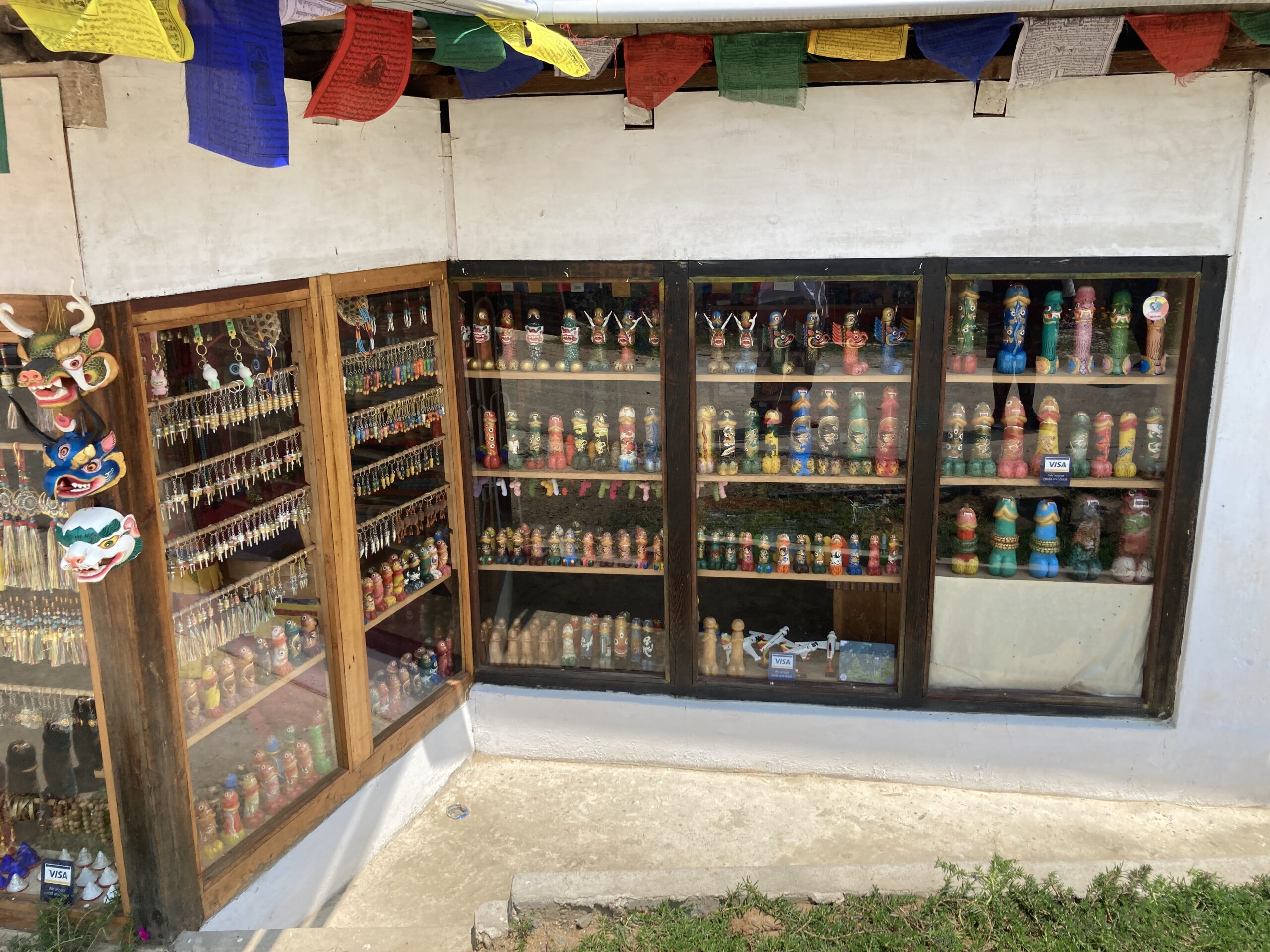
Except that more than half of the items on sale in this village – called Sopsoka – are erect penises. They come in all shapes and sizes, plain wooden, and brightly coloured, and painted with intricate designs. At one shop I buy a large blue one with a white Druk painted onto it curving round the shaft, and an angry face on the glans at the top.
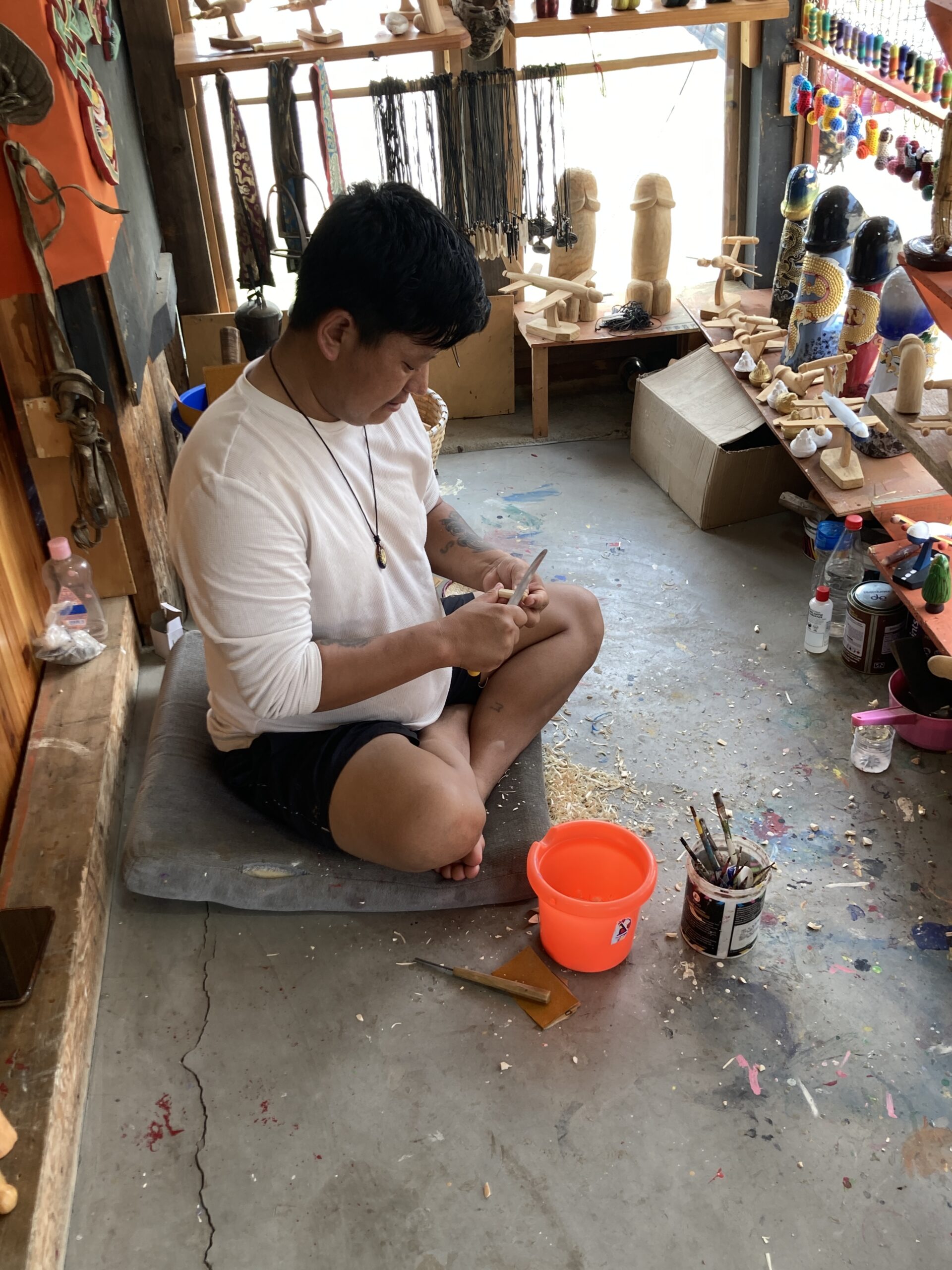
At another shop I see the man hand-carving his wares, and buy a pair of plain wooden ones. Only one is varnished, but he says he will varnish the other for me and I can collect them both on my way back down by which time it will be dry. At the top of the village we come to the entrance to the Chimi Lakhang Temple, and take the short climb up the steps to the top. It is hard going in the 31’ heat, up the steep steps, but I manage it, excited to be here at last. The view from the top is wonderful. Under a tree my guide tells me the story of 15th century CE Lama Kinley Drukpa, the Divine Madman – the Tibetan Lama who came to this area and gave the most unorthodox teachings of all.
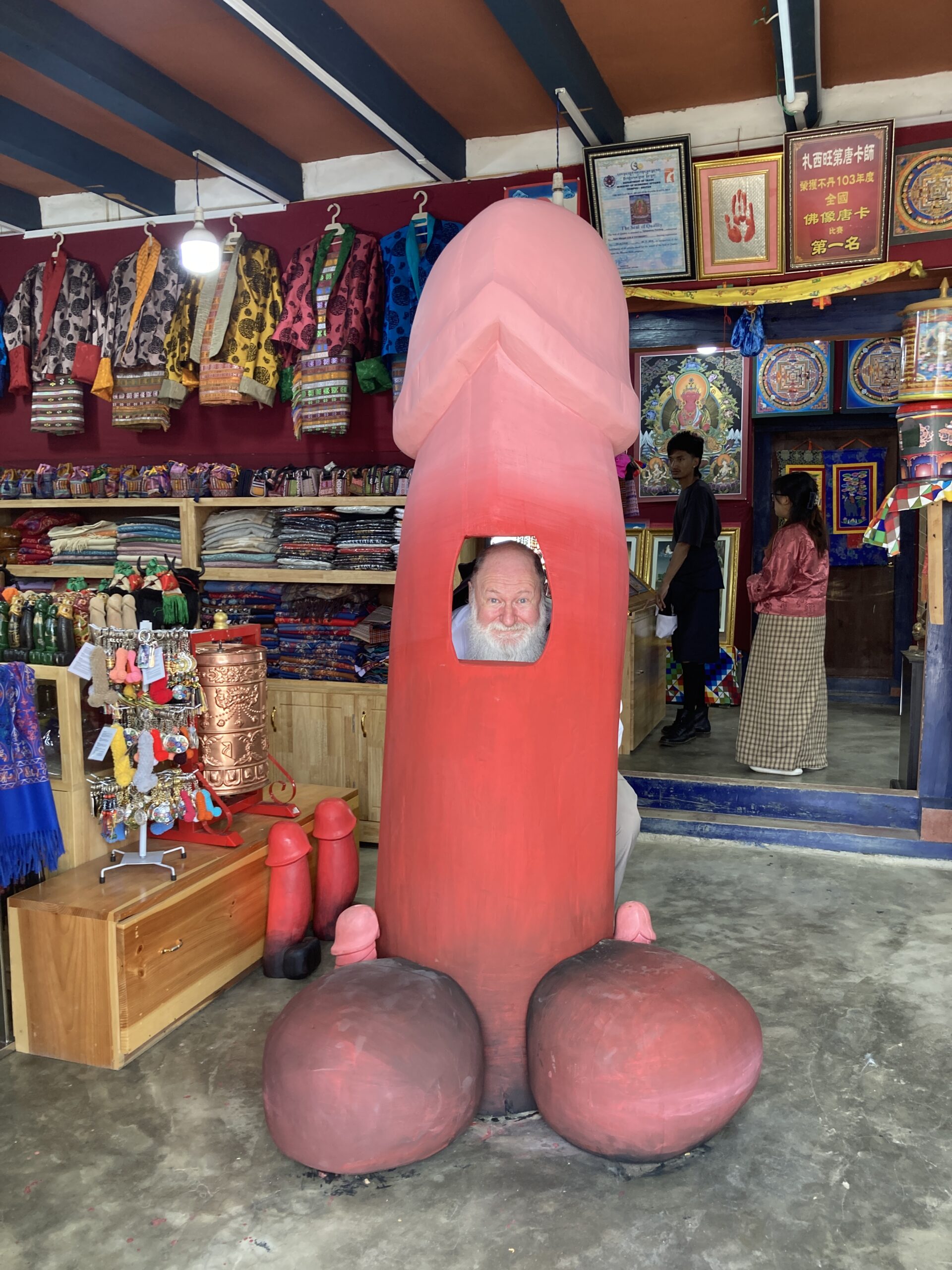
He used sex and alcohol and drugs and behaved in an outrageous manner to prove that the hierarchy and the establishment and all the ‘right way’ to do things were not necessary, if you had the right attitude inside. It seems clear he also found – in the pre-Buddhist Bon spirituality of this region, focussed around the phallus – a fascination with it that could not/would not/should not be dislodged, and so he assimilated it. Using his own phallus, shooting fire with it, he vanquished evil forces that were terrorising the traders trying to use the passes in and out of this valley: protecting the people. He set up his Temple here, and gave teachings. A couple having trouble getting a child to live beyond a few months brought their latest dead child to him, begging him for help. He took the child and threw it across the river. The parents were shocked, but then saw a demon leap out of the child’s dead body and run away, shouting over his shoulder that he would never trouble Lama Drukpa again.
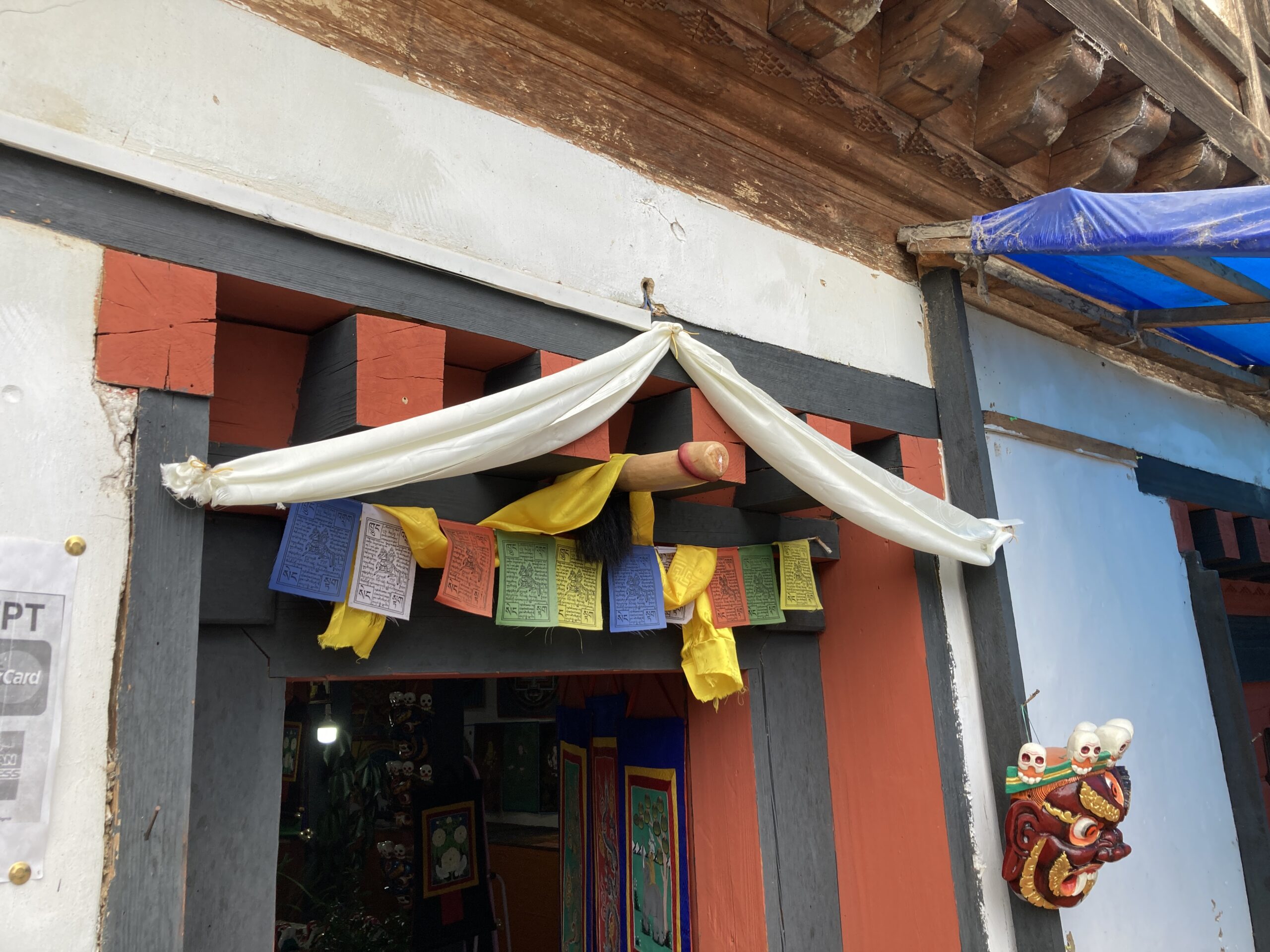
Ever since then Lama Drukpa and his Phallus have been associated with protection, and with fertility, and couples come from all over the world to circle around the giant wooden phallus in the Temple for aid with fertility. Of course there is no photography in the temple, but I can tell you it was a big one, and very beautifully carved. The monks inside give tourists little coloured threads to tie around wrist or neck, which you must wear for several days, to bring you fertility and good luck. Descending once more from the Temple, back through the shops, I buy a nice ritual dagger – the three-sided blade with which the three great sins of delusion/ignorance; greed; and hate are vanquished, through wisdom, compassion, and power. We return to the shop with the carver, and he presents me with the pair of wooden phalli, the freshly varnished one already dry in the sun. Driving away I am very pleased to been able to visit here at last.
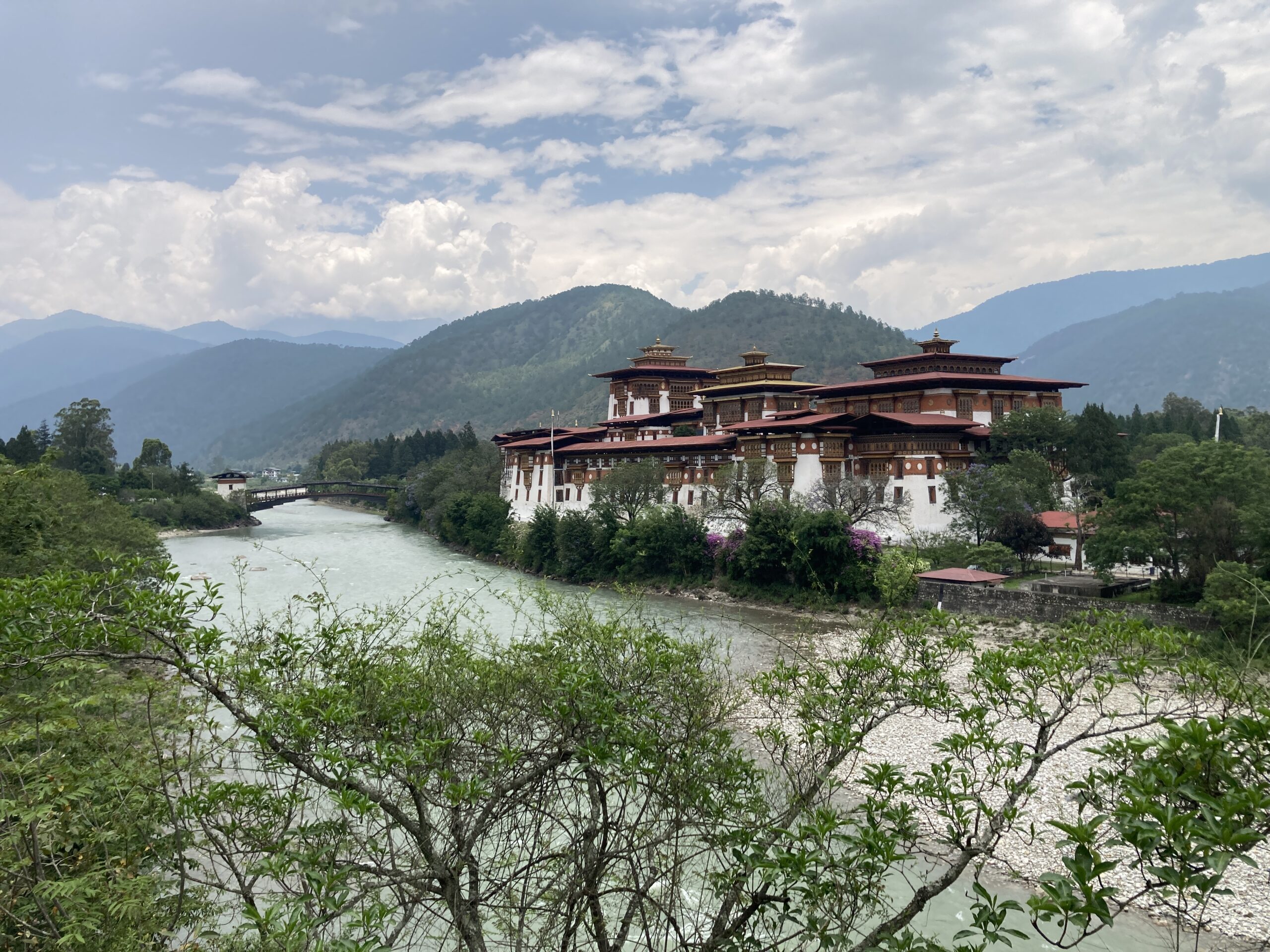
Our last big stop of the day is the Punakha Dzong, probably the finest and most famous Dzong in Bhutan. It is breathtakingly beautiful. Built – by Zhabdrung – in 1637 as a fortress (and maintained ever since) at the confluence of the Mother River and the Father River, the Mother-Father River flowing on from where they join, it is simply magnificent. Today, as with the other Dzongs, it remains in dual use; part for the Government administration of this district, and part as a monastery. As we are quite high up here, it is the Summer Palace of the Head of the Religion, with the Winter Palace at the much lower Thimphu Dzong.
Exhausted by now, in the heat, I am glad to return to the air-conditioned car, for the long drive (some two and half hours) up and over yet another pass, to my Hotel for this night, the Gangtey, overlooking the broad marshy valley that is the habitat of the black-necked crane, birds which I shall see in their sanctuary in the morning.
4/6/26
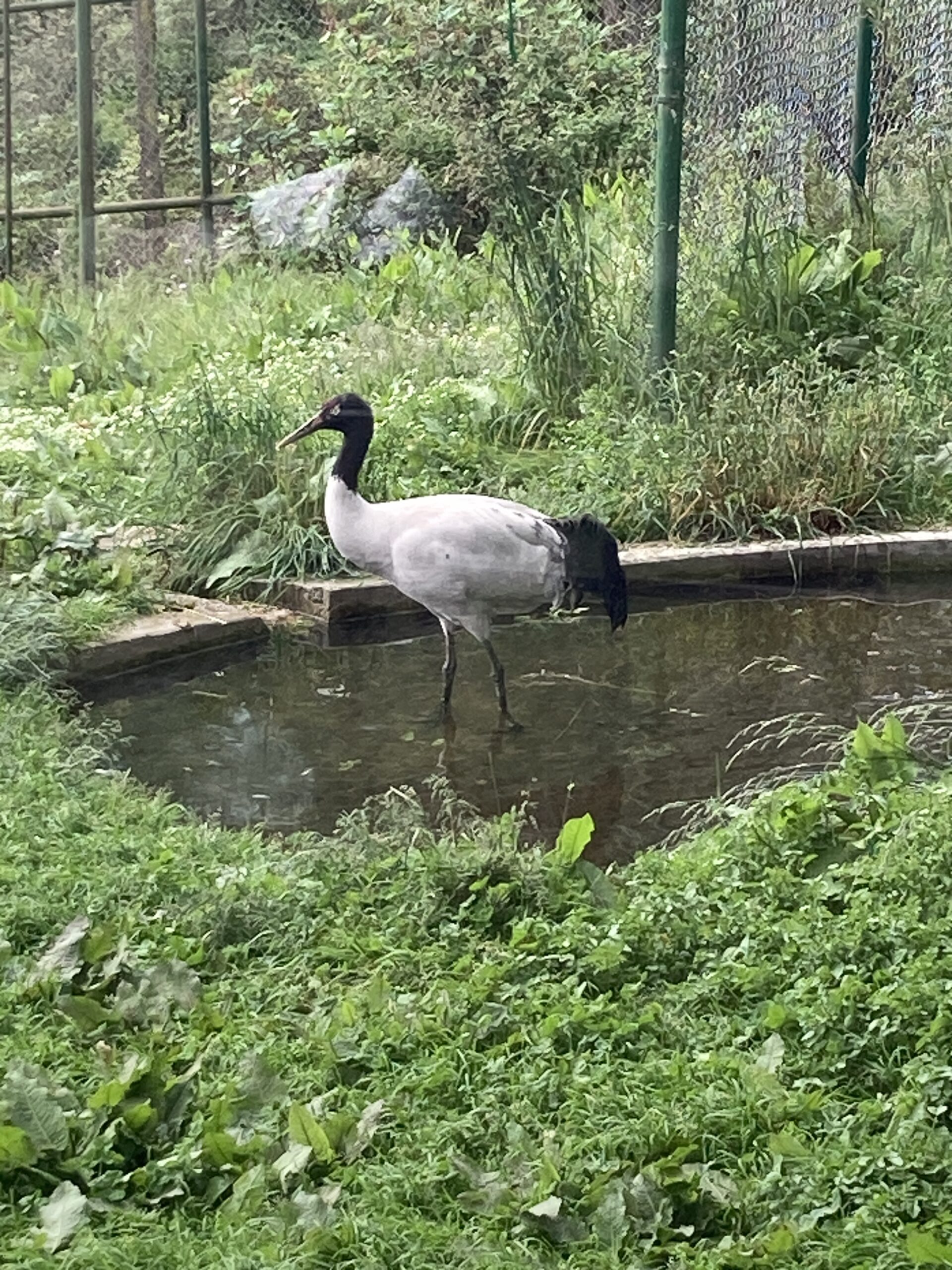
This centre for conservation effort takes pride in looking after two cranes wounded by predators – one a wild dog, the other a leopard – and enabling people to get up close to see them. There is a good deal of information and an excellent documentary in the centre, where I learn that one of the most important tasks of the centre is in educating the local farmers, who have become very successful in exporting their potato crops. A balance between development and conservation is the mantra of this centre.
Lastly then, a visit to hilltop Gangtey Monastery, where the migratory cranes circle three times, each autumn, on their way down to the marshy valley bottom where they winter. This is a peaceful and friendly farewell to this lovely country, before my 5hour drive, back over the Dochula Pass, where we have coffee, to Thimphu and at last to Paro, where I check-in for my last night before the journey back to Kathmandu in the morning.
5/6/26
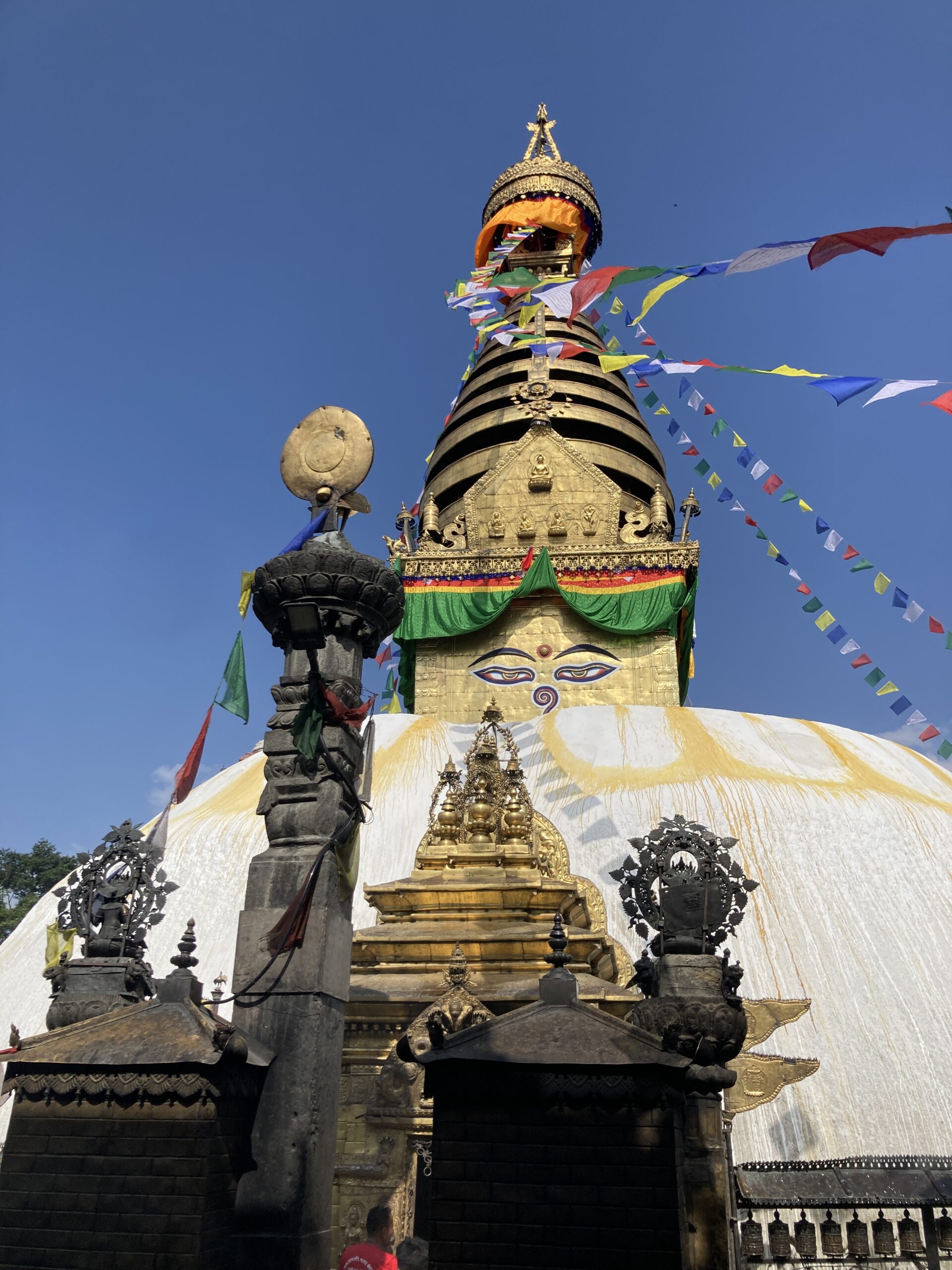
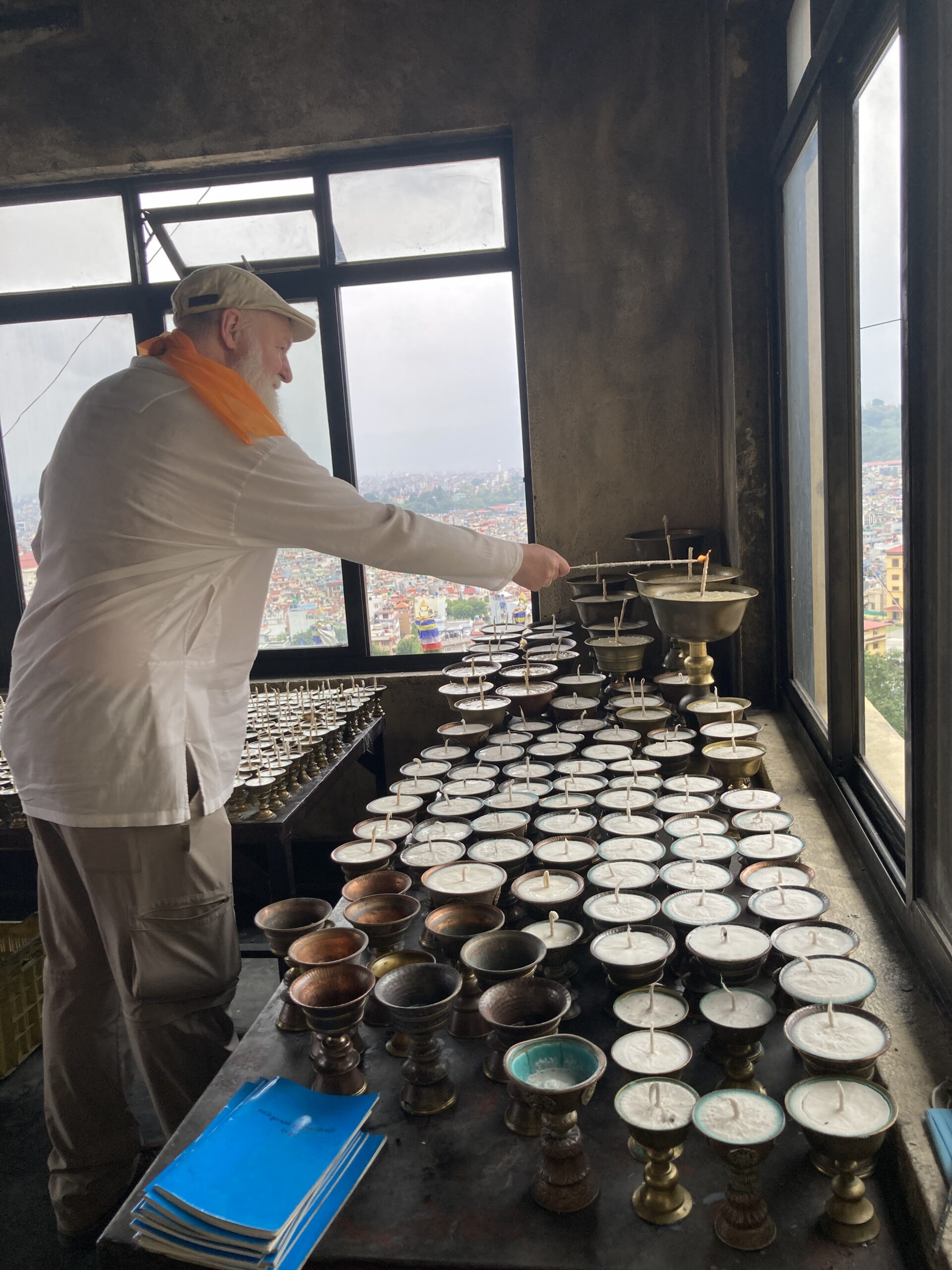
Finally, it remains for me to visit Swayambanath, on my last day in this trip – a Buddhist centre second only in importance to Boudhanath, here – and to take in the breathtaking splendour of this Stupa and Temple.
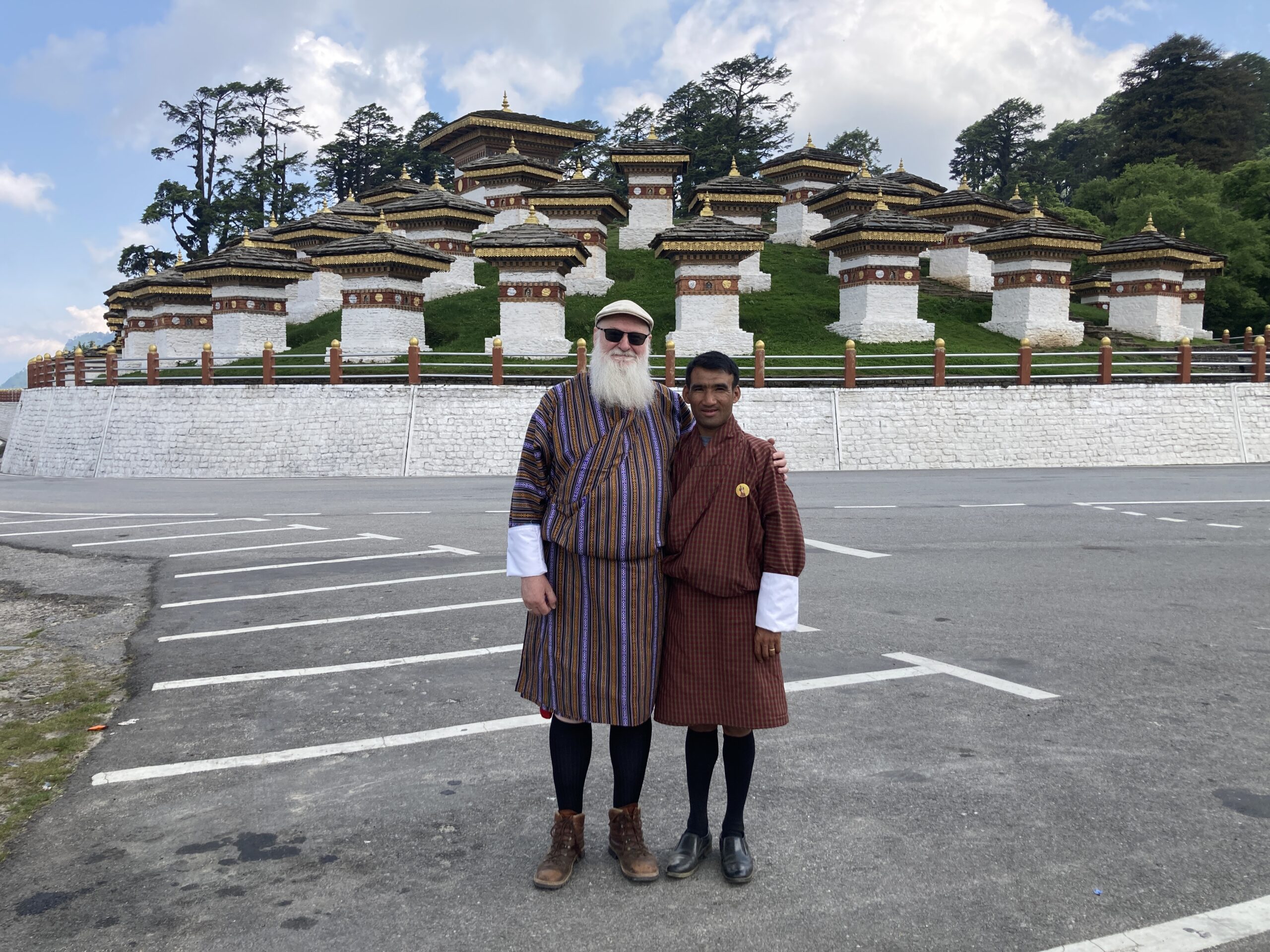
But before I finish this blog, I must put in a good word for 3rd Rock Adventures, my tour operator. Naba, with whom I have been in very regular contact, first organising the tour, and then during it, and all his guides and drivers, have been attentive, knowledgeable, friendly, helpful, on-time, informative – I could go on but really, I couldn’t have asked for better and couldn’t recommend them more highly if you are considering a trip to this part of world. I did converse with one or two others, back in February, but even then Naba stood out as someone whom I could do business with, someone I could trust. It was a great holiday, and I am grateful.
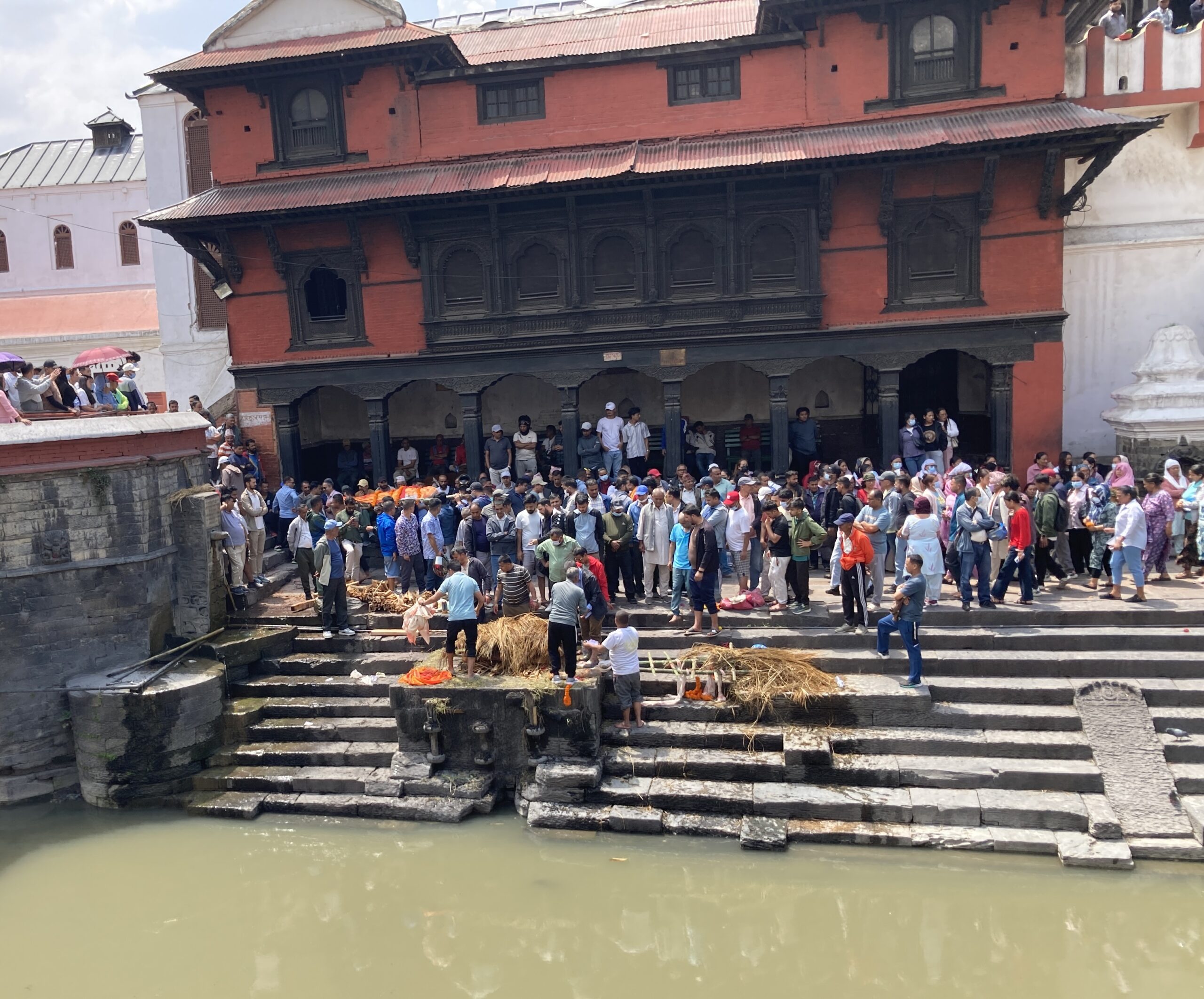
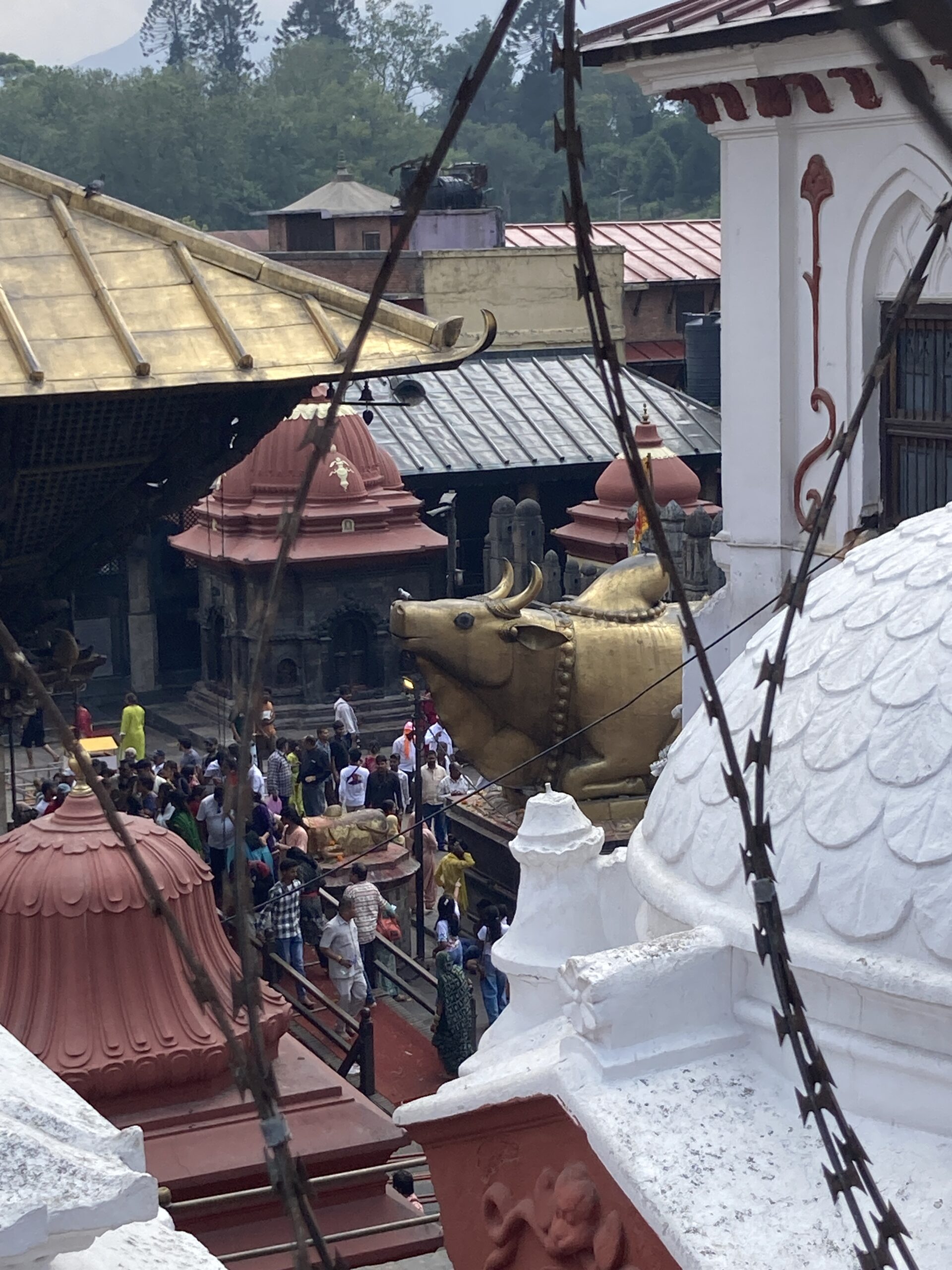
In summary, I think I have seen and experienced as much as I am able and keen to of Bhutan, but that I would come back to Nepal again. There is Pokhara (Nepal’s 2nd city) and Chitwan National Park, which I did not have time to visit on this occasion, and I would welcome the opportunity to visit Pashupatinath again – probably my favourite place of this entire trip, if I had to choose – and to stay again at the wonderful Barahi Hotel, which did much to make my stay in Kathmandu so comfortable.


 From 1st December 2020 I take up a new post as a Lecturer (‘B’ Above the Bar) in the Business Information Systems group in J.E. Cairnes School of Business and Economics, National University of Ireland, Galway. It will be almost 17 years since I was appointed as a Lecturer in the Information Systems Institute (ISI), University of Salford, in January 2004. Salford was at around No. 50 in the UK rankings at that time, and the IS Group I joined likely No.2 in the country. As an Early Career Researcher with a new PhD, I was awarded a 30% research allowance, which grew over the succeeding years, hitting 60% at one point.