29/5/26
Today is a more peaceful – and shorter – day of sightseeing, than yesterday.
Kopan Gompa
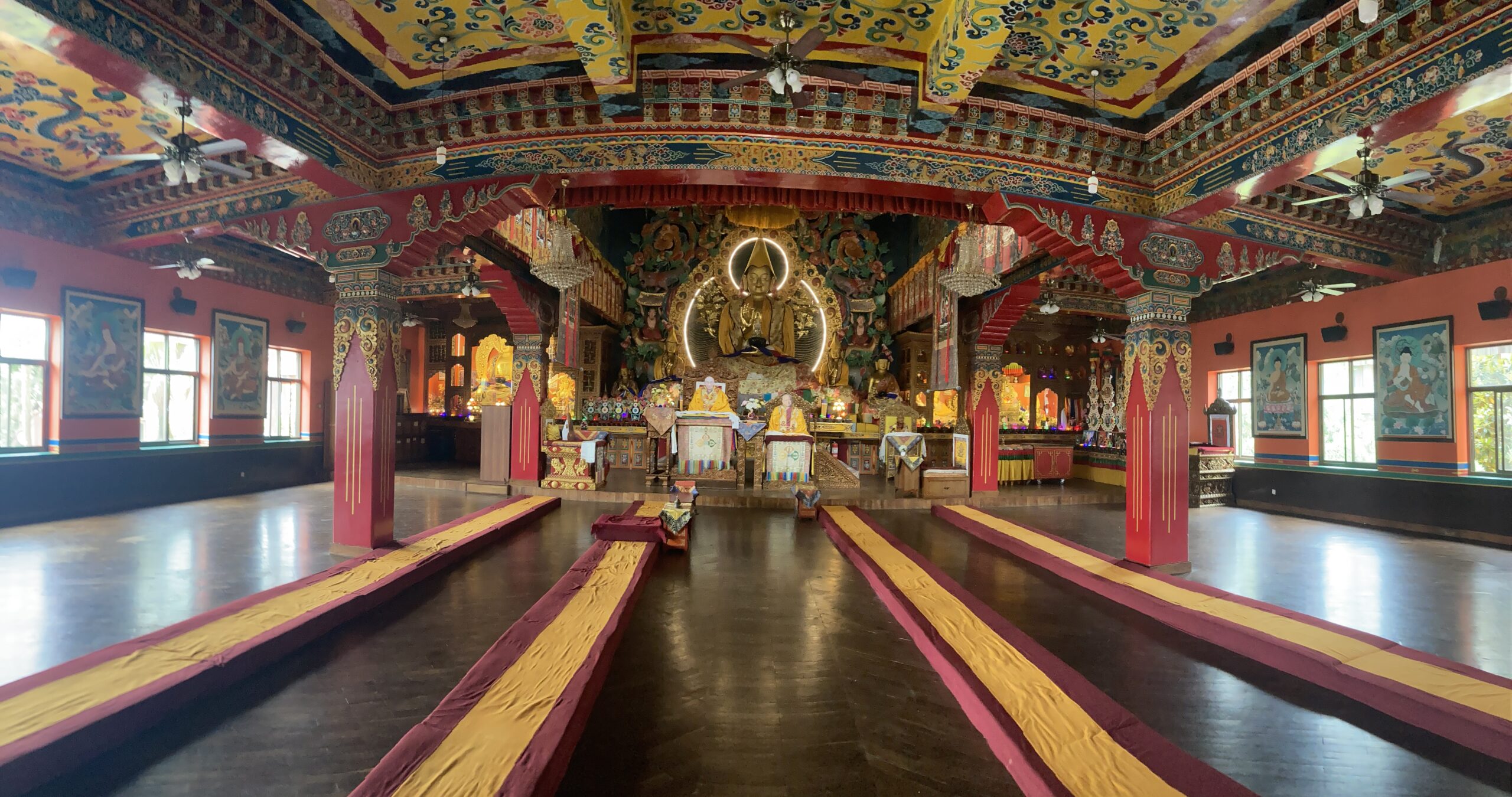
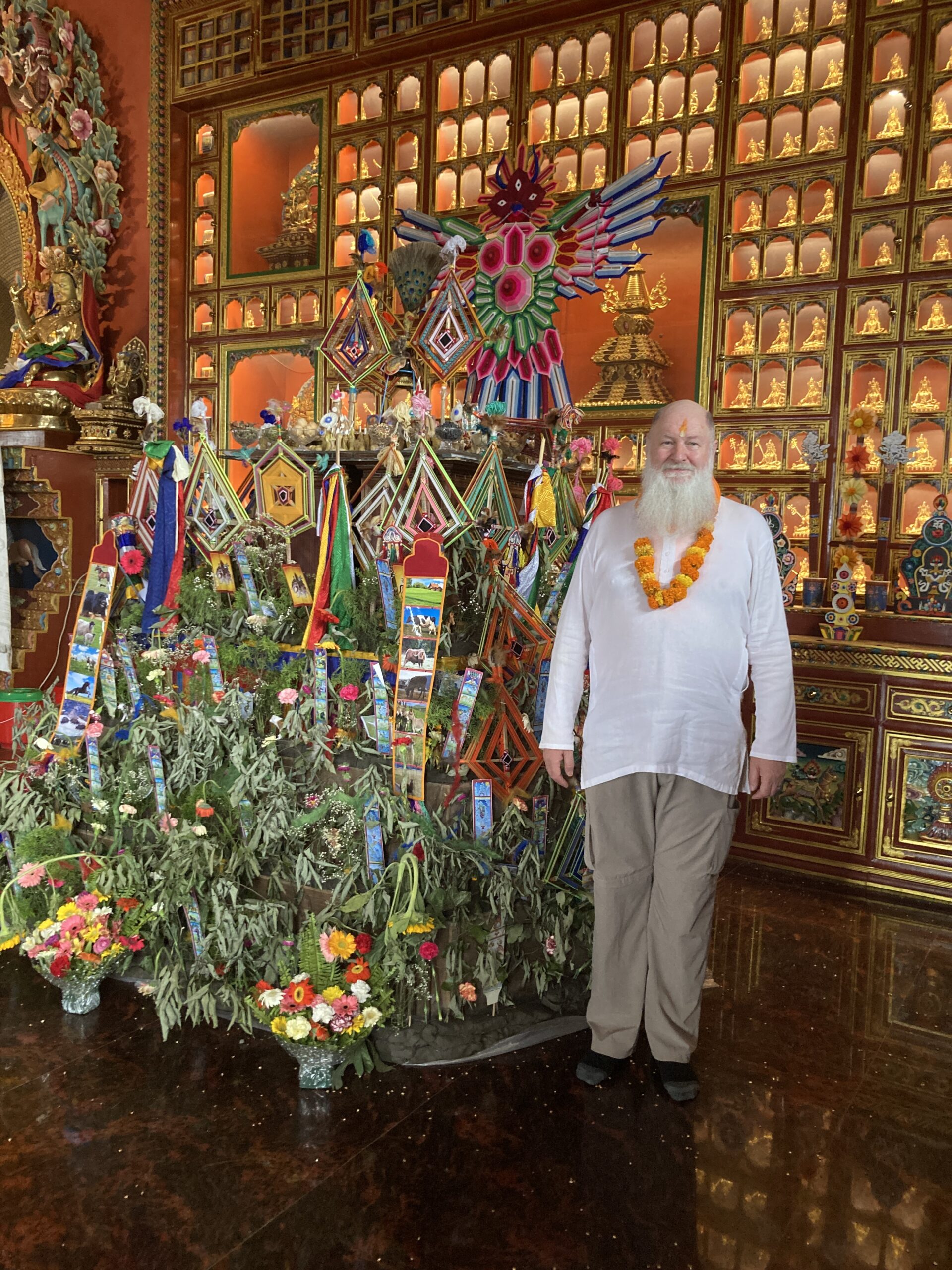
We begin at Kopan Gompa (Monastery), home of Mahayana Buddhism in Kathmandu, where I find, in the library, a little bookshop, and – amongst one or two other finds – buy a copy of Hermann Hesse’s Siddharta, a book which I read in the early 1980s, and which it would be good to read again. In novel form it tells the story of the Buddha’s life, which is the centre of all the various forms of Buddhism. The main shrine is beautiful- like that at Namobuddha – but somehow the Dalai Lama seems more prominent here. Tibetan Buddhism is a form of Mahayana and very strong here. Mahayana Buddhism includes many boddhisatvas along with the teachings of the Buddhas, and their own many and varied guides to the Way. Very strong here at Kopan is the Boddhisatva Avalokiteshvara, whose specialisation is compassion.
At the Sleeping Vishnu
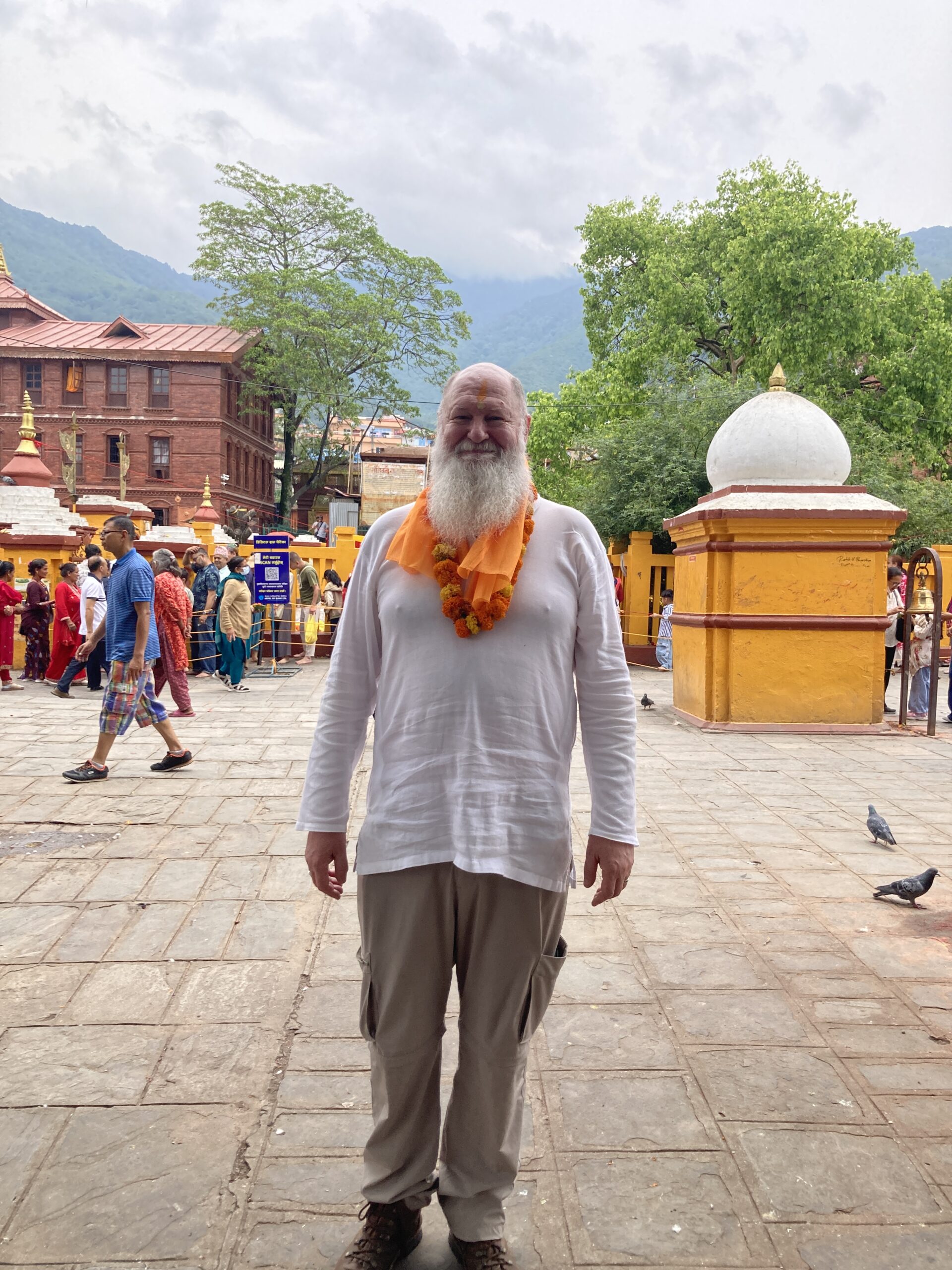
We then go to the Sleeping Vishnu – the Buddhanilthankah Temple. This 7th century carving from a single slab of basalt rock is sacred to the Buddhists, too, as an emanation of Avolkiteshvara. Completing a trinity of sanctity, this statue is also regarded by the Shaivites as the emanation of Shiva known as Nilakanta Shiva. Young boys trained at the Temple monastery preside here, chanting, and placing tika on foreheads and garlands of flowers around necks. I am very touched by the whole experience, despite the long queue! The chanting here is quite mesmerising, and learning it from my guide, I repeat the mantra as I pay homage to the shrine.
Lama at Triten Norbutse Bonpo Monastery
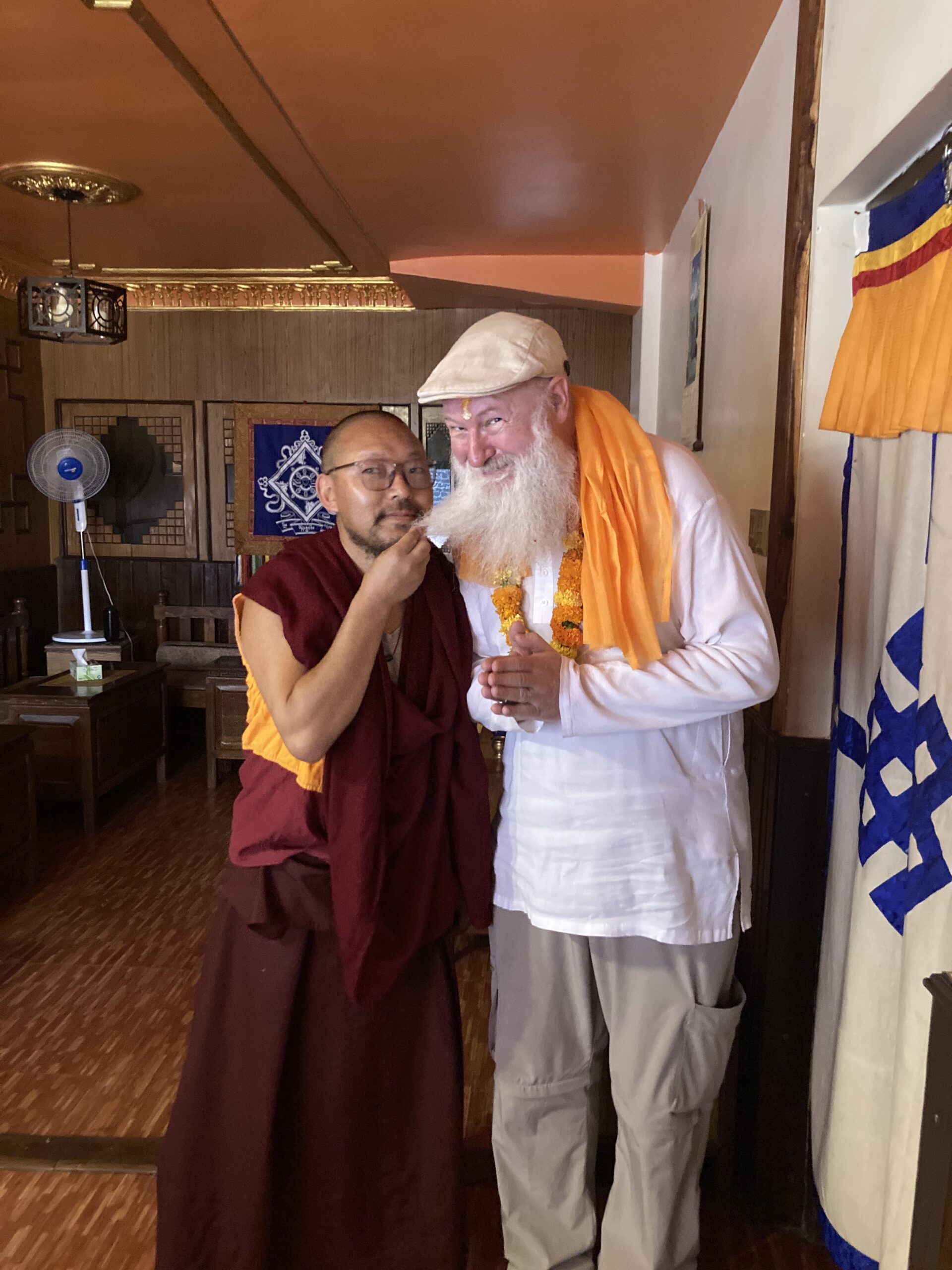
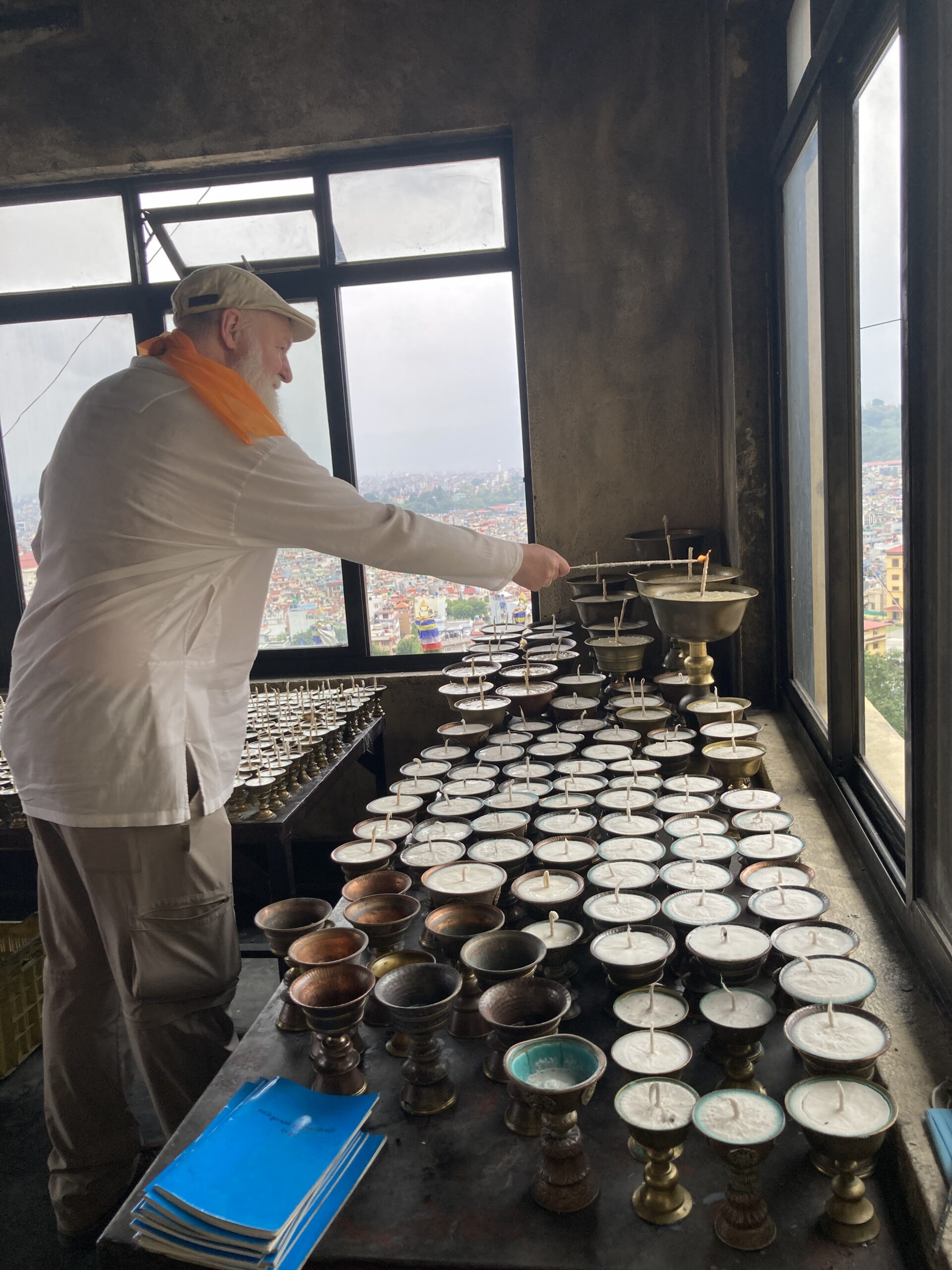
Thirdly we climb up into the hills again for our second Buddhist Temple of the day, this time the Triten Norbutse Bonpo Monastery. Bonpo is one of the lesser known schools of Buddhism, with its stronghold in the West of Nepal, rather than in Kathmandu, but there are 280 monks here, and I met a lama – who liked my beard – and invited me to light a large butter candle, saying a prayer for my loved ones, before going in to see the main the temple.
Lighting a butter candleCotton Mandalas in the Main Gompa
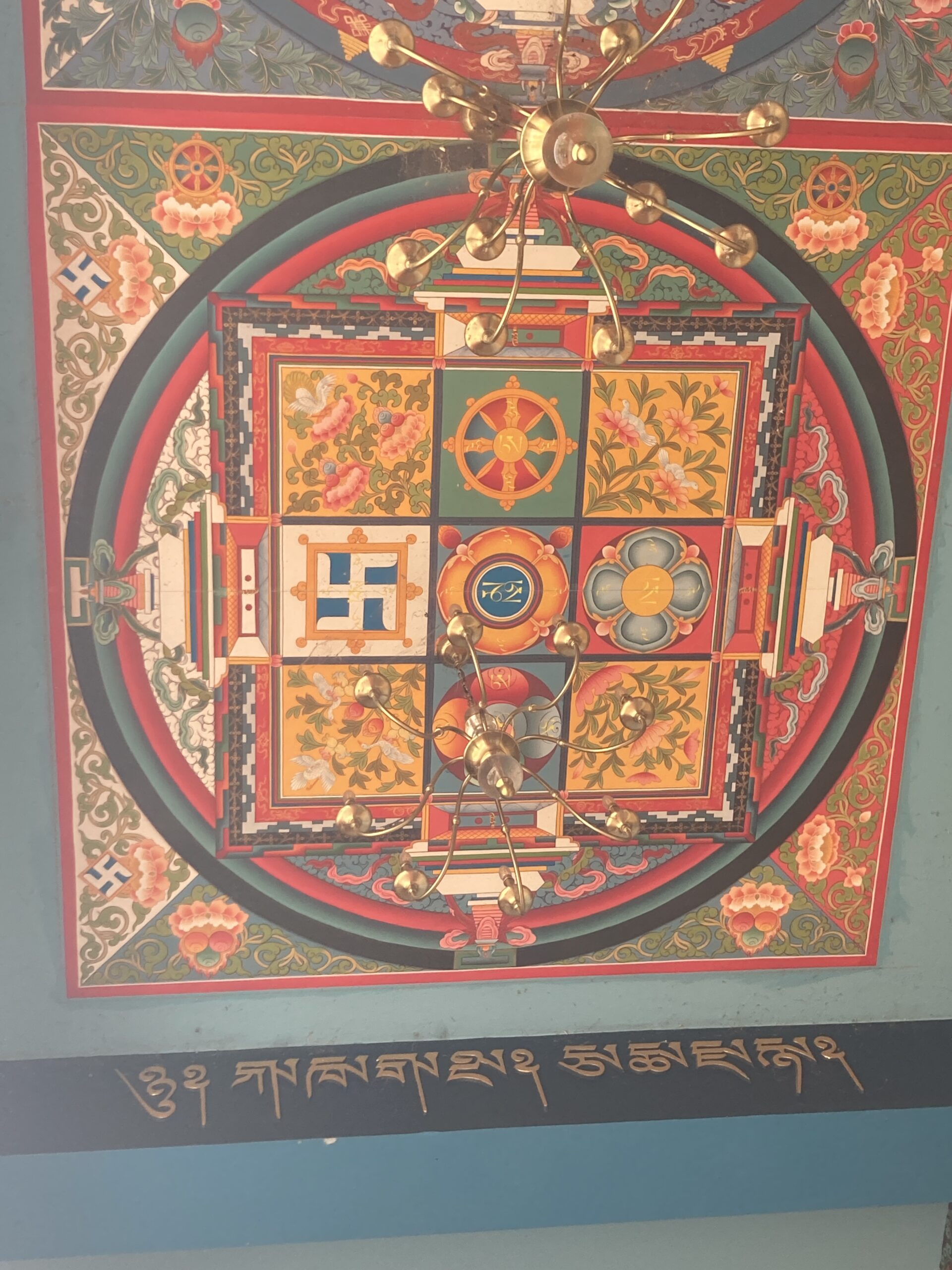
Here the very ancient (pre-Buddhist) roots of Bonpo are visible in the unique cotton mandalas, and the intensity of their relationship with the Buddha in the – equally unique – and huge mandalas painted directly onto the ceiling.
Huge painted mandalas on the ceiling
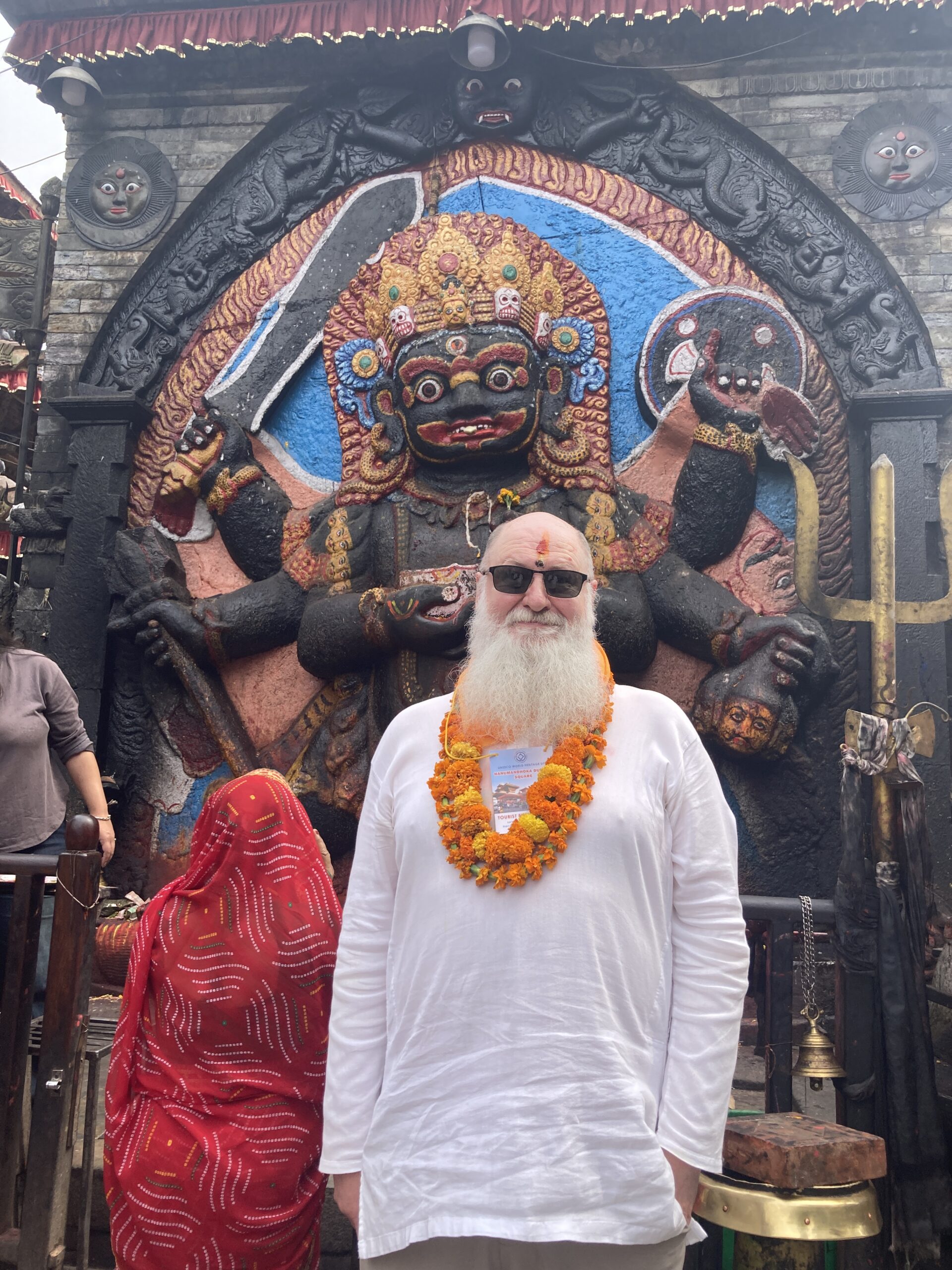
Lastly, we pass through Kathmandu Durbar Square, the medieval royal heart of the city, with its 15th and 16th century pagodas, and its early 20th century neo-classical dictatorship palace. Most interesting, for me, is the Kaal Bhairav – the great Shiva in his aspect of destroyer and protector. The presiding priest places the unique black tika of this emanation of Shiva on my forehead. In one of the many shops, I acquire a brass Kaal Bhairav to take home.
28/5/26
This was a huge day. Conference done – my paper on the Buddhist concept of anatman presented on Tuesday – I awoke this morning excited to begin a true holiday. I didn’t count on it being such a deeply moving day.
Collected by Jaya, my guide, and my driver, Ram, in our little Hyundai (they let me sit in front, thankfully, to stretch my long legs) I discover they are friendly and knowledgeable, and clearly pleased to have a tourist who seems not just genuinely interested in their religion and culture but both vaguely knowledgeable about it and keen to learn more.
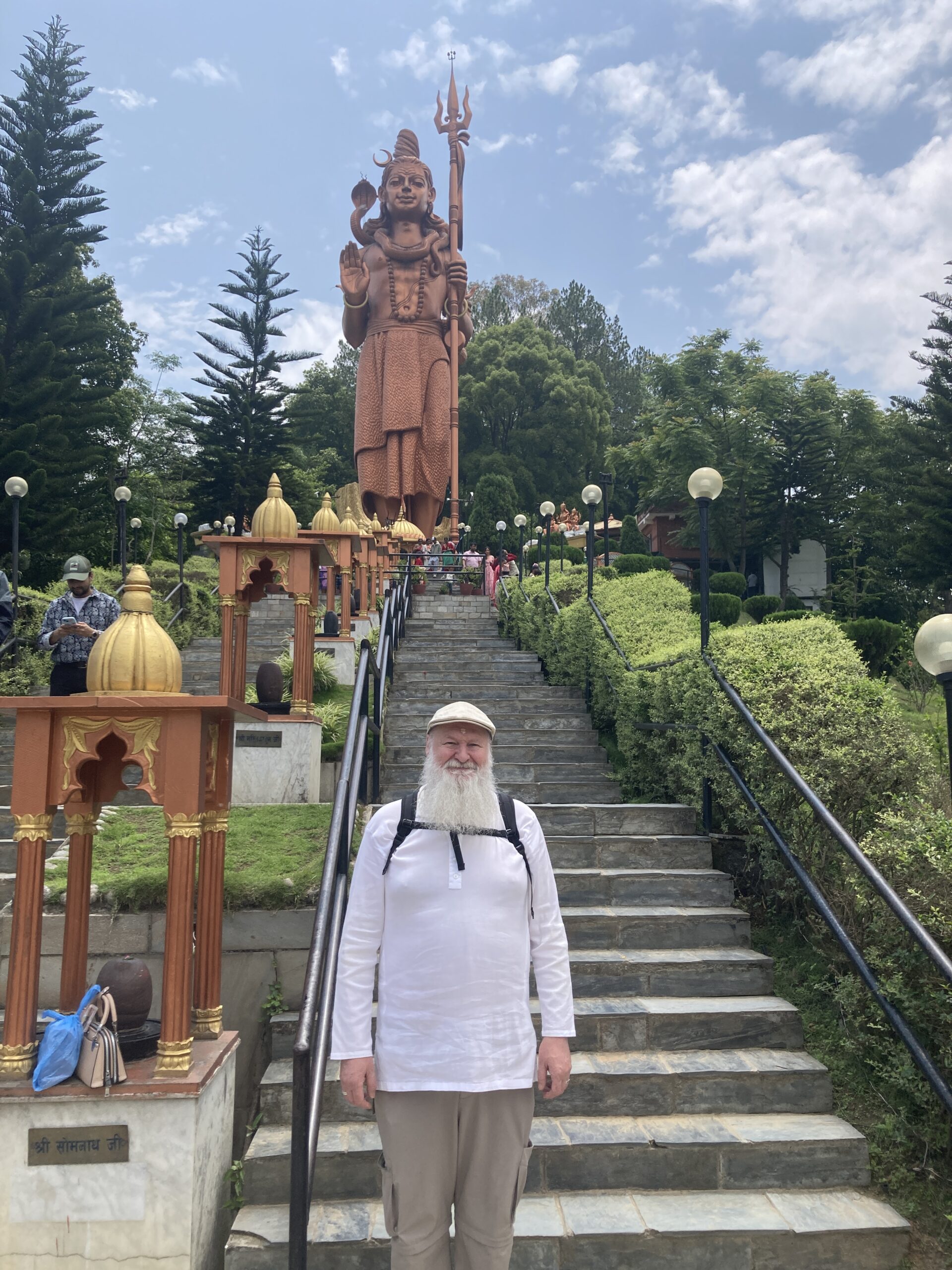
Shiva
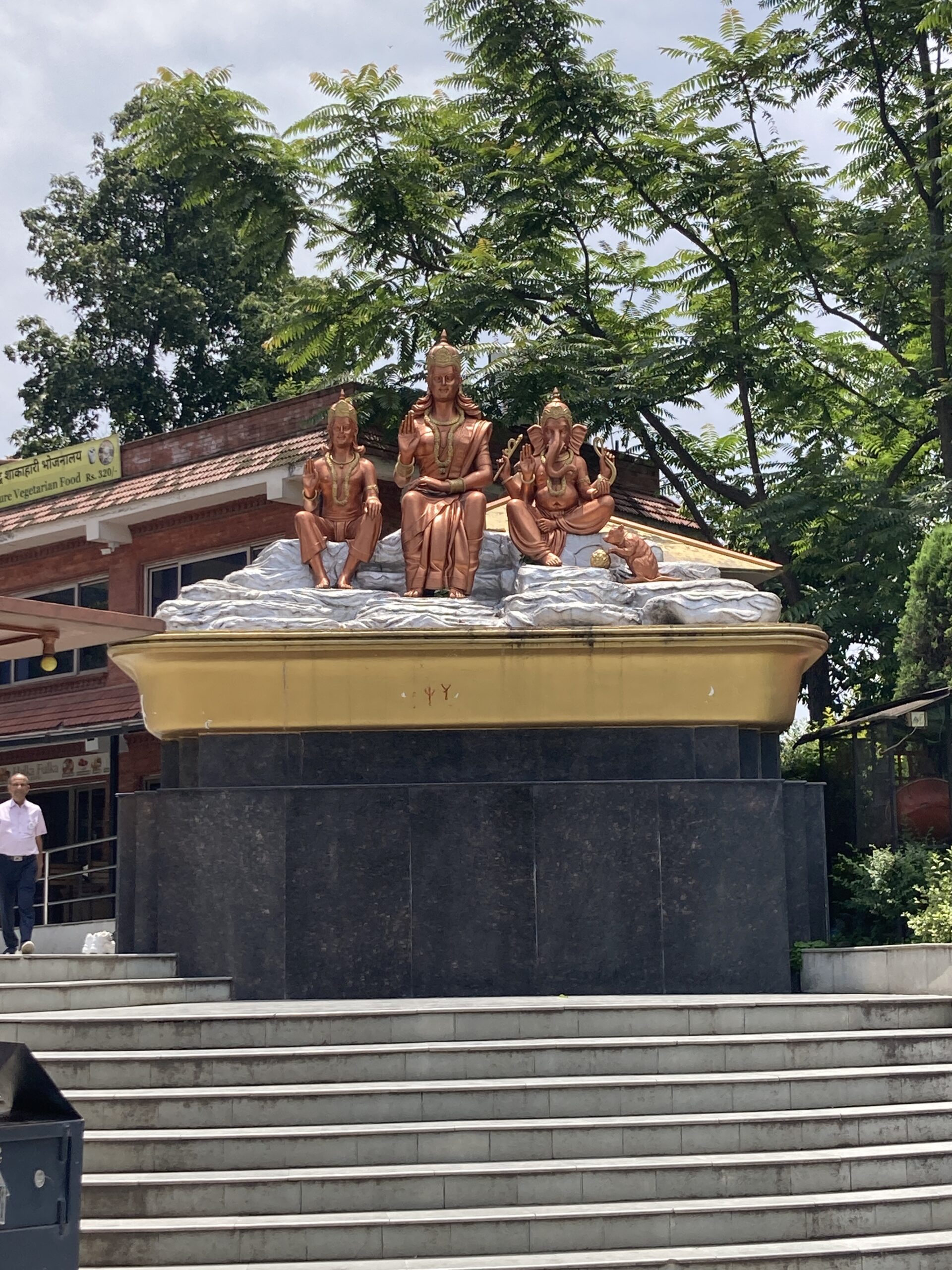
Our first visit was to the largest Shiva statue in the world. Very impressive. 144feet tall, with Parvati, Ganesh and Skanda on a little plinth at his feet, Mahadev is here in his purple splendour with trident and cobra.
Ganesh, Parvati and Skanda
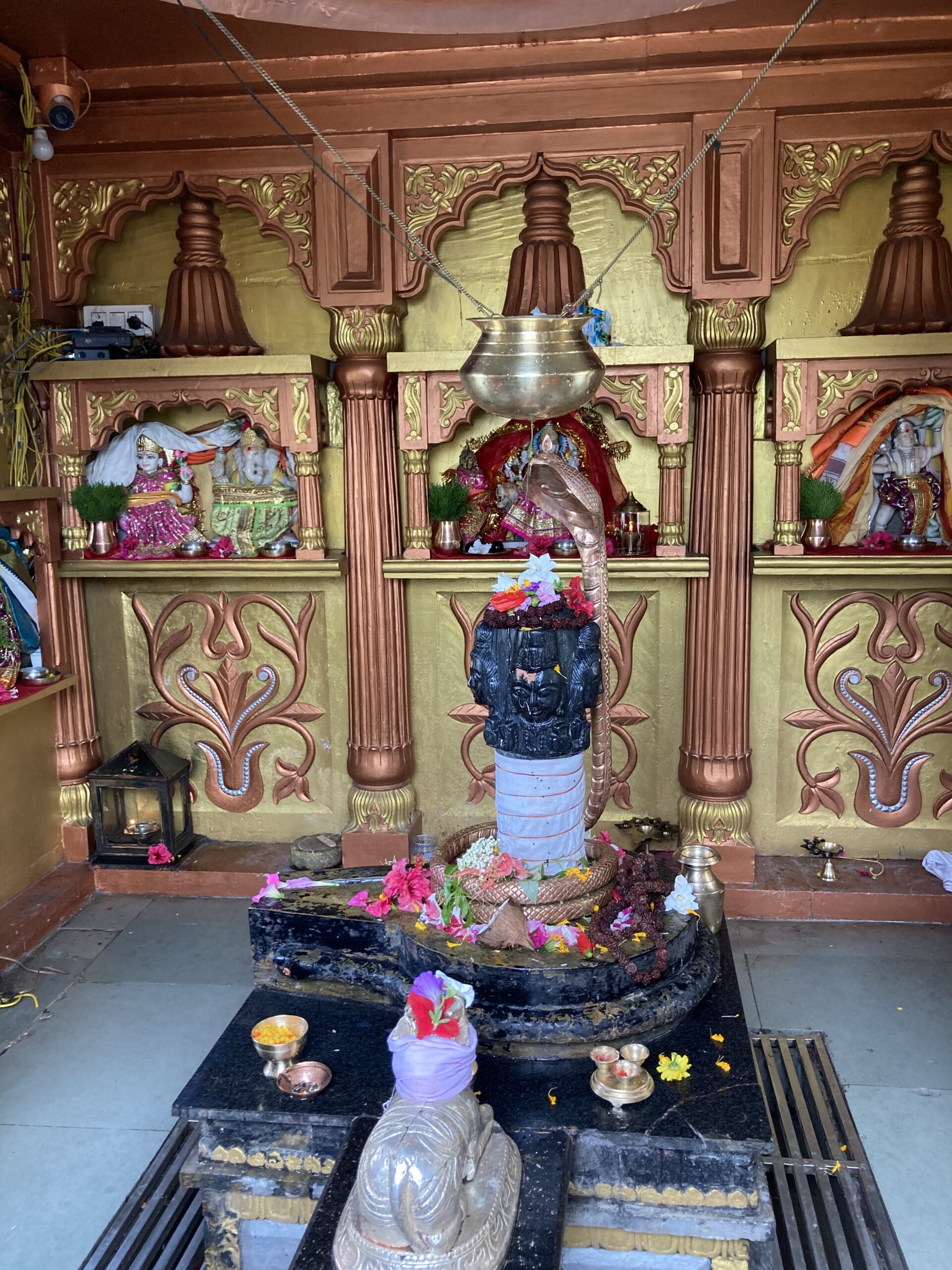
At the little shrine at his feet, the priest put a tika on my forehead, blessed me with the rudraksha beads, gave me a few little yellow flower petals from the flowers draped across the shivalingam in the shrine, which I placed upon the crown of my head, and handed me a few of the sugared sweetcorn, which I duly ate. It was very special to embrace and engage with the ritual of this Shiva puja. My guide taught me how to sing the mantra, “Om namaha shiva—-ya”
Shrine at the feet of Shiva
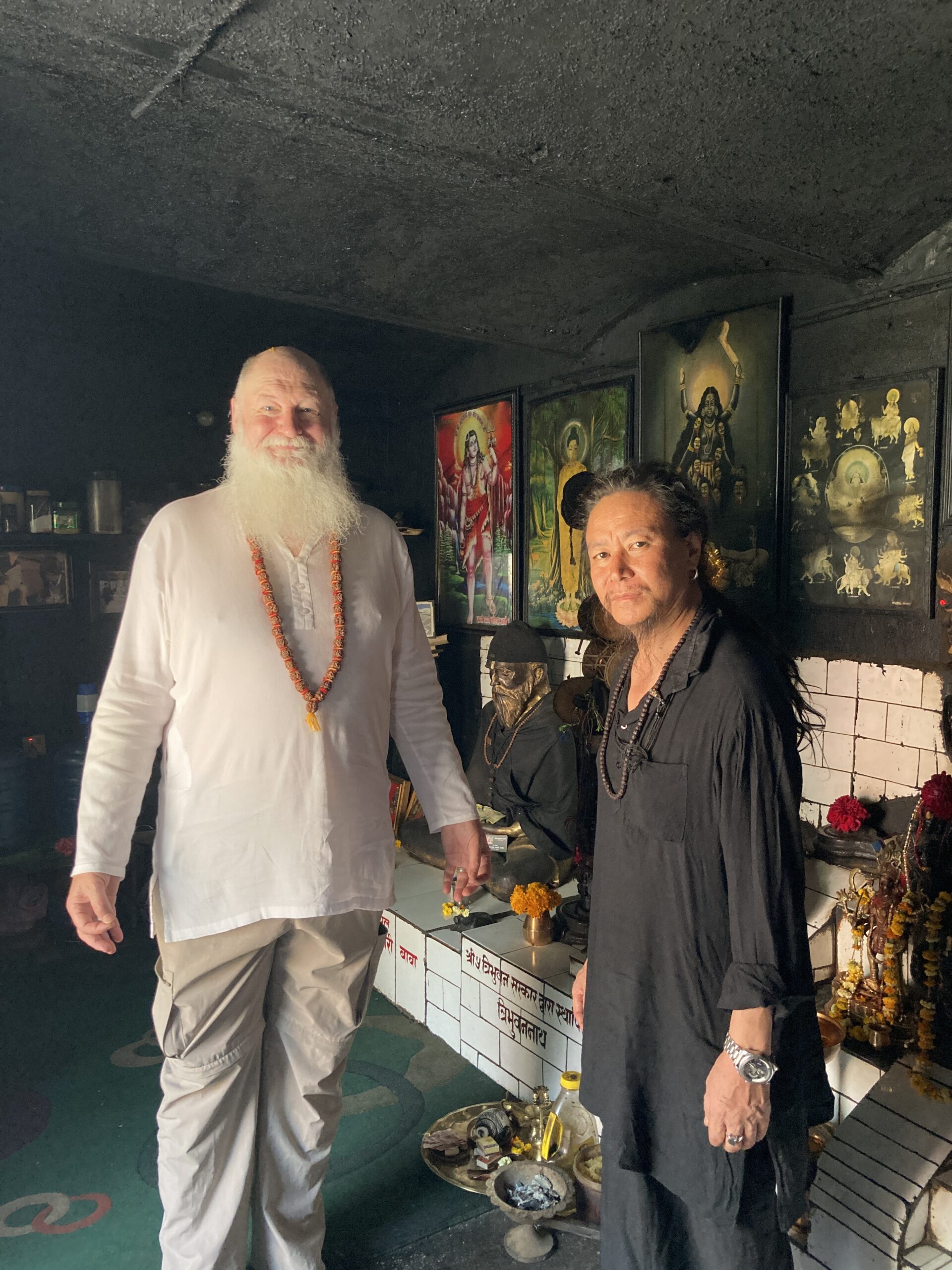
But this was just the introduction. Because we then drove to Pashupatinath. This huge complex of over 500 shrines to Shiva in his ‘Lord of the Animals’ guise was simply breathtaking, and we began it by going straight to the cave-like shrine of an Aghori Baba Sadhu. These black-linen clothed holy men follow a very special path, different to the better known white-linen clad ascetic sadhus, and their specialisation is conquering fear. This is why the aghori sadhu (who has been practicing for 32 years, I am told) has his shrine in the wall overlooking where the bodies of Kathmandu people are prepared for, and then cremated, at the shore of the sacred Bagmati river that runs through this city – Nepal’s Ganges. I am led into the shrine, and greeted by the sadhu, invited to take off my shoes, and sit facing the seated statue of the Guru Dresh. A small woman with a friendly smile shows me how and where to sit, with my fingers in the proper rudra (thumb and first finger touching, the other fingers outstretched, both hands resting palm upwards on my knees, and invited to meditate for 15 minutes. My guide goes to sit at the other end of the shrine, and he and the two women and the sadhu chat quietly. Occasionally a phone makes a sound. There is chatter just outside the shrine too. But somehow none of this matters. I am soon lost to the world, deep in meditation in this sacred space. But my back is really not up to sitting in this position for very long, and I begin to shift and feel uncomfortable. Opening my eyes, I turn to look across and my guide calls over saying just to be comfortable and take it easy. So I lie down, with my knees up, and my elbows on the ground but hands in the air, fingers in the rudra. This is much better. But inside, now, it is the mantra om namaha shivaaaaya that runs over and over in my mind. This is somehow easier than silent meditation. It is simple. I lie in this position, with the mantra in my mind, hoping to last for 15 minutes. At last, feeling a little numb in my elbows, and then realising my hands are tingling with pins and needles, I shift again, and begin to sit up. I am done. Looking at the clock on the wall, I realise I have been meditating for 25 minutes. It is quite something. The sadhu is smiling at me. He seems quite young to me, perhaps in his late 40s. His dreadlocks hanging down his back are the same colour as the black cloth draped around him. His welcoming smile is reassuring. I am invited to stand so my guide can take pictures, with my phone, of me standing with the sadhu, in particular with the statue of Guru Dresh in the background.
Aghori Sadhu
Then, suddenly, I am invited to look into the holy of holies – the sacred place at the back of the shrine I did not expect to see. My guide tells me there is a skull there. Would I like to see? I nod, and follow the sadhu into the inner sanctum. There, on a small desk, deep red all over with glistening Chandan, is a human skull. I believe it may be the head of the Guru Dresh, who taught the sadhu. I am deeply moved, my hands together in prayer of thanks, my head bowing, my lips muttering Namaste, and Thankyou. The sadhu smiles. Stepping back out into the main shrine, the sadhu puts his thumb on my third eye, presses for a while, and mutters a prayer, and I am blessed. He does the same for my guide. We both turn and place NPR500 notes in the little offering dish, and step back out into the sun. I am completely blown away. My guide tells me this was a rare experience. Usually tourists come in for 2 minutes and are gone. Being invited in to see the skull is almost unheard of – even for locals. The sadhu, apparently, told him that I had a deep connection with Shiva (for a tourist!), and he was pleased and glad to help me to honour it. It has been a deeply moving experience.
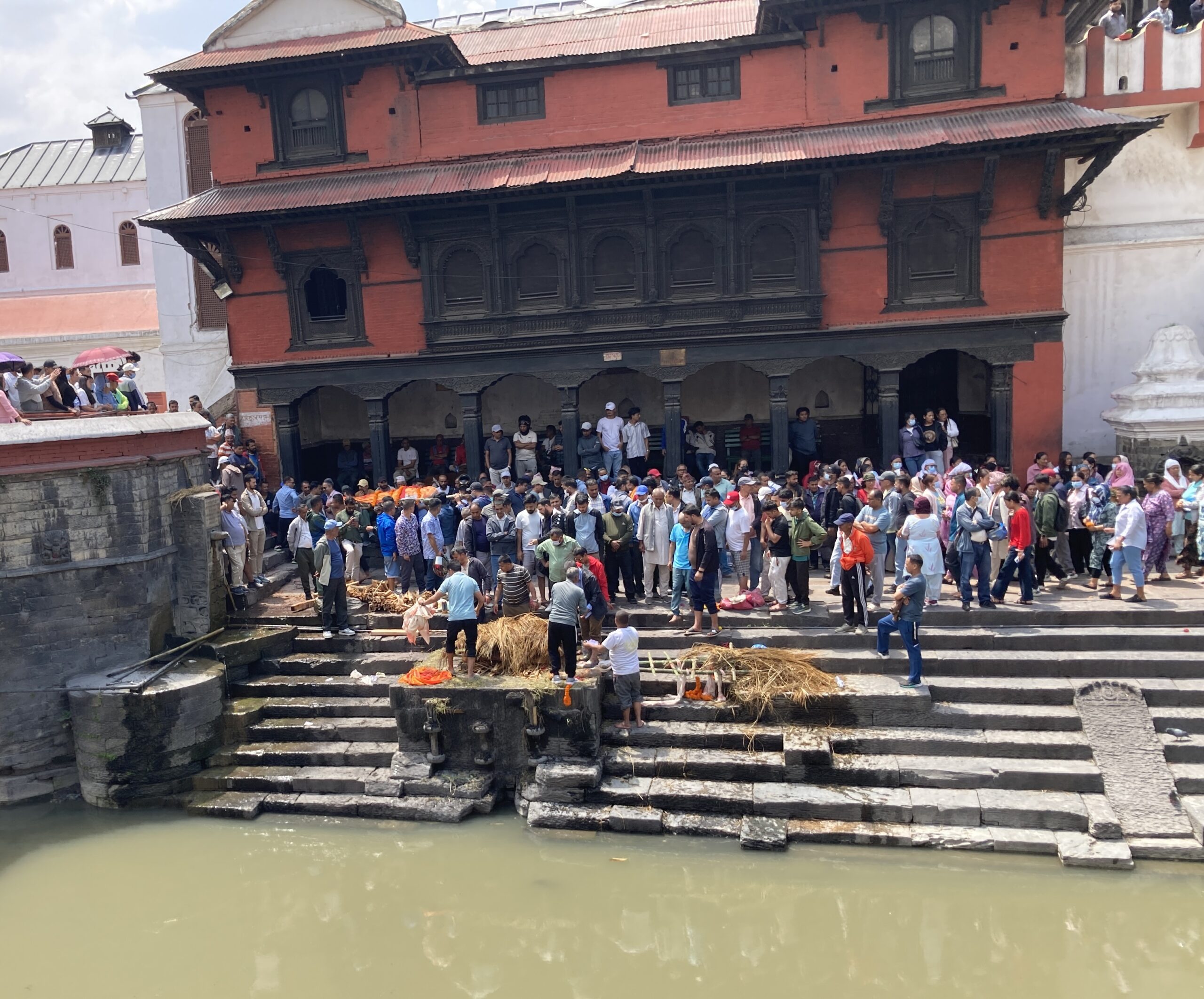
Funeral pyre
Out in the sun, we walk across a little footbridge, over the Bagmati River, and stand to watch as families tend to their dead. (The other four of Kathmandu’s rivers flow into the Bagmati, which itself later joins the Ganges.) There are four dead bodies on the paving on the other side of the river, and their families are purifying them with milk, honey, water, and tears, dressing them ready to be carried to the pyre where they are covered with straw, and set alight, in the typical open-air cremation that all the people of Kathmandu may enjoy. It is free – one only pays for milk, honey, incense, etc – and the favoured manner of seeing off the dead. It takes about 3-4 hours to burn each body, I am told.
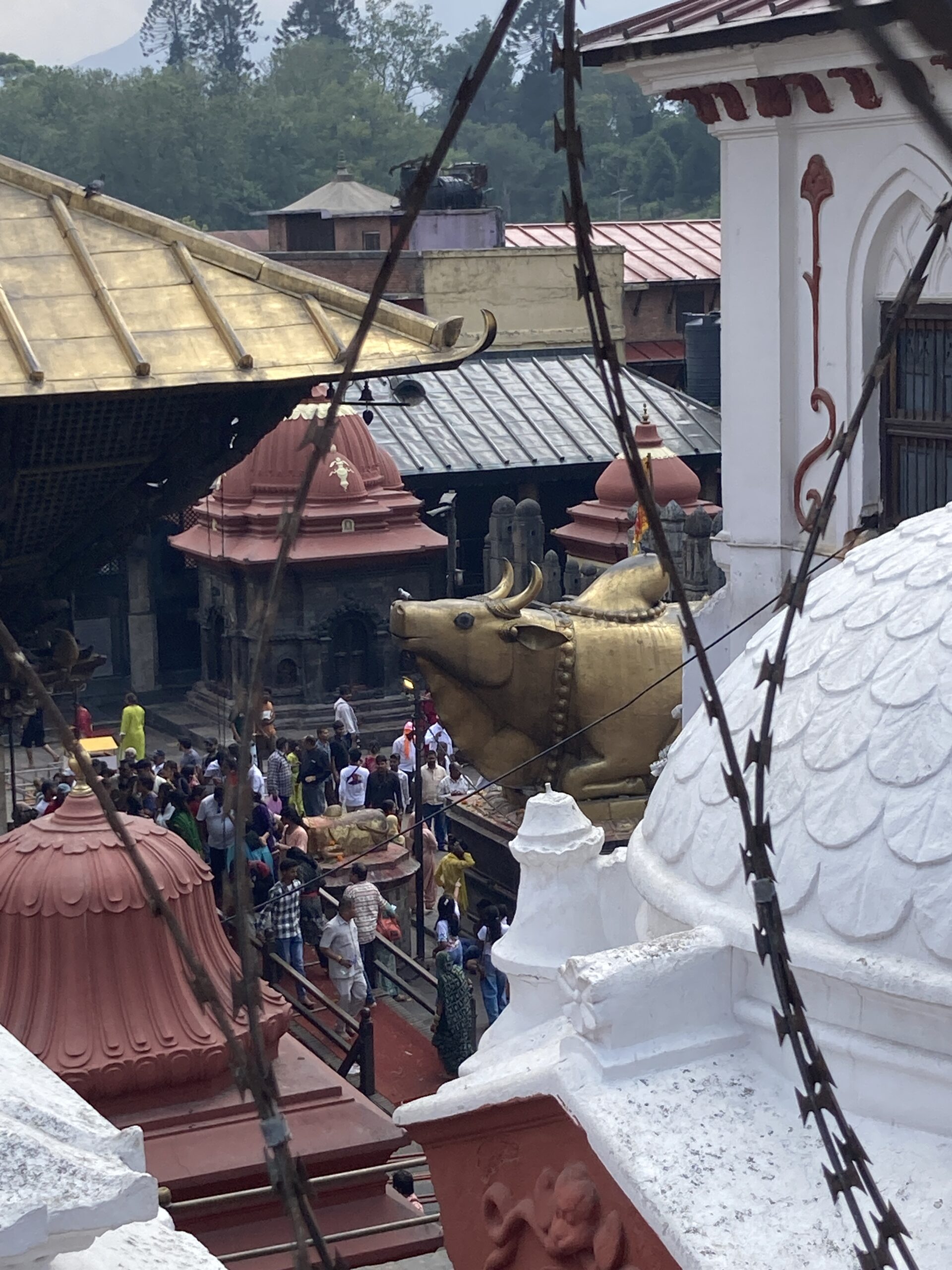
After my experience with the sadhu, somehow all this just seems quite natural, and I am not phased. It is a serious business, but not I am not discomforted. We move back across the footbridge, and round to the side of the main Pashupatinath Shrine. Only genetic Hindus are allowed within the main temple. Only five sadhus from the south of India, who have been chosen and come to Kathmandu for the last 1400 years, are allowed to touch the self-existing ShivaLingam in the centre of the main shrine. All I am allowed is a glimpse of the great Bull – shiva’s ‘ride’ – outside the main temple, where people gather on their way in and out of the shrine.
Shiva’s Bull Ride
It has been an incredible morning, and I am glad of the rest and opportunity to have some lunch, before the visit to Boudhanath – the Buddhist Stupa some five minutes away from Pashupatinath.
After lunch, we strolled around the enormous Boudhanath Stupa. Built in the 7th century CE, by a woman who made bricks with dew water she collected each morning, it is sometimes known as the Dew Stupa. Jaya tells me the prayer flags represent the five elements: Yellow earth; White wind; Green water; Red fire; Blue sky. The Enormous Eyes represent compassion and wisdom to the four directions, and the Third Eye is the eye without illusion.
The stupa is surrounded by shops, making a huge circle of friendly but vibrant capitalism around the solid representation of liberation from all that stuff…. I am – like most – enraptured with all the things, nonetheless – the Buddhist Tat, as one might call it (as opposed to Hindu Tat, Christian Tat, etc) and fork out on a magnificent Thangka painting of the Kalashakra – the wheel of time mandala – representing the four truths and the journey towards enlightenment: an ‘asset’ for one who meditates.
Finally, then, we arrive at my hotel, and western comforts.
Travel Writer has been rather quiet on this blog, of late. The blog itself has been pretty quiet! After the profound trip deep into my ancestral past in Ukraine, in October 2019, I have made, in comparison to previous years, almost no ventures out into the wider world; certainly none worthy of blogging.
There was a trip, almost immediately afterwards, to the Hawaiian island of Maui – for a January 2020 conference – involving four flights each way (!) at the end of which I had the opportunity for a day’s drive around the northern tip of the island – the area some years later destroyed by extreme weather! Then COVID struck and all international travel stopped. Or rather, as I did indeed record in this blog, there was one international trip during the pandemic: emigration to Ireland, in January 2021. Since then, apart from frequent hops back and forth between Ireland and the UK for one reason or another (some just for a restful break, most for family and friend visits, once back to the Orkneys again(!) in 2024), there have been a few brief work trips: to Nantes, to Lille, to Sydney (a long way to go for three days!), to Bratislava, to Lisbon, to Nyon near Geneva. All rather civilisationally familiar, european (with a small e) places.
So although travel picked up again, work-wise, from 2023, there has been little in the way of personal, exploratory international travel, and none really worthy of blogging. Four days celebrating my 60th birthday (and Colin’s 50th) in Turkey in March 2023 consisted mainly of a visit to Ephesus, about which there is little more to say, on a personal note, than that I was struck by how my own academic discipline of ‘information systems’, once known as Library and Information Management before it was all digitalised, could be said to have begun at Ephesus, where indexing alphabetically by the first letter of an author’s surname is said to have been invented, by its famous Library’s Roman director, Celsus. And then in December 2024, a conference in Bangkok, which included two days sightseeing, taking in some fantastic Buddhist temples. Perhaps I might have written about what I saw and experienced there. But I have long held the view that, in general, one should write a review of something in terms that are at least appreciative, and rather than writing a bad review (of a hotel, a restaurant, a travel agent, a country) simply decline to go again, or even mention it. On this occasion I wrote a bad review, not worthy of this blog.
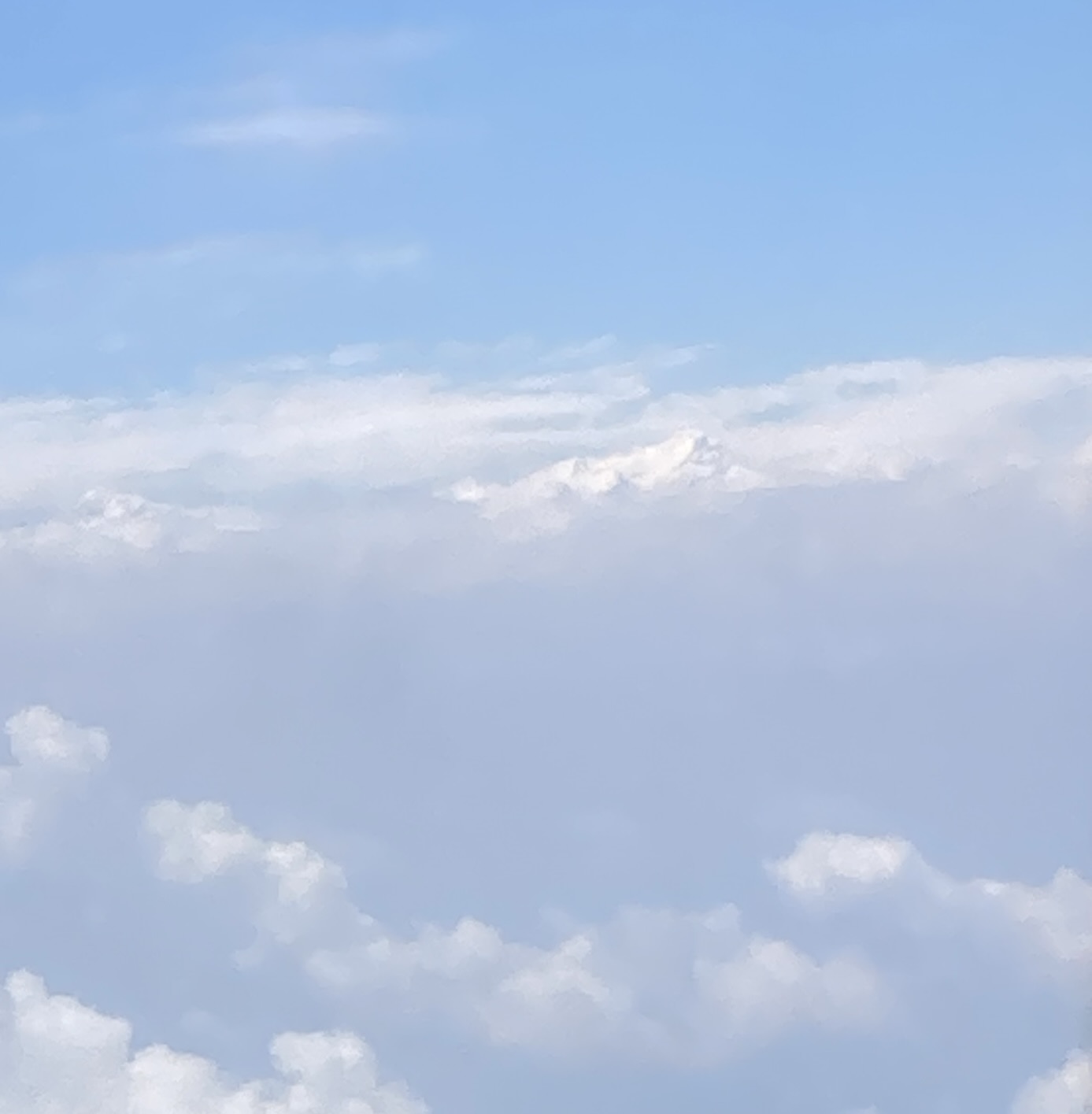
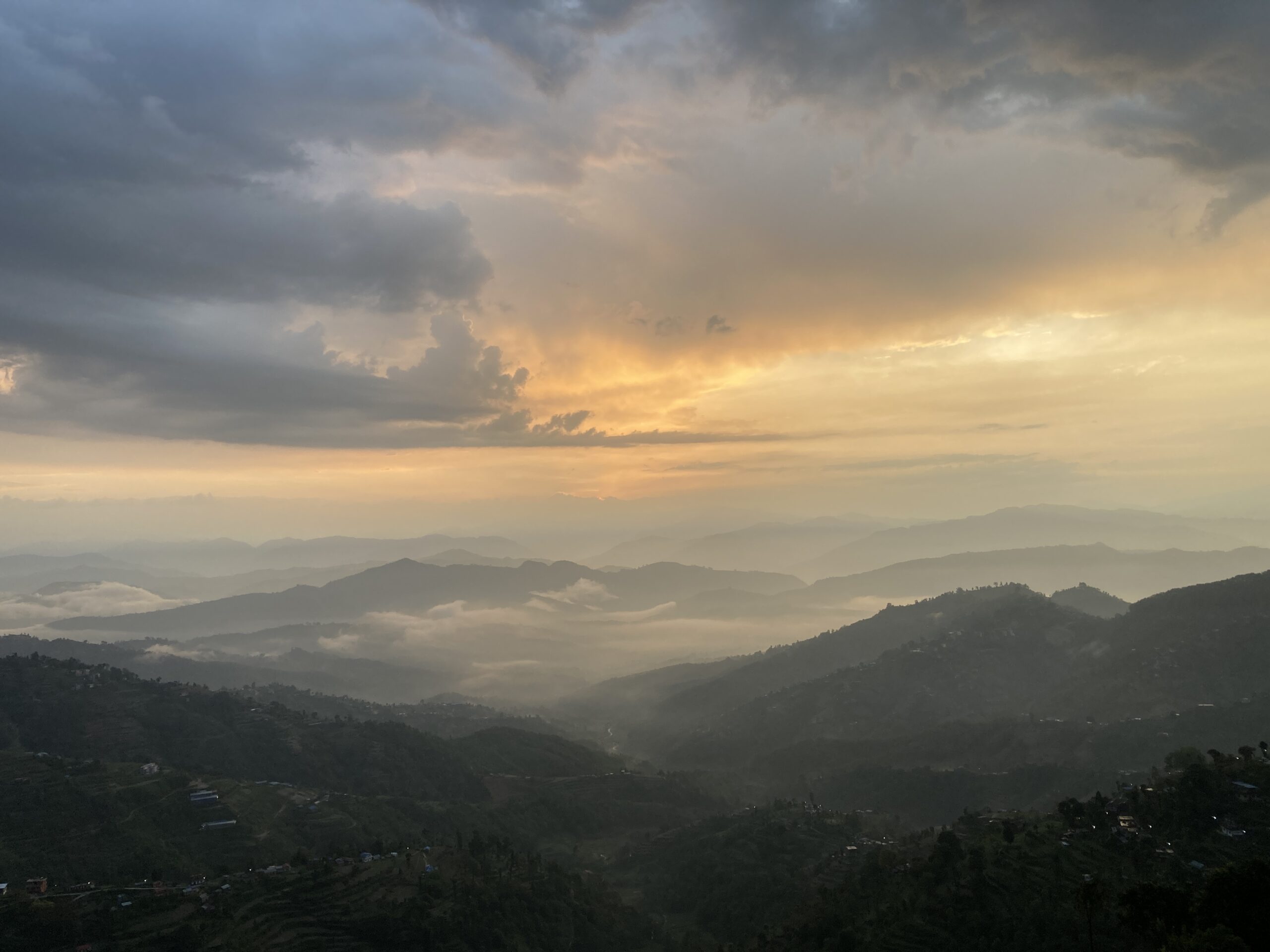
Dawn from Himamlaya Drishya Resort
All this changes now. Similar to my trips to Ukraine (2019), Sri Lanka (2017), Japan (2016), and Peru (2010), work has sent me somewhere really quite exotic, for a change, this May, (to a conference where I have given a talk on the Buddhist concept of anatman) and I have taken the opportunity, once again, to properly go on vacation, whilst here, before returning home. So, I am in Nepal -a multi-ethnic, multicultural, multi-religious republic, as it proudly describes itself. Conference is done, and I am now on holiday – for four days here, and then for another four days in Bhutan! Travel Writer’s blog, then, for this trip, begins with my arrival on the 23rd, and my one day of sightseeing on Sunday 24th May, the day before the conference, and continues on 28th when my vacation proper begins.
23/5/26
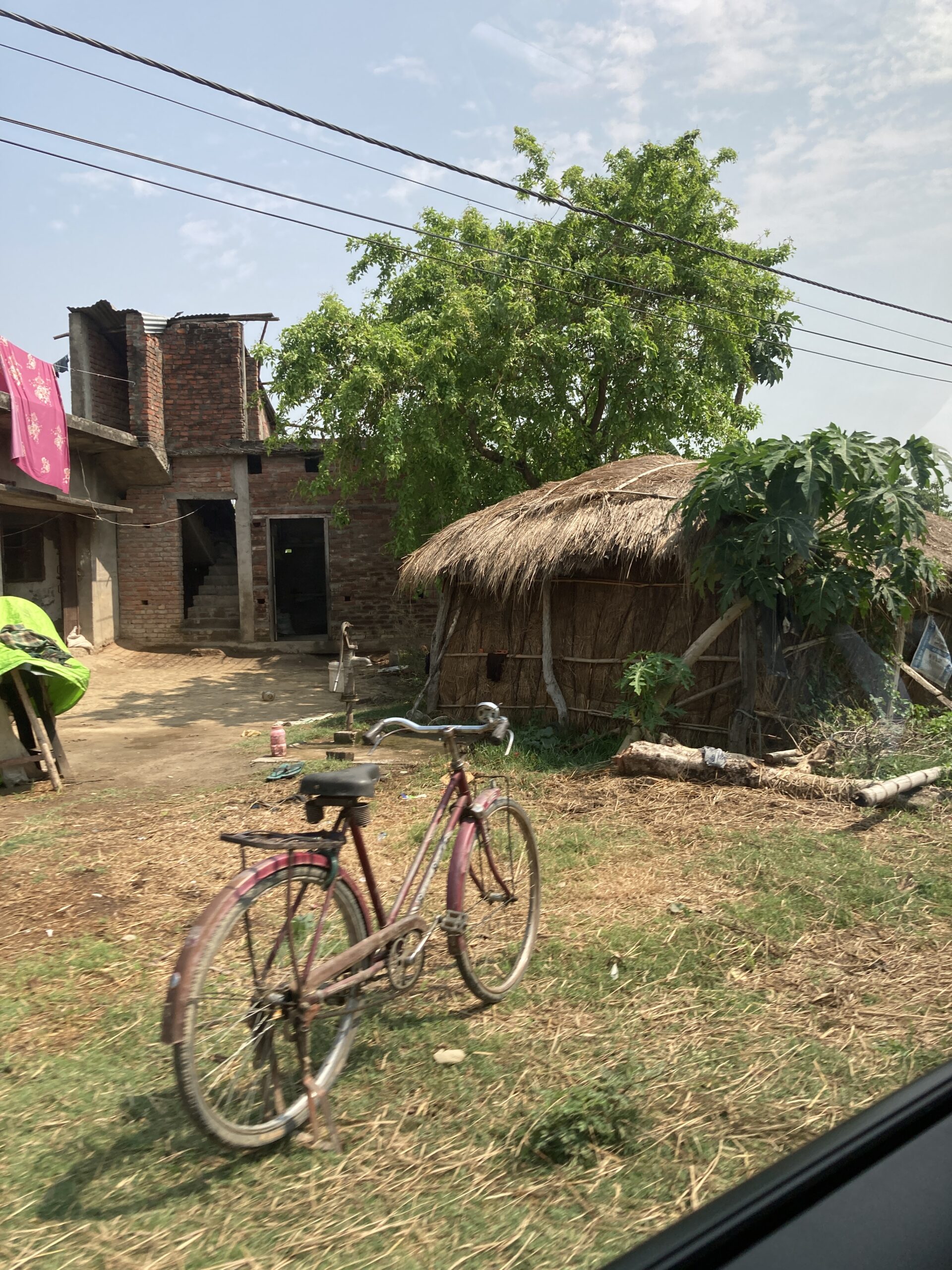
Collected at the airport by the hotel transit in a nice cosy BYD, I was relieved and impressed. The drive from the airport to the hotel, however, was very instructive. My driver took a ‘secondary route’, perhaps because the main highway is very full. The state of these roads is appalling. We were frequently reduced to a crawl across rough ground, frequently circumventing half-made gravel tracks. Occasional stretches of concrete road were rarely long. The hills and valleys of the sprawling city make for perilous climbs and sharp bends. My first views the city made it seem to be a vast collection of half-finished buildings, rarely joined up. Shops are everywhere but most sell vegetables and fruit. Dotted in between are global brands like Pizza Hut. A wide range of development, seen from my air conditioned BYD SUV.
Finally reaching the hotel, after unpacking and a shower, I drifted off to sleep at around 10am. It was strange to wake, pick up my ipad, and see it was 10am. That was, of course, in Ireland. Here in Nepal it was now 2.45pm. The heat in the morning was oppressive. In the afternoon, sitting on the balcony of my room, watching the warm rain, I delighted in the cooler temperatures that come with it, and the thunder!
24/5/26
Here at Dhuilikhel, to the east of Kathmandu proper, where the University is located, I find I am a good 90 minutes (at least) away from both Durbar Square and Swayambanath, the two places I thought I might visit on my first full day in Nepal. This is not just distance, but the fact that the roads are in such a shocking state. This is in part due to the generally low level of development, here; Nepal is one of the 30 poorest countries in the world, in GDP per capita, (and Ireland is currently at No.3). It is also in part due to the massive earthquake 11 years ago, from which the country is still recovering, and in part due to renewed landslides from time to time due to bad weather. In conversation with hotel reception here, I decided on a more local tour, taking in (1) the nearby market and its local Hindu shrine to Gita Mandir, which boasts one of the tallest stone pillars in Nepal, then (2) Devisthan Kali Temple, famous for its 1000 steps, which – fortunately – my car will be able to avoid on a winding lane to the top of the hill where the shrine is built. (3) Thirdly the Namobuddha Buddhist Monastery, and lastly (4) Panauti Indreshwar Mahadev Hindu Temple and Museum. All this will only take up five hours of driving and walking around.
We agree for me to set off at 10am – with the same driver in the same BYD that collected me from the airport. Orun (29) is friendly, helpful, knowledgeable, very local, and although his English is poor the translation apps on our phones ensure we understand each other well enough.
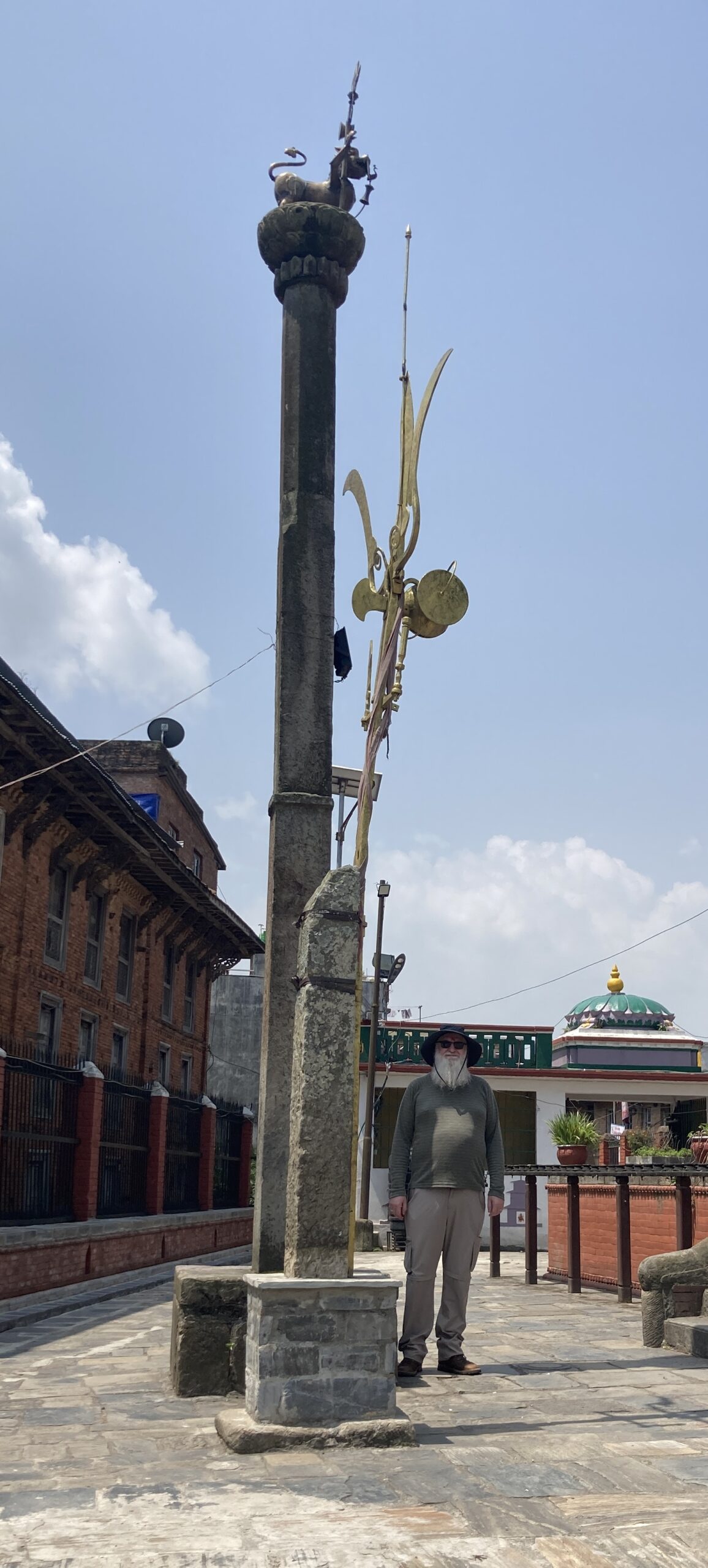
Tall stone pillar at Gita Mandir
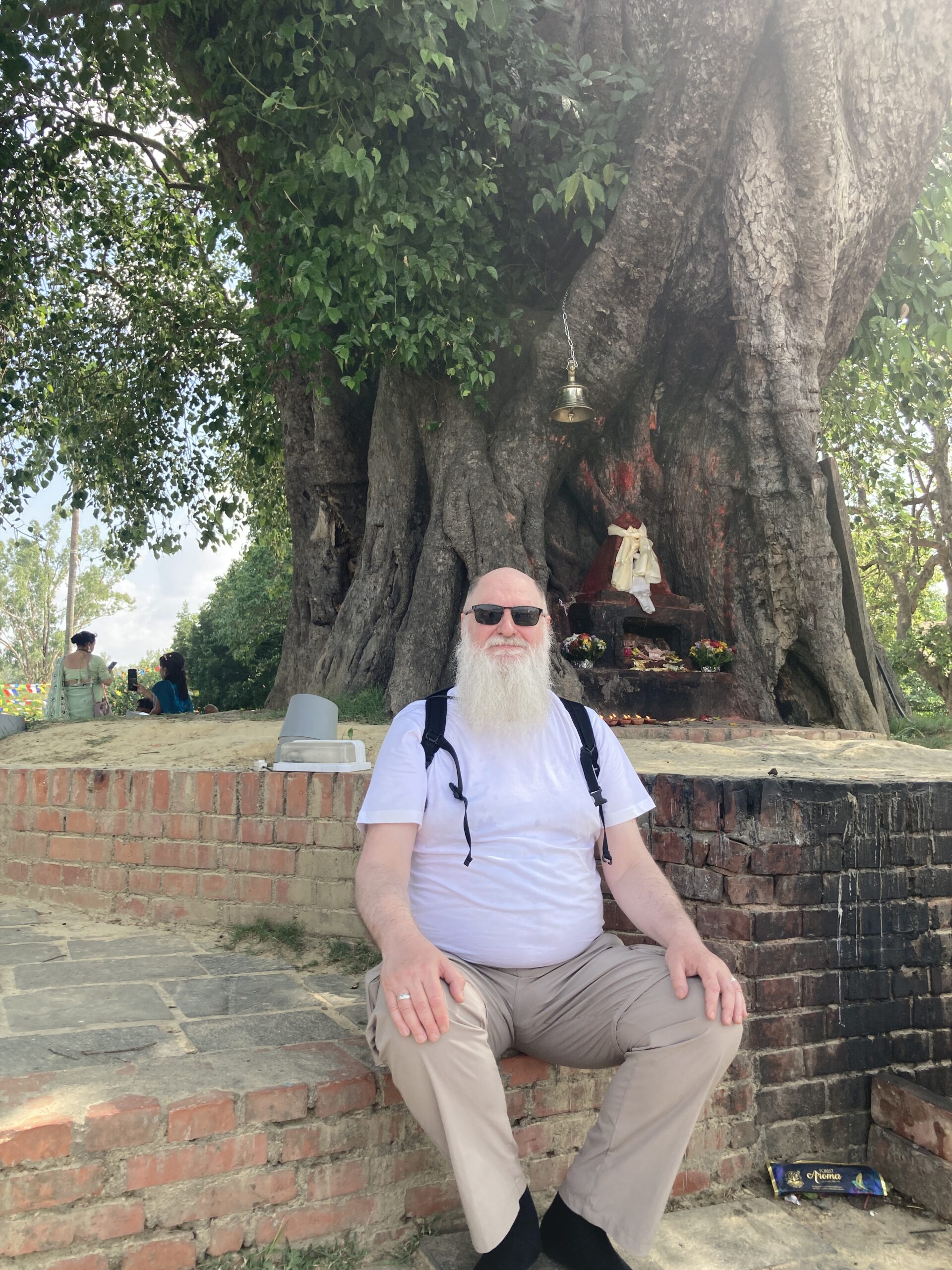
The little market in Dhulikhel is tiny, but boasts a life size statue of a Tiger, a little shrine, and a pool. Nowhere has a Nepali cotton shirt I would like: only typical Western shirts. But on the hill above the shops we visit an equally tiny local shrine: Gita Mandir Temple. There are little shrines to Shiva and to Ganesh on the way in, and a lovely small Temple to Gita Mandir overlooked by the tall stone pillar. The place is deserted. We ascend to the outer court of the Temple: the inner court with the idol is fenced off. Orun touches the stone threshold slab at the entrance with the fingertips of his right hand, then touches his chest with them, and lastly his forehead, in a seamless 1-2-3 gesture honouring the sanctity of the space, as we enter. I follow and do the same, delighted and intrigued by this simple expression of religious feeling. At the entrance to the inner courtyard, by the fence, there is a bowl of red paste. He invites me to add, with the tips of the fingers of my right hand, a bright red Tika on my forehead, “a gift from the Gods” he says, from the bowl of Chandan (brightly coloured sandalwood paste). I’m not very good at it. He does it for me, and I thank him for doing it properly.
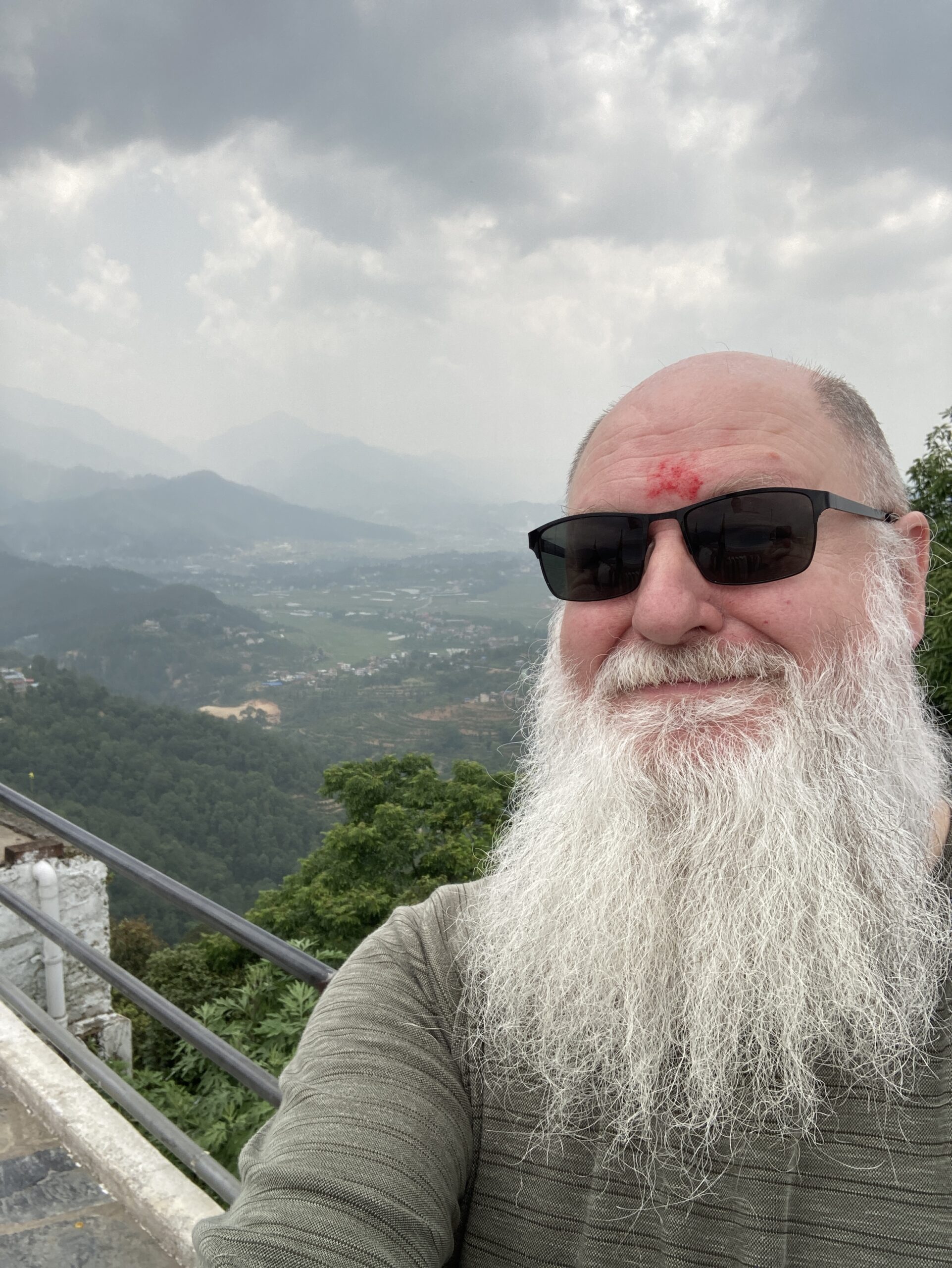
Sporting a Tika
So, for the rest of the day, I proudly sport the daub of bright red Chandan paste on my forehead, between my eyes at the top of the bridge of my nose – known as a Tika – as symbol of my experience of the holy places of this area. I am touched, and already enriched by this small local shrine. I put a NPR20 note into the slot where monetary offerings are made. I am reminded of Japan, here, and the Shinto habit of making an offering of a few coins.
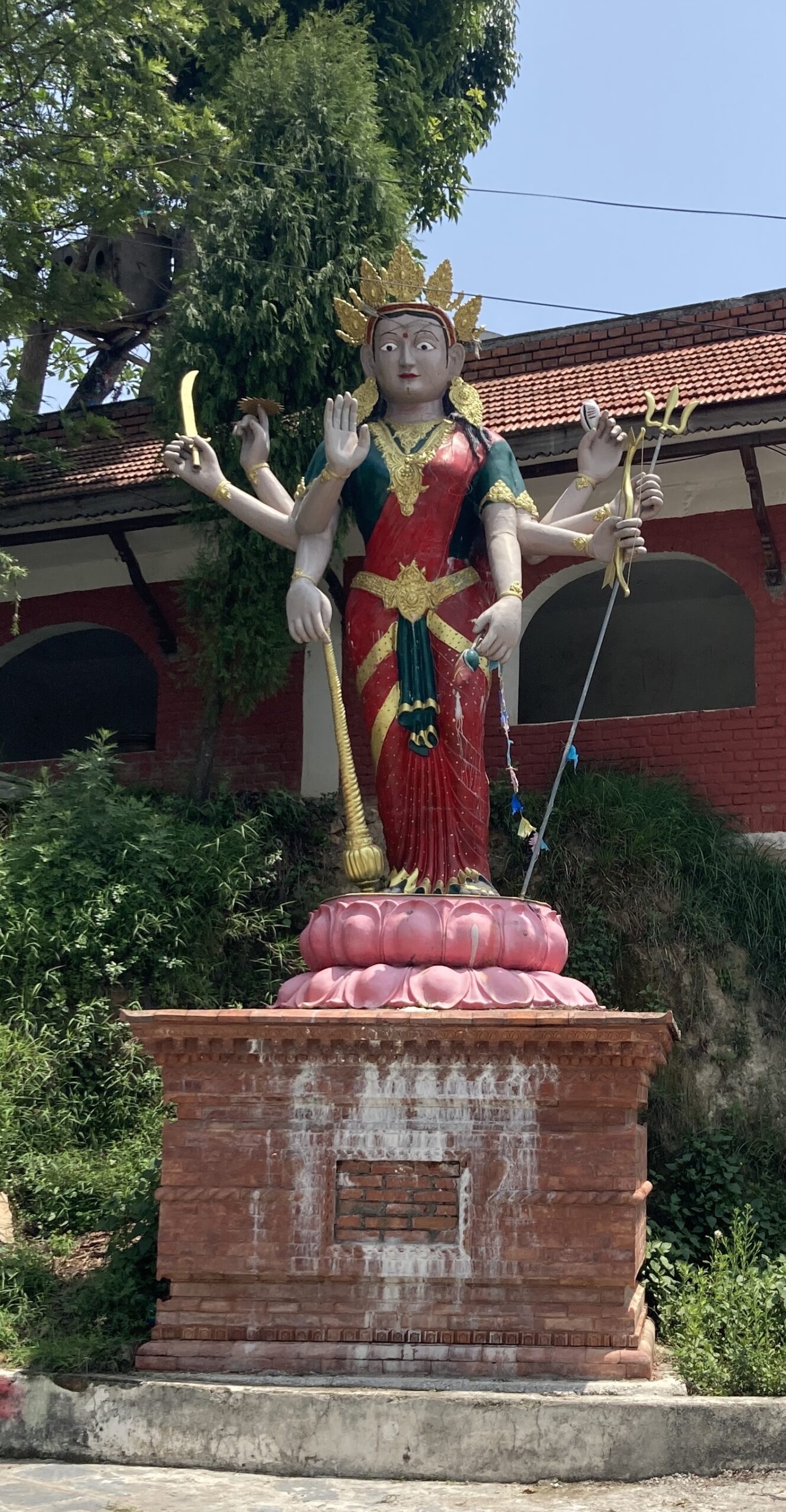
Kali
Next, we head to the Devisthan Kali Temple. The 1000 steps are indeed a very long and quite steep set of steps up the side of one of the many hills that are scattered across this region. Winding up across it, back and forth like a snake, the concrete lane we drive along cuts left and right through the steps, leading us up to an area where we can park near the top, and get out to complete the last short flight of steps to the Temple. The flat crest of the hill here, at the top of the steps, boasts a statue of the first King of modern Nepal, who united the country. Then intricately carved wooden doors in the distinctive local style, in a small break in an outer wall, grant entrance into the outer courtyard of the Temple, beneath a carved Nag – the cobra. A small open Shiva shrine in the outer courtyard is all we have access to. The inner courtyard, with the Idol of the ancient Crone Mother Goddess Devi – known best in the West as Kali – is locked away in an inner walled shrine to which we neither have access nor any ability to see inside. It is a truly imposing place and I am deeply touched by the Shiva shrine, at any rate, and impressed by the amazing views. Despite not being able to see her idol, it feels as though the ancient Goddess seems very much a living presence here, where she is worshipped by living devotees. We are fortunate to be here when there is nothing going on, and almost no-one here but ourselves, save a trio of small boys.
Then the drive, back down the winding lane and across a little valley – the roads a little better around here I’m glad to say – to another hill, where another winding lane takes us up the side of a wooded hill, up, up, up to Namobuddha Stupa & Monastery – home to large complex of brightly painted buildings and hundreds of monks & peaceful chants. After the quiet of the Devi shrine the crowds of monks, visitors, and tourists here makes for quite a different experience, but we are nonetheless not overwhelmed, and able to experience some parts of the Temple almost alone, from time to time. Taking off my boots each time, we visit the Main Shrine, the Shrine of 1000 Buddhas, and the Shrine to Green Tara.
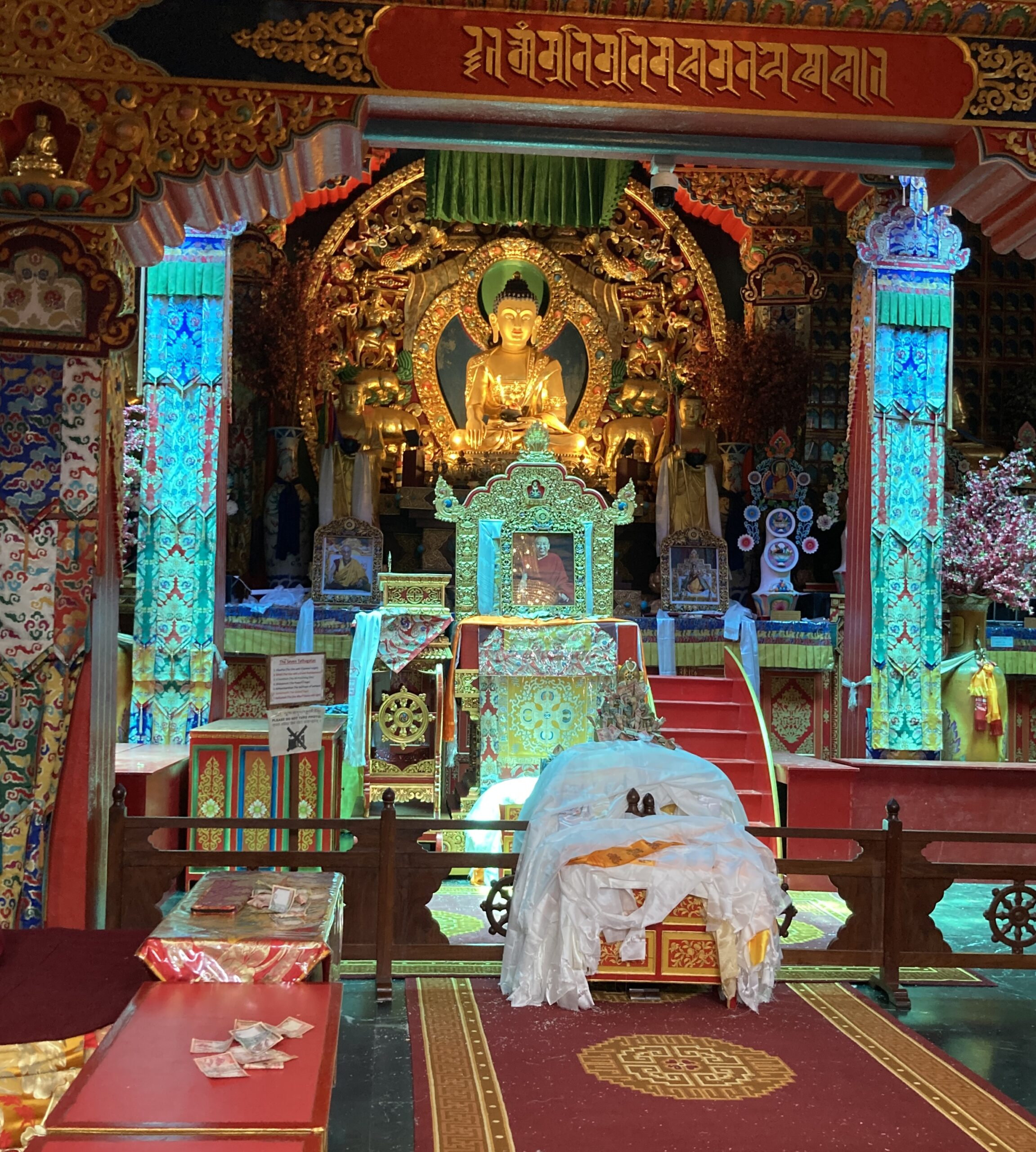
Namobuddha main shrine
The main shrine is really amazing. My guide and I take off our shoes and walk up the stone steps, in through the great wooden doors to the main shrine, and walk up the aisle, and stand in front of the central Buddha at the shrine for a good while, silent. There is a line of small shrines in front of one great wide shrine that supports a series of huge Buddha statues. My heart is full. My face is a beaming smile. I am filled with peace. But the only thoughts that pass through my mind are of anatman – the topic of my presentation at the conference here on Tuesday: the Buddhist concept of not-self. I am not, and not being, I am filled with both joy and love, and compassion for both myself and all others. I am enriched, and the boundaries of who I am are wide open; there is no difference between me, and Orun, and the other devotees who now begin to file into the shrine. Noticing them, I am drawn away, at last, and follow my guide off to left of the shrine. A monk leads a group of devotees up the aisle to where we have been standing, explaining things to them in Nepali. As they turn to the left, we see they are filing past the little ‘no entry’ sign to make a tour behind the front pillars, nearer to the big Buddha statues. Following Orun’s lead, we join them in making a (clockwise) tour of the inner part of the shrine. Following my guide, I bow my head and touch my forehead to the white shawls draped across special parts of the shrine. I put a NPR20 note in amongst all the other little monetary offerings that gather like flowers atop the pillars. I follow the devotees ensuring that I touch my forehead to the correct places, as we walk in file around the shrine. I join them in making another small donation of a low denomination note of NPR in one of the little clusters of notes. At the last we return from our tour to stand again in the aisle, for a while, before turning at last to leave the main shrine. It has been very special. Just before we leave, many of the devotees are standing taking photos of the shrine – seemingly with the permission of the monk. Orun whispers to me to join them quickly. I take one picture. It is very precious. We step out through the main doors of the shrine, back to the top of the stone steps. As I return to myself, my Western self, the man in his early 60s on a tourist visit, I am blessed with such an experience. We walk back down the stone steps, put our shoes back on, and out again into the crowds. Next we visit the Shrine of 1000 Buddhas – another very peaceful place – where we make a tour of the lower courtyard, amongst many, many little statues. No thoughts really, just a peaceful emptiness, inside feeling close to, almost merging with what is outside of me. Lastly, the Shrine to Green Tara. Om Tare Tuttare Ture Swaha. My experience from 1989 playing the role of Lepchani in a big community theatre production in Glastonbury returns to my thoughts. The producer/director had a dream about me – this was the way she had created all her shows – and then wrote a script with me as the main character, experiencing the final journey through the six Bardos. She said she had dreamt I was once a monk in a Tibetan monastery. As a Goddess worshipper in Glastonbury, she made the show more about Green Tara than any of the other Buddhist figures. Tara has – since then – on more than one occasion, led me “across the sea of my unknown fears”, and brought me succour when I was afraid, deeply upset, or suffered an emotional blow or loss. At her shrine here, I put a higher denomination Nepali Rupee note at the cluster of offerings. I know what to do now and followed other devotees less slavishly and more for myself and in my own right, worshipping the Buddhist divinity with whom – at least at this moment – I had most affinity. Beaming and serenely at peace, I followed Orun back out to the edges of the temple complex, where we stopped at the Monastery’s tourist shop. Unable to resist, I bought a proper Buddhist Singing Bowl, and some Green Tara Incense. In the car, afterwards, I reflected on the fact that even now, so many years later, a familiar history is still playing out. The academic discipline I fell into, in the decade after that Glastonbury experience, once known as Library and Information Management, before computing changed it completely into information systems, means in some strange way I guess I am still the librarian, that I am here at all because of that continued engagement in the library….
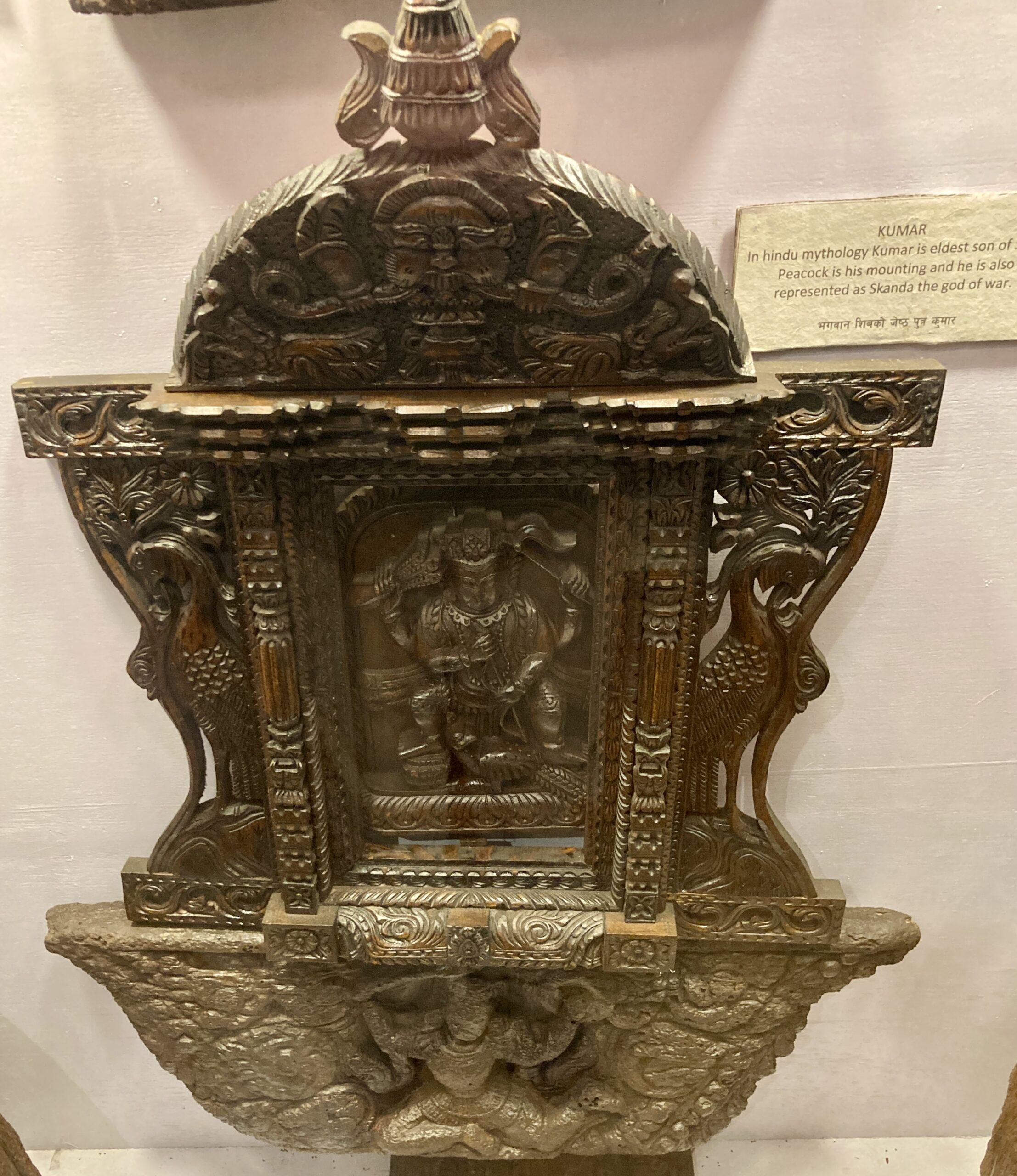
Mahadev shrineKumar wooden plaque
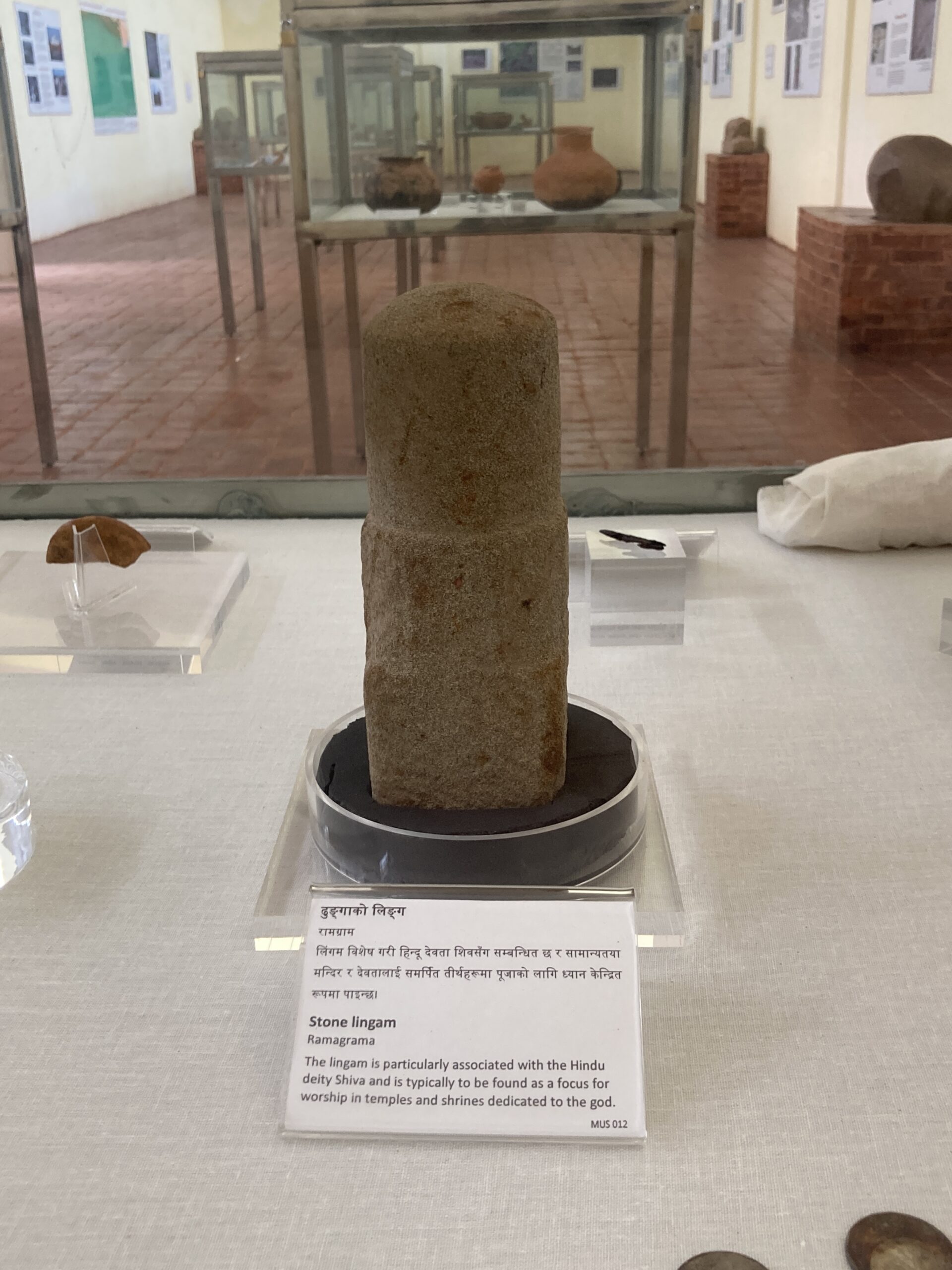
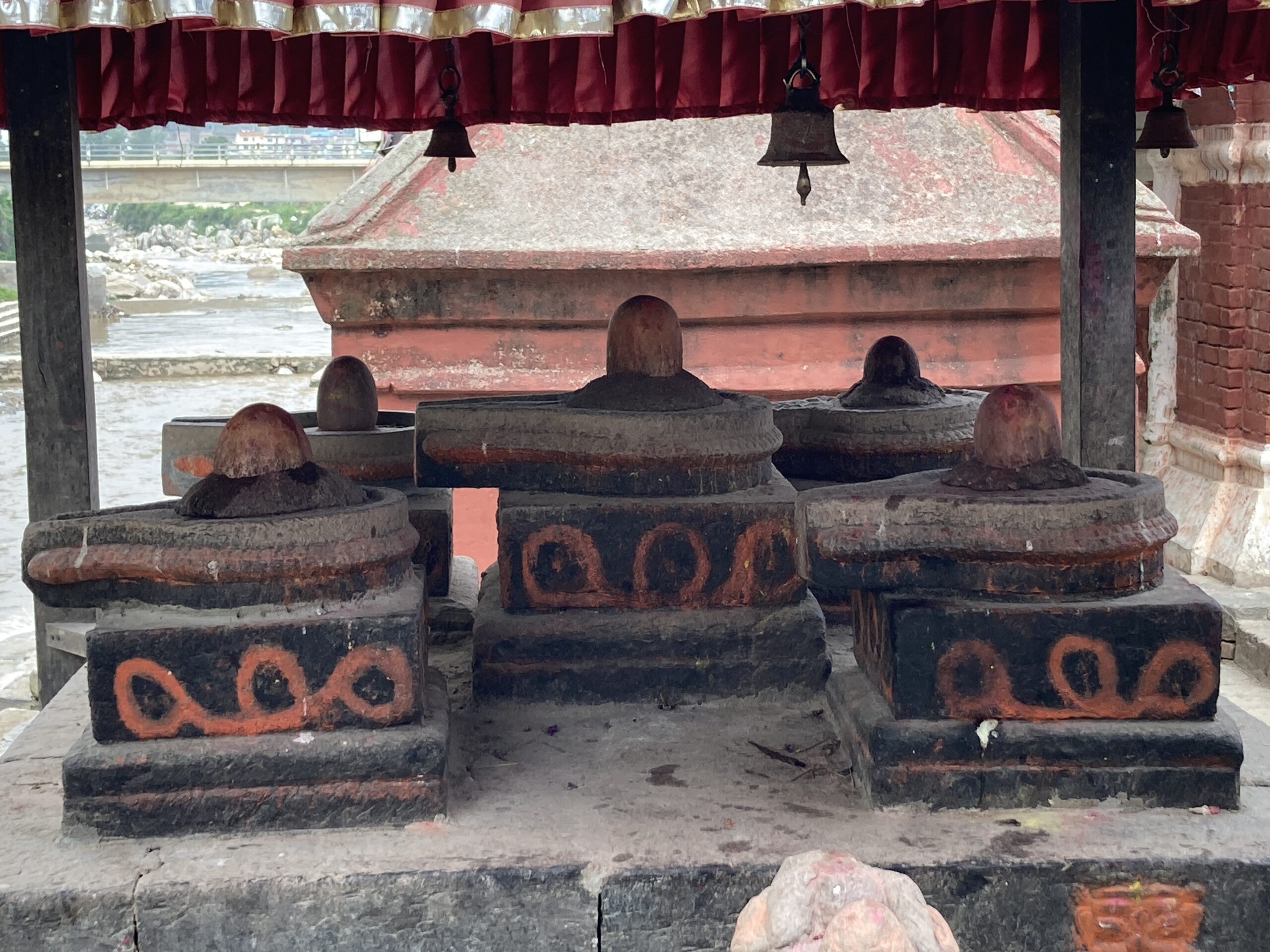
On the way back to the hotel, then, after this, we stopped for a while at a very, very old Hindu Temple at the confluence of two rivers. Panauti, in Kavre, a historical Newari town known for its ancient temples, culture, and traditions, includes this temple – the Indreshwor Mahadev Temple, one of Nepal’s oldest and largest pagoda-style temples. Mahadev is one of the names of the god I know as Shiva. There is even a museum here, where I spend some time in the cool and relative dark and quiet looking at old items from the Temple. I am also drawn to the Mahadev shrines where Shiva Linga are gathered, and the Bull and Trident make it very clear that Shiva – here known as Mahadev – is the principal god here; god of gods. I have learnt something else new too: in the Museum I discover that Shiva’s eldest son, whom I have known as Skanda (or Murugan in South India) is here known as Kumar. So Mahadev (Shiva) and his son Kumar (Skanda) are worshipped here, at the confluence of two rivers, and – as if to underline this – where the waters meet, there is a pile of logs burning, with a trail of smoke rising from it, and Orun tells me there is a body. I don’t see it. I am not phased by it. But it is my first witness of the Nepali practice of open-air cremation. I tell my guide that in Europe we cremate our dead too, often, but in furnaces, hidden away. I think of my mother, cremated only a few months ago; of my father, cremated 23 years ago now. We drive away, slowly, back up the side of the valley to wind our way over yet another hill, back towards the hotel.
As in Sri Lanka, Hinduism and Buddhism sit side by side here in Nepal. Yet there seems no contradiction. It seems to me that, as a European, I might understand it in the following way: the pantheon of Greek Gods – Zeus, Hera, Apollo, Athena, etc, and all their rivalries and strange relationships, were honoured and sacrificed to by the great philosophers of Athens. So too, the pantheon of Hindu Gods – Shiva, his wife Parvati, their sons Skanda and Ganesh – are honoured and worshipped alongside a devotion to the philosophy of the Buddha. In Japan it is Shinto instead of Hinduism, but the relationship seems similar. None of these traditions seems as jealous of the strict adherence of its devotees as Christianity.