Peru Trip #2 – The Lambayeque and the Moche Lords of Sipan

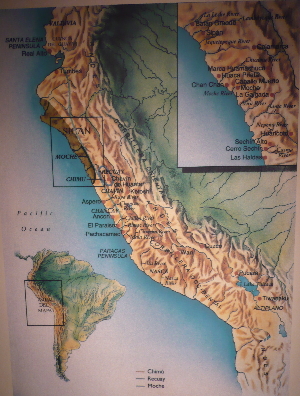
Map of Peru showing Moche civilisationWhat an epic day. Lying in bed late yesterday evening, reading myself to sleep, I noticed the bed suddenly wobbling strangely, I thought maybe it was a tremor – nothing as alarming as an earthquake – then maybe just a couple in the room next door having a rather good time. Then it was over before I could really work it out, and I forgot about it. Today, however, it was the small talk of the day amongst the Chiclayo guides and drivers who took me around to the tourist sites in my itinerary
today. It was a mini-earthquake; the first in quite some time, especially noticeable for someone, like me, on the sixth floor of my hotel. The joys of being so close to a continental plate subduction zone!

Anyway – up early to get breakfast in before meeting my guide for the
day at 8.45am, we headed straight off to the Tucume complex, a
Lambayeque (also known as Sican) site to the north of Chiclayo.
Following the Cupisnique culture 800-200BCE on the far north coast, the
Piera-based Vicus culture 1000BCE-300CE and the Moche civilisation
1-800CE over the whole of northern Peru, the Lambayeque/Sican culture
750-1375CE, contemporary with the Chimu in the southern half of northern
Peru, covered the northern half of what had been the Moche
civilisation. Facial reconstruction from royal skulls, along with
distinctive ceramic and architectural styles, set them apart from both
their Moche forebears, and their Chimu 900-1470CE neighbours, whose
culture represented more of a development from the earlier Moche. Both
were later taken over by the pan-Andean Inca’s, shortly before the
arrival of the Spanish. The only surviving written records of any
pre-Columbian cultures are of course, like Roman accounts of the Celts,
written by the Spanish conquerors, but include a monk’s retelling of the
Lambayeque origin myth, which claims that their first God-King arrived
from the sea, with a fleet. Thor Heyerdahl’s Kon-Tiki expedition proved
the practical possibility of the Lambayeque having originated from a
Polynesian invasion. Contemporary with the third stage of the
Lambayeque culture another group of Polynesians of course arrived in New
Zealand, establishing the Maori, and populating the islands for the
first time. Even if, after the manner of Francis Pryor’s anti-invasion
historical stance, this Polynesian invasion of northern Peru was little
more than a Norman-style invasion by a new ruling elite, it is still a
compelling theory. Mochica, the language of the Moche, was spoken all
over the north right up until the last Mochica speaker died 25 years
ago, and there is no record of any specific Lambayeque language.

The Tucume complex is from the third stage of the Lambayeque/Sican
culture, with its own distinctive style of ceramics. The first and
second stages, 750-900CE, and 900-1100CE, were characterised by a dark
grey ceramic style (the colour came from the smoke of the firing
process) that, at least in the second stage, was mainly focussed on
representations of their God-Kings. The second stage ended during a La
Nina – the 20-30year dry period that appears erratically in opposition
to the more common El Nino
wet periods that bring floods every half-decade or so to the Peruvian
coast. The 2nd stage Sican culture – and their 30 or more pyramids –
ended in flames, and they moved to Tucume, where a third stage Sican
culture 1100-1375CE, built another 26 new pyramids, but were no longer
led by God-Kings.
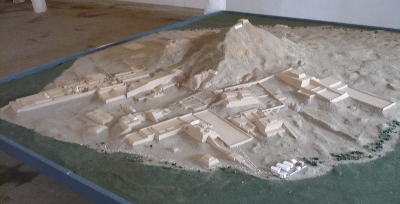
Tucume pyramids

Tucume is a vast site – a complex of 26 mud-brick pyramids –
clustered around an isolated pyramidal hill. The pre-columbian peruvian
pyramid is not like the Egyptian pyramid; in the north here,
especially. Here in the north they were made of mud-brick, and with wide
flat tops that act as platforms for royalty and priesthood to live on,
with all their various entourages. The largest of the pyramids here at
Tucume is the largest pyramid in the Americas. They have all suffered
somewhat from the last 1000 years of rain, but for mud-brick it is
remarkable how much has actually survived!
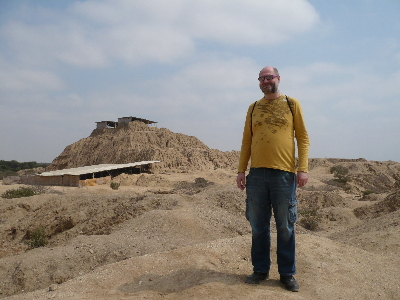
Me at the Tucume pyramids

Further south the last museum of the day showcases the remains of two of
the Lords of the Sican/Lambayeque culture – from the second stage
900-1100CE, prior to Tucume.
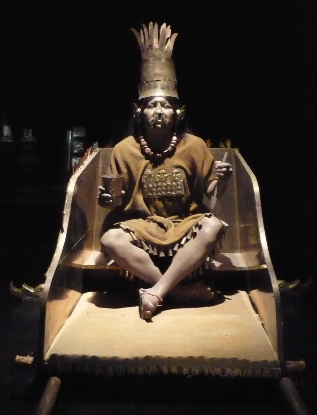
Sican Lord from Huaca Loro Lambayeque II

But by far the most amazing visit of the day has been to the Lords of
Sipan museum in the town of Lambayeque. Sipan, a pyramid site up to the
north east of the coastal area and unsupported by electricity and other
amenities, was one of the main burial tombs of the Moche kings, and the
museum here in Lambayeque houses two of them – everything from the gold
and silver clothing to their very skeletons, in a magnificent new
building built just like a pyramid. This is probably one of the finest
museums I have ever been to, and although everything was in spanish my
guide interpreted it all in excellent English for me and it was the
highlight of the day. Cameras and mobile phones are not allowed inside,
so I took no pictures. I did however buy the book, and have taken a
couple of snaps for you to get the idea…
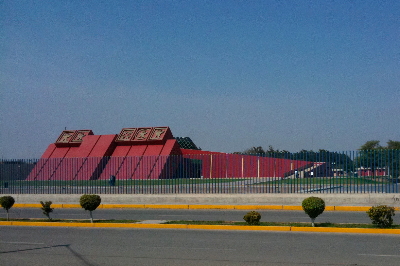
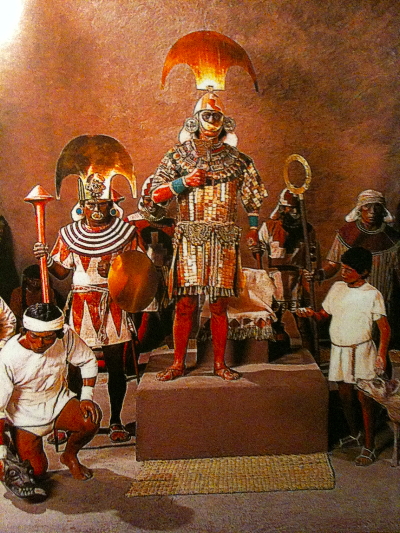
Lords of Sipan museum


Reconstruction scene at Lords of Sipan museum


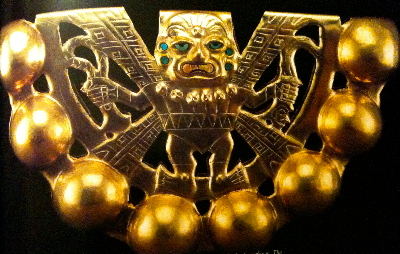
Belt bangle at Lords of Sipan museum

All in all an exhausting day – and time for the local specialty dish: duck and rice; washed down with a Chilean red methinks!

Peru Trip #1 – Arrival and Larco Museum

Chimu gold funerary ornaments Impressions of Peru so far? So many! As the KLM flight came in to land at Lima International Airport, the first impression was of a brown, low-rise, half-built town, with a glittering glass crown in the centre. My week in that centre, at an international conference, served to underline this. The ‘middle classes’ of Lima, if I can use such a term, are the wealthy, with, it seems, far, far below them, the very poor, and little if anything in between. The gap is evident in the gated business sector I have spent the last week in, like a Baghdad Green Zone, characterised by the profusion of security guards, high steel fences, the railings, broken-glass-topped walls, spikes and grilled up doors and windows that are ubiquitous here.

As a colleague of mine said to me yesterday, as we took a hotel taxi to the best private museum, we have earned the privilege of being among Lima’s wealthy, chaperoned, protected, looked after. There are poor in our countries, too, and we have worked hard to get where we are. Yet, in the UK at least, the welfare net is set so very much higher than the average level of the poor here, and prevents the worst excesses of poverty so visible in the faces of those desperate to sell us “anything” at the windows of the taxis when they stop at the lights. The driver presses the central locking switch, in a quiet, protective move, and then we are gone. The garish colours and busy-ness of the advertising hoardings and shop fronts are such a contrast to the dull brown, low-rise town seen from the air as you approach – the outskirts surely where the poor gather like (equally brown) moths to the city-centre flame, their (equally brown) faces pressed to the security gates, admiring the spectacle of transnational wealth.

And never before have I been given so many warnings about how dangerous a country is – what not to do, where not to go, what to be careful about. In Egypt the tour guides marshalled the hawkers, fair enough, but they were pleasant enough, just a little overwhelming. Here, apparently, it just isn’t safe to go out at night in many places, where ones tourist face is so clear to pick out. I don’t know if the tales are an exaggeration, but am I really that inclined to find out? What with this having been the worst year for my back in over a decade, and the orthotic strap holding me together the only reason I didn’t bring my stick, I don’t fancy my chances at running away from anything. But everyone I have met has been really pleasant, welcoming – albeit also protective. I am glad I have booked this entire trip through a travel agent, and that every step of my journey around Peru will be guided. My Spanish is non-existent, at any rate, and outside of the city-centre, so is the English of most people other than my guides.

Arriving in Chiclayo, today, after the short flight north from Lima, the impression is immediately one of being in a third world country. I am strongly reminded of southern Egypt. Although it is winter here now, and I arrive in the early evening, the warm air as I step off the plane is dry, slightly dusty, and faintly sweet. The view of the town during the descent was similar to the outskirts of Lima – half-built, (at best), and here the metalled roads are in the minority – the main thoroughfares, interspersed with broken concrete lanes near the centre, and simple flattened dirt in the outskirts. The taxi ride to the hotel reinforces this impression. I must say something about the driving here. It is terrifying. I am so glad I didn’t even consider hiring a car. Although the drivers (well, the one who spoke some English) tell me there are few accidents because of the driving style, just the usual accidents due to drink and speed, this is clearly because, as he says, all Peruvian drivers “have eight eyes and radar inside their heads”. The roads are a complete free-for-all with no rules at all. Terrifying for a well-behaved British road user.
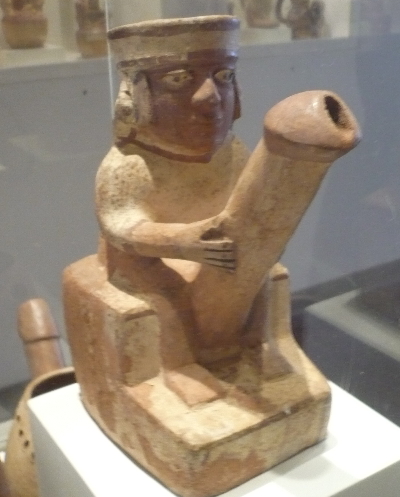
Moche Phallic Pot
Anyway. I am here principally, now that my conference is over, to see pre-Columbian Peru, and extremely fortunate to be able to do so. Like most tourists from the ‘rich’ world, I will simply have to deal with the poverty around me by getting into private cars, taking private tours, and, basically, not dealing with it, not looking at it. All I can hope is that by visiting some of the less well known sites, as I am doing this week, in the north of the country, I am bringing some desperately needed tourist dollars to the local economy, and that this is at least something, and all I can possibly be expected to do, in the face of so much need.

The Larco Herrera Museum, in Lima, is reputedly the best collection of pre-Columbian artefacts in the capital, if not the largest (The National Anthropological Museum) or the richest (the Central Bank’s Gold Museum). I have taken over 100 photos there, and confess to being completely enchanted by pre-Columbian history. The Moche, in particular, I am finding really fascinating – a culture that rose and fell through five stages from 1-800CE, and which has left some very striking artefacts, along with its own mark on the civilisations which followed it. Of particular note, (predictably) for me, is that the Moche left a great deal of erotic art and ceramics behind, of which there was a whole separate gallery at the Larco, and of which I am told there will be more at the Cassinelli Museum I am to visit during my stay up here in the north.
See flickr.com for all the photos.

California trip #6 – Redwood country

Native American exhibit

The visitor centre at Humboldts National Park includes an exhibit on the Lolangkok Sinkyone tribe who lived here before the coming of the white man. There is no history. This is pre-history, with utensils, tools, beads etc. The difference from any other exhibit of Neolithic life is that this exhibit includes photographs – 19th century ones, but photographs nonetheless – of the people themselves. As someone used to seeing such exhibits all over Europe, where there is, it must be said, much more information, much more detail, much more understanding of peoples several thousand years dead, this exhibit was quite eerie, quite odd – more like a tour of Auschwitz with all the shoes and spectacles and human hair. “Here lie the remains of a people decimated by genocide,” was the information plaque I would like to have put on this exhibit. It is sad, but there really does seem to be two Americas. The one I met in San Francisco was warm, open, friendly, liberal. The other – all too often the tourist kind we in Europe have learnt to hate – is simply ignorant, arrogant, and loud. There were several of the latter in the Visitors’ Centre, and I was glad to leave sooner rather than later.

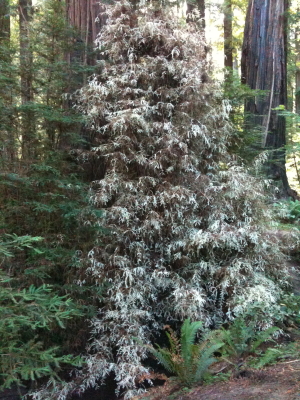
Albino outgrowth at foot of Redwood The hostess at the Myers Inn, however, told me a wonderful story of how the logging company wanted to take out a whole part of the forest, and all the womens’ clubs and institutes in the region got together to protest, and raise the cash to buy this part of the forest, and grant it to the National Park. This area is now called the Womens’ Grove, and includes the mysterious Albino Tree, which, according to my hostess, was known by the ‘Indians’ as the ‘Spirit of the Forest’. I love this other America. I can’t say I got much spiritual communication from this genetic deformity, however – it was simply a very unusual brilliant white fir tree – an natural oddity.

The Giant Tree in Humboldts National Park Further up the Avenue of the Giants there are indeed some really big trees – the Tall Tree, at 360ft apparently something like the ninth tallest living thing on Earth (the others are in Redwood National Forest, to the north, and in China, where the other remaining Redwoods live.) Walking alone in this part of the forest one really gets a sense of the ancient woods of the world – something almost pre-mammalian, let alone pre-human, ancient, almost other-worldly.
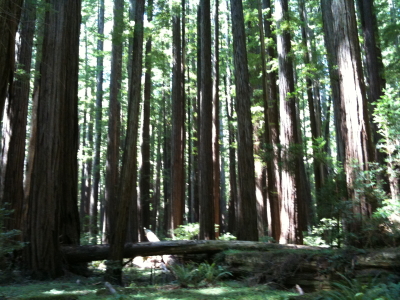
Humboldts National Forest – Bull Creek Flats trail

beach driftwood
At last, on the very border with Oregon, I came to my last stop – the oceanfront guest house, Casa Rubio, where I had a delightful room, with my own door out onto the beautiful garden, my own deckchairs from which to catch the late afternoon sun, and my own view of the rolling white chargers of the Pacific. This was a truly special place to end my holiday, walking along the beach collecting pebbles and driftwood, sunning myself in my little part of the garden above the beach, strolling down the beach later to enjoy a really excellent dinner at the Nautical Inn, with a fine bottle of Russian River Chardonnay from the Napa Valley, and enjoy the sunset from my table.

Sunset from my table at the Nautical Inn

California trip #5 – Humboldts National Park

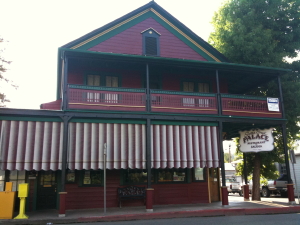
Sutter Creek saloon I stopped overnight, some two hours north of Tuoloumne Grove and the Yoesemite National Park, at the Hanford House Inn, in Sutter Creek. This was a lovely guest house – plush luxury for two-thirds the price of Wawona – about the same standard as the Marriot in San Francisco, for half the price. Sutter Creek is one of several old Gold towns on Route 49 north from Yosemite, but its tourist industry has preserved much of the charm of the old west town better than most. Well worth a visit, though I didn’t have time to go down the Gold Mine that looked curiously inviting!

Dashboard of Hire Car showing 100deg F
Driving up the Gold trail today I discovered that the heat of northern California in August really is bigger down in the valleys than it is up in the high peaks of Yosemite. Past Sacramento and on up to Clear Lake I followed the suggestion of one of the tourist magazines to stop for lunch at Lakeport. This, however, proved very disappointing – much more run down than Sutter Creek, and the only lakeside eatery I could see was part of a Motel that didn’t look very inviting for casual drop-in guests. I skipped lunch and drove on, choosing instead to take the scenic route further on Route 20 west to the coast, in order to take the old Route 1 north to the Humboldts National Park. I’m glad I did. A late picnic lunch at a little campsite in the heart of the Jackson
Demonstration National Forest proved very peaceful – indeed the whole forest was cool and peaceful, on the road west, and when I finally reached Route 1 the scenic views of the Pacific were well worth it.

Pacific beaches

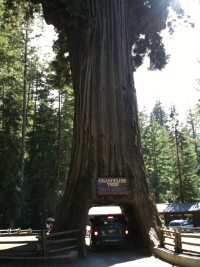
Legett drive through tree
Arriving in Redwood country in the early evening, the first tourist trap to greet one is the Legett drive through tree, which was frankly exploitative, and clearly hacked with a chainsaw – and that not so long ago. But soon after the Avenue of the Giants proper begins, and the magnificence, the majesty of these enormous trees, proves truly awe inspiring. My room at the Myers Inn in Myers Flat was comfortable, the hostess fabulously enthusiastic, informative and helpful, and after a rather stodgy meal at the only restaurant for 10miles, I spent an hour simply wandering among the trees, in the cool of the evening, thankfully all to myself. It was quiet, peaceful, like a cathedral closed to the public, cool, and yet very, very much alive, albeit in a slow,
ponderous, very slowly pulsing way. These Sequoia trees – the ones in Yosemite, these clinging to the northern Californian coast, and a third group in the wilds of China – are all that is left, according to the
fossil record, of a Redwood forest that once covered almost the entire planet.

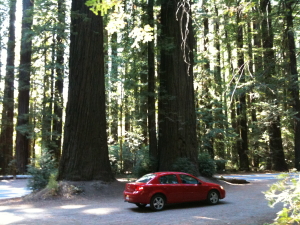
Hire car at foot of Giant Redwoods

California trip #4 – Yosemite National Park pt2

View from Glacier point
A whole day discovering more of Yosemite, after leaving Wawona in a bit of a huff – woken at 5.30am by hoovers downstairs, let alone the couple nextdoor pee-ing all night in their bathroom which was next to my room, through a door in my room that was locked. Don’t get me wrong – the Wawona is ok, for £40 a night. For £100 a night, it is a rip-off, and this rather spoilt my stay. Never mind – away promptly at 8am, I drove first up to Glacier Point. One often comes across hyperbole on tourist info boards – especially perhaps in the insular-minded USA. But I have to agree, at Glacier Point one is indeed treated to one of “the most spectacular views on earth”.


My picnic lunch spot
From there I went down to the Yosemite valley floor, got some grub from the Village Store, and drove back to Cathedral Beach, to enjoy a picnic by the river. This was as idyllic as you could ask for!

Finally, then, I headed out, and stopped off to take a look at the Sequoias in Tuolumne Grove. They were smaller than the ones in Mariposa Grove, but there were less people, and it was a better experience. And
then, in just a few moments, the entire trip to Yosemite changed. Flowers just before the corner where the cactus-tree stood On the way back up. At a corner, already a little out of breath, I was again alone.

I saw, in passing, in the corner as the path wound up the hill, was a dead tree, barely taller than me, but in the classic shape of a cactus, tall straight trunk up to the middle, then a U-bend of two curving branches reaching up to left and right, the one on the left about two-thirds the height of the one on the right. In the middle, just below the split, was a very small protruding branch, broken off, gnarled. Suddenly I realised that the little broken off branch looked like a face – the face of a wise old man of the forest, standing proud, arms upstretched. I stopped, surrounded by the silence, transfixed by the old man of the forest. My hands felt tingly, heavy and electric, and the forest around me almost crackled with life in the silence of the wood, as my feet felt suddenly rooted deep, deep into the forest floor. I lifted my right hand to my solar plexus and breathed a deep sigh of contentment, a huge smile spread across my face. It felt as if for a moment I had touched the Mind that had made this amazing land, long before the arrival of Man. Butterfly at Yosemite
I spoke aloud, thanking this Great Spirit for this moment when it seemed he had revealed himself to me. A cricket chirruped loudly in response, and a large butterfly appeared, circled around me, and disappeared off into the wood. There was a rustle and all of a sudden one of those little striped squirrels came running out of the forest straight toward me, skirting around me just in time to dash across the trail and disappear into the forest above. It was sheer magic. You couldn’t ask for better. I breathed another huge sigh of contentment,
and began to tread the trail again, up the hill, as the voices of excited Dutch children ahead began to bring the 21st century back into focus.

California trip #3 – Yosemite National Park pt1

Squirrel at Yosemite National park
For just a short, brief moment – maybe two or three minutes – today, I tasted solitude in the ancient wilderness. I was alone, for a few minutes, on the trail, and stopped. All I could hear was the rustle of the pine needles, and the scuffling of a tiny squirrel nearby. Its mate stood upright, watching me intently. A black-headed green bird pecked at the ground. And the giant sequoias around me rose up, up, up into the sky, majestic, silent, brittle, in the dry, dry heat. It was a sweet moment, and I will cherish it.


The rest of the day was filled with people, cars, the busy to-ing and fro-ing of Californian life and of the immense tourist machine that is Yosemite National Park. The drive was reasonably easy – initial nerves some nine months since I last drove on the right-hand side of the road, in Portugal last November, were quickly overcome, and the automatic hire car was very easy to drive, and I was, of course in no hurry, happy to keep within the low speed limits of North America. Wamona Hotel, in South Yosemite, is a lovely old place, and a welcome respite from the heat, though I have to say my bathroom-less, window-less room is grossly
overpriced at $150 per night, though I’m not sure I wish I’d spent the $220 on a room with a bathroom and window. After four nights at $225 per night in the luxury of the San Francisco Marriott, it’s perhaps no bad thing to be spending a little less.
Wawona Hotel

Mariposa Grove, and the Grizzly Giant, the Bachelor and the Three Graces – the largest of the trees here in the South of the Park, were all sights worth seeing, despite the crowds around them, made all the more worthwhile by my moment’s solitude with smaller trees and the wildlife, on the way up the hill. Sitting on the veranda of the old wooden hotel building, in the cool of the evening, full with good homely fare from the hotel restaurant, I am content with a day well spent, experiencing the natural wonders of California, a landscape filled with beauty, if not with much in the way of human history – certainly none that the tourist machine tells of, beyond the early 19th century.
The Three Graces

California trip #2 – Warming my Heart in San Francisco

Avalokitesvara
Well, I have fallen in love with San Francisco. It only took 24hours. Conference done and dusted – and a successful one, too, with two good connections and good feedback for my presentation – on Saturday evening I at last was able to ‘kick back’ and begin to relax. The evening began with the conference reception at the Asian Art Museum, where we were treated to lovely Californian wine and an enormous spread of sushi, which I tucked into with gusto. The Samurai exhibit was small but very interesting. However by far the most impressive of all the exhibits was a 12th century wooden statue of the Boddhisatva Avalokitesvara, (male aspect of the female Boddhisatva, Tara) which still carried with it the power and presence of a deity, and made quite an impression on me. It was quite humbling and quite an honour to stand before it.

Models in a Castro denim shop
The evening then continued with a visit to San Francisco’s gay district, on Castro. I have to say that I found this much more appealing than Manchester’s Canal Street gay district, which has very much lost its shine since the 1990s. As well as a number of bars and clubs, Castro includes restaurants, and a whole range of different shops, catering to the gay community. The Twin Peaks bar, moreover, caters to everyone. Quite in contrast to Manchester’s Canal Street, this bar was full over men over 30 – some indeed quite elderly – as well as younger men, and women of a similar range of ages. This was SO refreshing, and I immediately liked the bar, its atmosphere, and fell to talking with people at the bar, and had a thoroughly good night! People in this town are so friendly!

Golden Gate Bridge
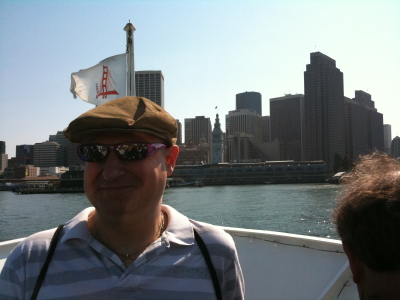
The following morning, I got a lift with one of the new friends I had made in the Twin Peaks bar – a retired Judge – in his Lexus, around the town and over the Golden Gate Bridge and down into Sausalito, where he dropped me off before heading off further north. Sausalito is a lovely little place, and I had a delicious Clam Chowder at one of the pier restaurants, and wandered up and down the sea front until finally getting the ferry back across the bay to the Ferry Building at San Francisco. There was a couple on the boat, too, who took my photo for
me.
Me on the Ferry

Back in the City, I of course then had to take a ride on the Cable Car, before finally returning to the hotel, tired but beaming after a truly delightful twenty four hours in friendly, welcoming San Francisco!

San Francisco Cable Car

California trip #1 – Stopover in Calgary

Westways Bed and Breakfast
Calgary. An unexpected stopover. Hadn’t noticed in my itinerary that I’d be stopping overnight in Calgary on the way to San Francisco. Didn’t realise til the Air Canada desk at Heathrow spelt it out for me. Heathrow was a nightmare. I followed the signs for ‘Flight Connections’, after disembarking from my comfy BMI flight down from Manchester, only to find, when I finally asked someone where I was, that ‘they should have taken those signs down’, and that I was now a long way from where I ought to be, and landside. The woman at the Air Canada desk was very understanding and helpful. I went through security again, and sat at the gate tapping away at my iPhone, found a gay B&B in Calgary, and booked a room, before boarding my transatlantic flight. (Well I wasn’t going to stay in some faceless Holiday Inn, after all!) We landed 20mins early, but the luggage took 90mins to get to the conveyor belt, so it was 9pm before I was being shown my very comfy room in the very welcoming and friendly Westways B&B. A very retro, 1910 building with everything Victorian they could lay their hands on, Westways was old (in Canadian terms) and lovely. The sky-scrapers of central Calgary rose around it, overshadowing it, in quite an eerie way. Canada’s 3rd city is split into four districts with a grid of streets and avenues, and has a No. 216, 25th Avenue, in the NW, the NE, the SE, and – where Westways is – the SW. Probably the most interesting thing about Calgary, that I could gleen, in my very brief, unexpected stopover. Montreal was SO much more interesting! I hear tell that Vancouver is too. I should visit.

Why the critique? Well, I suppose when it boils down to it, as an Englishman, I am so in love with the rich and ancient human history that piles up layer after layer in the landscape of the British Isles, that the great expanses of North America, where the remnants of human history are sparse and hard to find (save for the recent thin crust of 20th century habitation) lack much appeal for me – on that score, at least. The natural history, on the other hand – the main focus of my holiday, once the work is done – is breathtaking, and I eagerly await it!

Trip Downunder Sept 07 – Entry 15: Uluru

Uluru
So, at last, I have been to Uluru. To the Uluru Kata-Tjuta National Park, to be precise. It was a 24 hour stopover – the flights from and back to Sydney essentially free, included in the globe-trotter ticket I bought for this trip downunder. I arrived at about 1pm at the Voyages Resort, where there are hotels for all budgets, (and the cheapest is dear for a backpacker) all run by the one company that got the government concession here. The first thing you notice as you get off the plane is the heat. It is 36deg here. The Park is some 40km from
Uluru, outside the National Park, adjacent to the new airport. My room is basic, but I shall only be putting my head down in it so I am content.

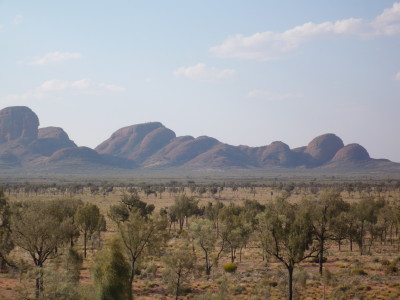
Kata-Tjuta

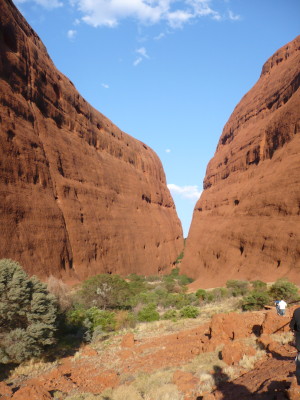
Kata-Tjuta gorge
At 4pm, I depart on my first tour – the Kata-Tjuta Dunes Sunset tour. Cherry, guide to the 20 tourists and driver of our mini-van on this Discovery Ecotours trip, is fresh, cheerful, and informative. We visit the large rock formations collectively known by the European name of The Olgas, their aboriginal name, Kata-Tjuta. The local peoples – a cluster of three dialect groupings, are known as the Anangu (pr. ‘ananoo’) but the stories of these lands include peoples from all over Australia. The Anangu have been living here for 22000 years, the deep red centre of this island continent – one of the last areas to be populated. We Europeans first sighted it in the 1870s. Tourism began in the 1950s, which was when the National Park was created – a slice taken out of the Aboriginal Reservation that covers the wider area. In 1985 the Land Rights Act returned ownership of the National Park to the Anangu, on condition that they lease it back to the Australian government for 99years. It was at this point that the resort and airport were relocated out of the Park, and the indigineous people began to have at least something of a say in the running of the land they had occupied for so long. None of them live a nomadic life anymore. They wear western clothes, live in houses, and are prey to the demon drink.
But their culture lives on through their ceremonies, rituals, social structure, language, mores. They have managed to restrict access to much of the park – with the voice of the conservationists on their side keen to preserve this unique environment. Everyone has to pay $25 at the entrance to the park, for a three day ticket. 25% of this goes to the local people. About $6. I spent about $400 here in 24 hours, on hotel room, food, wine, t-shirt, hat…. ..and $6 of it went to the indigenous people.

Kata-Tjuta sign
Kata-Tjuta is the ancient sacred site of the Men’s Mysteries for the aboriginal people, where their young men are initiated to this day, and it is to a carefully fenced-off area with clear walkways and viewing platforms that we are taken, into a gorge that is no longer used by the indigenous people, and their gorges are off limits. Here the trees from which the men make their spears and spear throwers grow, drinking up the rich water source at the foot of the rocks. Only yards away from the rock formations, the desert takes over again, with coarse grass the only greenery that breaks the surface. Somehow, on this tour, with the multi-national cohort and our Australian tour-guide, on the carefully managed paths, it is landscape that we have come to see, and the mystery of this place is carefully hidden from us. Cherry cannot know anything about the mysteries, for she is female, and there are female tourists with us. She explains that amongst local people, only men are allowed to come to Kata-Tjuta. It feels somehow as though sacrilege has been committed. Walking back out of the gorge, back onto the bus, we are taken to a viewing platform on the top of a sand dune, from which to watch the rocks gradually change colour as the sun sets behind us. Cherry gets out bread, oil and balsamic, and a seed mix which includes a local tree bark, and pours sparkling wine into champagne flutes for everyone, except the children who get orange juice. I, of course, tickled by the sheer decadence of this experience, have to mix the too, and soon several of us are quaffing bucks fizz, in the desert, watching the sunset over Kata-Tjuta. It is somehow fittingly colonial, distant and distinct from the true and ancient meaning of the place.

Bucks Fizz at Kata-Tjuta

Quite merry by the time we get back to the resort, after buying a better (kangaroo leather) sunhat and a flynet to keep off the extremely irritating desert flies, I bought a plate of raw kangaroo meet and barramundi fish and barbecued it myself on the backpacker-communal barbecues, washing it down with strong aussie wine. Then an early night, and up at 4.30am for the Uluru sunrise tour.

Sunrise over Uluru

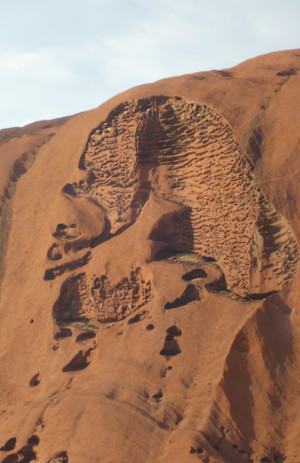
Uluru Mala Face
There’s only five of us this morning, and our tour-guide, Jessie, is more experienced and more knowledgeable than Cherry was. Jessie takes us to the viewing area for sunrise, and we watch the colours change, drinking coffee and eating a light breakfast of cereal bars and muffins. Then he drives us around the base of the Uluru, telling us some of the tales of the aboriginal culture that tie aspects of this great rock into the history and mythology of both the local and many more distant peoples. It is quite fascinating. But the tension between landlord and leaseholder is so evident. All the literature from the Voyages Resort, and all the various tour-guide companies that operate here, include the statement from the Anangu that they would rather people did not climb the rock. Yet of course the climb is available and allowed and tour-guides take you up, and we watch the long line of tourists climbing the precarious path – with a steel rope to guide you – up onto the top of the rock. As Jessie explains to us, in the ancient tale of the Mala ancestors, it was a great wise elder who climbed the rock here, to plant the totem-pole announcing the beginning of the men’s mysteries ceremonies. The totem pole is echoed in one of the rock formations. The tourists tread this processional way, as if clambering up onto the High Altar in the Vatican, oblivious to all insult. I saw the request from the Anangu, and did not climb. I did not buy the postcard that said “I respected the wishes of the Anangu and did not climb,” but was amused to see it in the rack.
Uluru snake lair
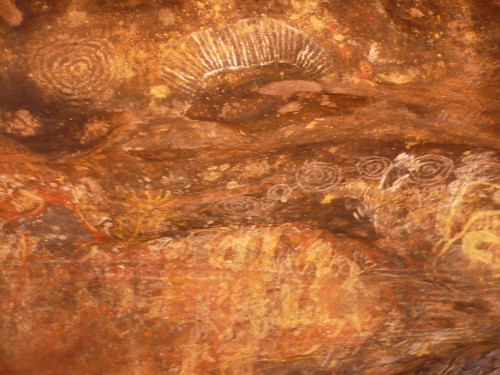
As we drive around the base Jessie tells us a fabulous story about a snake ancestor and her eggs, and the shapes on the sides of the rock that pick out moments of the tale. It is quite fascinating to the see the mythology mapped onto the geology in this way. We leave the bus at a car park and Jessie takes us to see one of the rock-paintings – barely more than a classroom blackboard, really, with a jumble of signs and symbols used to aid in passing on the oral tradition.

Uluru rock paintings

We go right up close to the rock and see into one of the pools of water that collect at its base – surrounded by lush vegetation, small lizards, and more tourists. Then its off to the Cultural Centre – the exhibition space of the National Park, where everything has been prepared by/on behalf of the the Anangnu, and there are shops selling local crafts and artworks. I buy a hand-crafted snake, to remember the story. There are aboriginal women, sitting cross legged on the floor in one of the shops, painting. They chat amongst themselves, in a world completely their own, oblivious to the tourists standing watching them, somehow in another time and place from us altogether. Even now, in their presence, in this shop, I feel that their mystery is hidden from us. It is carefully managed, and very effective. The storyboards in the exhibition tell a little, and then fall silent. Here and there it is mentioned that the true ending of a story is reserved for initiates only. Perhaps, in the end, it is a mark of the victory of the aboriginal people here, that outsiders do not know, cannot understand their ways, their mysteries. They have kept the strength of their magic by keeping silent. It is good.

Having completed the circumference we pull in for a last stop at a viewing platform for a good view of the rock, and Jessie and I take each others’ pictures.

Jessie - Uluru guide

Uluru

Then it’s back to the resort, for an hour wandering around the visitors centre, where I learn more about the geology and the natural history of the place, and at last back to the airport and back to Sydney.

I am glad to have been there at last, to have at least touched the surface of the mysteries of an ancient people, to have gained, at least, a knowledge of the power of its silence.

Trip Downunder Sept 07 – Entry 14: Sydney

Me at the Opera House Back to Sydney! Delightful dinner with fellow Kaotician (and its original founder) Phil Morle and his wife at their lovely home overlooking the bush in Hornsby, followed by a day out in the City seeing the sights, drinking tea outside the Opera House – and several beers in Sydney’s gay village, Surrey Hills. A lovely day indeed. And then back to Sean’s for the weekend – to make him a new website!