Peru Trip #5 – Underwhelmed by the Nazca Lines

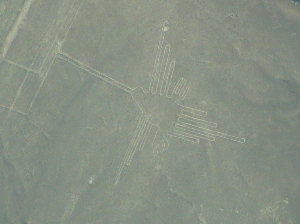
One of the shapes of the Nazca linesWell here’s a turn-up for the books. For the first time in my life, I have
suffered from air-sickness. I got up at 5.30am, grabbed some breakfast, got picked up at 6.15am and taken to the bus station for a 4hr 30m bus journey – again in one of the comfy airline style coaches – arriving in Ica at 11.30am, to find my Nazca trip delayed til 3pm. I could have got a later bus. Not particularly pleased, but acquiescent, I wandered about the gardens of the Las Dunas hotel, a sort of oasis in the desert here, where a big conference was taking place, and then ate a very light salad lunch in the restaurant. Finally taken to the airfield, I and four other passengers and the two pilots took off in the little Cessna at 3pm, for a 30min journey across the desert to the plain where the lines are carved into the ground, 30mins flying over them, and then the 30min return journey. The updrafts from the mountainous surroundings made conditions quite choppy on the journey out there, but nothing worse than my similar Cessna journey from Milford Sound to Queenstown in 2007. But once we got to the lines, the pilot very enthusiastically ensured both sides of the plane got a very good view of each and every one of the twelve big patterns amongst the lines, by turning steeply and sharply in both directions. By the fourth shape I was feeling very hot, sweaty, and uncomfortable, and spent the next 10mins vomiting my lunch into the plastic bag provided. Only by the last little group of shapes had I recovered sufficiently to doggedly point my camera at the ground. I closed my eyes and left my body for the trip home, feeling, as I told anyone who asked, “awful.”

So now I know: I can – and will – get air-sick, in a little Cessna doing wild manouvres. And now I am stuck in a small villa hotel in the middle of nowhere for the evening, where after a long nap recovering I am at last going to have a small dinner, and then a long sleep and lie-in, to get the bus back to Lima tomorrow lunchtime. All in all, I have to say, considering the huge discomfort incurred on the overflight itself, and the 9hrs of bus travel to get here and back, I am distinctly underwhelmed by my trip to the Nazca lines. What photos I did manage to take are not as good as the ones you see in books. One wouldn’t expect
them to be. So why be here to take them for oneself? For the experience? You can keep it.

Update 3/10/10 : “Britons killed in Peru aircrash”
==============================
So – for anyone in any doubt that this pilot was displaying typical macho bravado and not only making people feel sick but playing fast and loose with common-sense safety – here is the tragic truth. I count myself very lucky, indeed, and hope that Health & Safety crawl all over that little operation. I feel very sorry indeed for the families of those bereaved – I think it was an accident waiting to happen.

Peru Trip #4 – El Brujo, Huaca de La Luna, Chan Chan

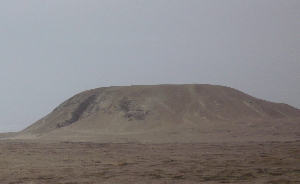
Huaca Prieta - 2500BCE Pyramid
Another long day with another punishing schedule, but SO worth it. Picked up from the hotel at 7am for a 90min journey to El Brujo, to visit the very celebrated Senora de Cao – the only Moche Queen discovered so far, clearly as powerful as the Lords of Sipan in her day (c250CE) with her own pyramid with all the usual Moche accompaniments.
But El Brujo is more than just her pyramid – here, too, is Huaca Prieta, the as yet unexcavated 2500BCE pyramid of the pre-ceramic originators of the El Brujo complex, followed later by the Cupisnique, and later still by the Moche, and the Chimu, and even a Dominican Church built by the Spanish. To this day, the local ‘brujo’s, (shamen) still practice their folk magic at the Moche Huaca El Brujo (named after them) facing the Huaca de Cao, the only part of the site so far excavated, opened to the public with an impressive museum, in April 2010.

There’s been 5000 years continuous sacred occupation of this same site,
overlooking the crashing waves of the pacific. A truly stunning site,
with my first sight of how the Moche ceramic style appears in
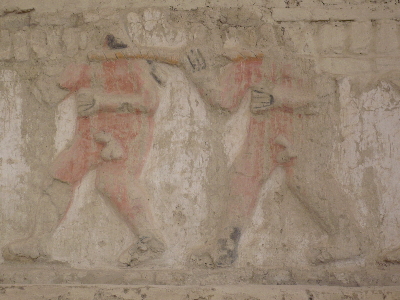
high-relief on the walls of their temples! In this warrior culture,
where soldiers paired off for ritual battle, the loser was stripped
naked, chained, and led to the top of the pyramid to be beheaded, where
his blood would sanctify the martial rite, and be presented in the
ceremonial cup to the Lord (or in this case Lady) to be drunk in
celebration of the life-death cycle epitomised in their primary deity,
Ai-Apaec: the beheading lord of death and creation.

Senora de Cao prisoners

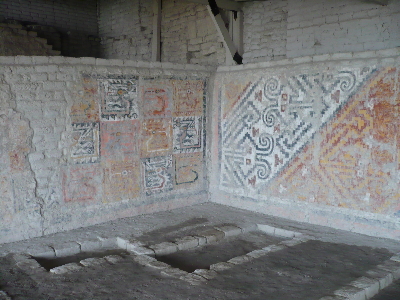
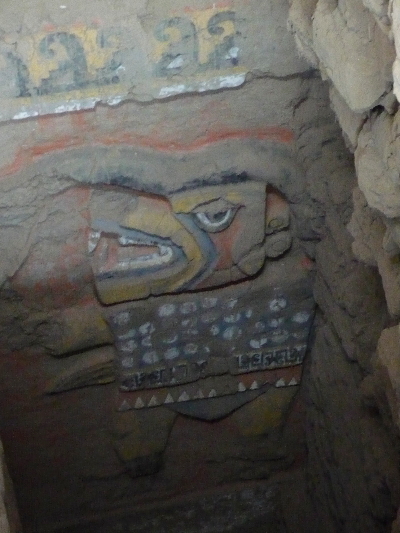
Wall paintings at Huaca de Cao

But I was yet in for a real treat. For our next stop was Huaca de La
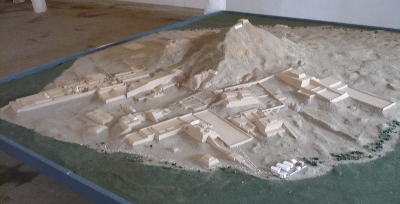
Luna. Two huge pyramids with a small town in between them, one slightly
larger than the other, named by the Spanish as the Temple of the Sun,
and then looted and destroyed, the other, smaller, named Temple of the
Moon, left alone for the archaeologists to discover, as late as 1990,
that there are five temples here, one built literally on top of the
other, like the top halves of Russian dolls. It seems after about a
century a particular ruling elite would simply completely renew, burying
the previous set wholesale by building directly on top of their temple –
a new temple for the new ruling elite, but all in essentially the same
cultural style – five times over, here at Huaca de La Luna. What has
been revealed is just simply stunning! Here is taster – check out Flickr for the MANY photos I took of this site.

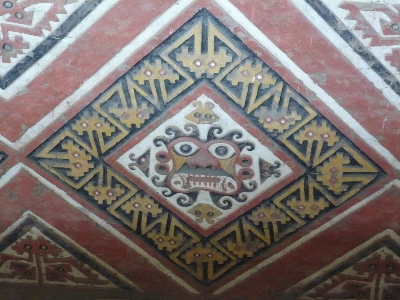
Ai-Apaec

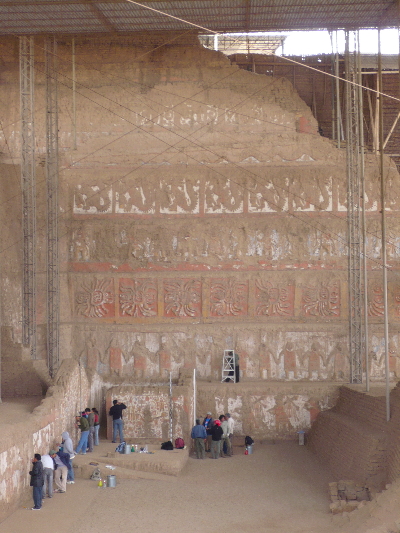
The wall of the fifth temple with the sacred corner sanctuary

Glimpse of the fourth temple behind the walls of the 5th

This entire complex was just truly stunning and left me quite
gob-smacked. My guide told me, as we stood a little away from three
suited gentlemen in heated discussion, that they were the principal
archaeologists who had discovered and were managing the excavation of
the site, debating the need for and likelihood of getting substantial
new funding to continue the work. This is already a World Memorial Fund
site, but needs more help from the EU, the US, etc etc.

Last of the day, then, after a delightful seafood lunch overlooking the
waves crashing onto the pacific shore at Huanchaco Beach, nearby, was
the rather disappointing mud walls of the Chan Chan archaeological site.
This vast Chimu city, 14km square, was simply abandoned and looted
when the Spanish arrived, and not covered up like the Moche pyramids
that preceded it. No paint survives, therefore, and the reliefs are
barely distinguishable. What is on show is reconstructed, and
unremittingly brown. Alone, on a day without the glories of the Moche,
it might have been impressive, if only for its size and extent.

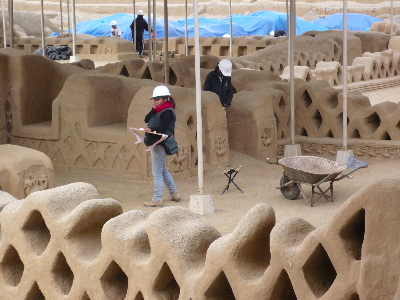
A view at Chan Chan

And then the flight from Trujillo back to Lima, a late dinner at the
Haiti Cafe near my hotel, and a very very welcome bed, after writing
this.

Peru Trip #3 – Trujillo and the Cassinelli Museum

Trujillo outskirtsCon-Air : Cameron Poe the honour-bound dominant dysfunctional male, somehow apposite here in Peru with its macho culture and all the crime and violence I have been warned about, where armed security men check bus passengers for weapons and video everyone’s face once all aboard, seated in our airline seats in this double-decker coach, watching the dubbed movie. I am grateful for the comfy seat on this 3hr drive, but listen to Anthony and the Johnsons, Rufus Wainwright, and Aqualung on shuffle on my iPhone – a much softer, more varied, more interesting selection of masculinities than those on Con-Air.

Seeing a bit more of northern Peru, from the bus, I take a few random
photos to try to capture the state of (un)development here. One thing I
will say, however, despite all the warnings, all the security, etc etc –
everyone I have met here in northern Peru has been very friendly, very
helpful, very warm. I know I’m in a bubble, chaperoned everywhere I go,
but I haven’t sensed any threat at all.

And so Trujillo! It’s a Spanish imperial town, in the centre at least,
and I am taken quickly around some of the grand houses they left behind,
and the ones built shortly after the start of the republic in the early
19th century. It is strange to see so much European architecture and
furnishings here. But what I am really looking forward to today, and
which we quickly move on to, is the Cassinelli Museum. Signor
Cassinelli, about 85yrs old now, is in the reception room, with his
young wife, when I get there, and personally greets me. He has been
buying ceramics from the haqueros (the grave robbers) for decades, and
is well known and liked for saving these ceramics for Peru, rather than
letting them go abroad where they could never be seen. The basement
where a third of the collection is on view, is under a petrol station,
and it is dearly hoped that this private collection will one day get a
better building! His son is downstairs, guarding their treasure, as my
guide and I look around. I took a LOT of photographs – all on Flickr
– but here are one or two to get a flavour. This is without doubt a
bigger and better collection than that at Larco Herrera, for all that it
is in such a tiny room in comparison.

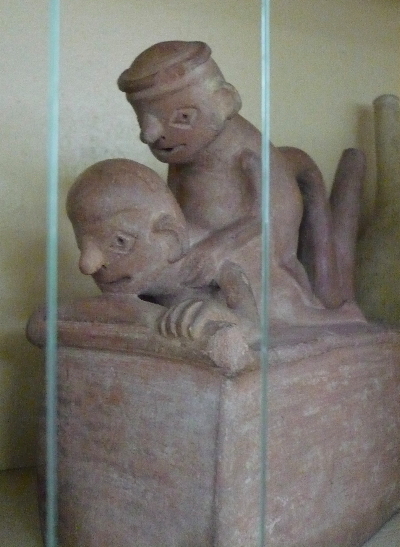
A gay couple ceramic in the Erotic Moche ceramics cupboard

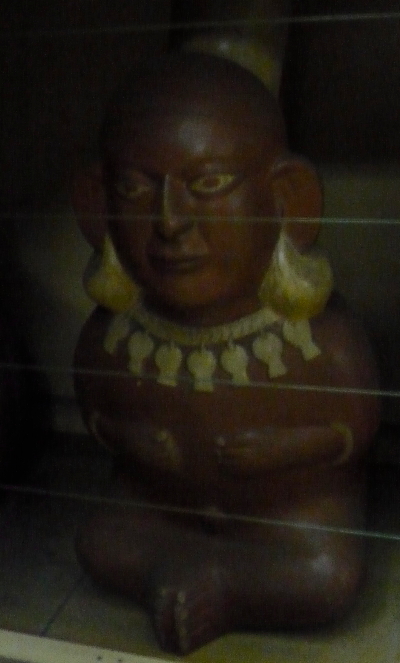
A shaven Moche priest?

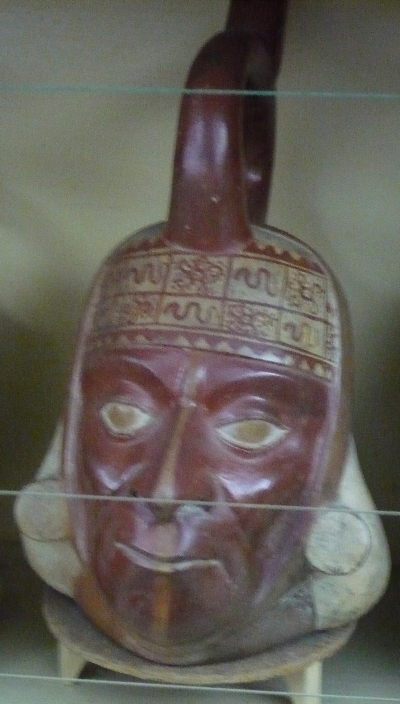
One of many Moche portrait ceramics

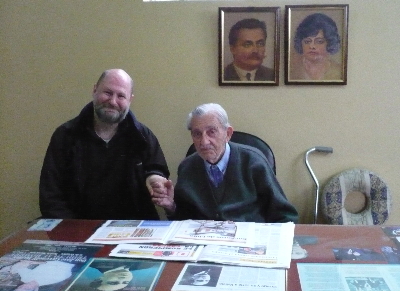
At the end of my visit, I am honoured to have further (interpreted)
conversation with Signor Cassinelli, and even a picture with him. My
guide has made it clear to him how very much I was looking forward to
seeing his collection, and how with how much delight I have enjoyed it.
He, in return, is honoured to have me visit him, all the way from
England.

Me with Signor Cassinelli

Peru Trip #2 – The Lambayeque and the Moche Lords of Sipan

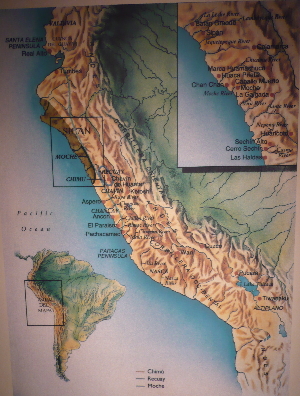
Map of Peru showing Moche civilisationWhat an epic day. Lying in bed late yesterday evening, reading myself to sleep, I noticed the bed suddenly wobbling strangely, I thought maybe it was a tremor – nothing as alarming as an earthquake – then maybe just a couple in the room next door having a rather good time. Then it was over before I could really work it out, and I forgot about it. Today, however, it was the small talk of the day amongst the Chiclayo guides and drivers who took me around to the tourist sites in my itinerary
today. It was a mini-earthquake; the first in quite some time, especially noticeable for someone, like me, on the sixth floor of my hotel. The joys of being so close to a continental plate subduction zone!

Anyway – up early to get breakfast in before meeting my guide for the
day at 8.45am, we headed straight off to the Tucume complex, a
Lambayeque (also known as Sican) site to the north of Chiclayo.
Following the Cupisnique culture 800-200BCE on the far north coast, the
Piera-based Vicus culture 1000BCE-300CE and the Moche civilisation
1-800CE over the whole of northern Peru, the Lambayeque/Sican culture
750-1375CE, contemporary with the Chimu in the southern half of northern
Peru, covered the northern half of what had been the Moche
civilisation. Facial reconstruction from royal skulls, along with
distinctive ceramic and architectural styles, set them apart from both
their Moche forebears, and their Chimu 900-1470CE neighbours, whose
culture represented more of a development from the earlier Moche. Both
were later taken over by the pan-Andean Inca’s, shortly before the
arrival of the Spanish. The only surviving written records of any
pre-Columbian cultures are of course, like Roman accounts of the Celts,
written by the Spanish conquerors, but include a monk’s retelling of the
Lambayeque origin myth, which claims that their first God-King arrived
from the sea, with a fleet. Thor Heyerdahl’s Kon-Tiki expedition proved
the practical possibility of the Lambayeque having originated from a
Polynesian invasion. Contemporary with the third stage of the
Lambayeque culture another group of Polynesians of course arrived in New
Zealand, establishing the Maori, and populating the islands for the
first time. Even if, after the manner of Francis Pryor’s anti-invasion
historical stance, this Polynesian invasion of northern Peru was little
more than a Norman-style invasion by a new ruling elite, it is still a
compelling theory. Mochica, the language of the Moche, was spoken all
over the north right up until the last Mochica speaker died 25 years
ago, and there is no record of any specific Lambayeque language.

The Tucume complex is from the third stage of the Lambayeque/Sican
culture, with its own distinctive style of ceramics. The first and
second stages, 750-900CE, and 900-1100CE, were characterised by a dark
grey ceramic style (the colour came from the smoke of the firing
process) that, at least in the second stage, was mainly focussed on
representations of their God-Kings. The second stage ended during a La
Nina – the 20-30year dry period that appears erratically in opposition
to the more common El Nino
wet periods that bring floods every half-decade or so to the Peruvian
coast. The 2nd stage Sican culture – and their 30 or more pyramids –
ended in flames, and they moved to Tucume, where a third stage Sican
culture 1100-1375CE, built another 26 new pyramids, but were no longer
led by God-Kings.

Tucume pyramids

Tucume is a vast site – a complex of 26 mud-brick pyramids –
clustered around an isolated pyramidal hill. The pre-columbian peruvian
pyramid is not like the Egyptian pyramid; in the north here,
especially. Here in the north they were made of mud-brick, and with wide
flat tops that act as platforms for royalty and priesthood to live on,
with all their various entourages. The largest of the pyramids here at
Tucume is the largest pyramid in the Americas. They have all suffered
somewhat from the last 1000 years of rain, but for mud-brick it is
remarkable how much has actually survived!

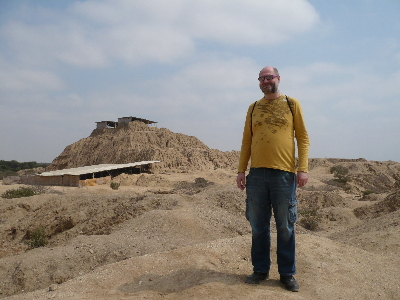
Me at the Tucume pyramids

Further south the last museum of the day showcases the remains of two of
the Lords of the Sican/Lambayeque culture – from the second stage
900-1100CE, prior to Tucume.

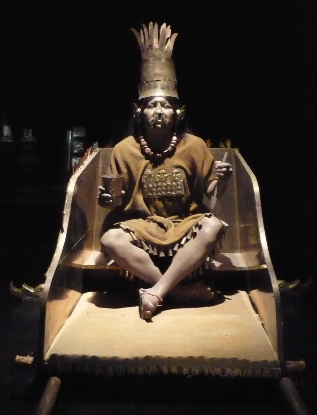
Sican Lord from Huaca Loro Lambayeque II

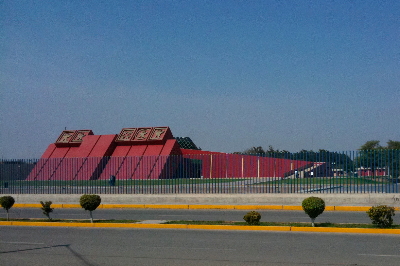
But by far the most amazing visit of the day has been to the Lords of
Sipan museum in the town of Lambayeque. Sipan, a pyramid site up to the
north east of the coastal area and unsupported by electricity and other
amenities, was one of the main burial tombs of the Moche kings, and the
museum here in Lambayeque houses two of them – everything from the gold
and silver clothing to their very skeletons, in a magnificent new
building built just like a pyramid. This is probably one of the finest
museums I have ever been to, and although everything was in spanish my
guide interpreted it all in excellent English for me and it was the
highlight of the day. Cameras and mobile phones are not allowed inside,
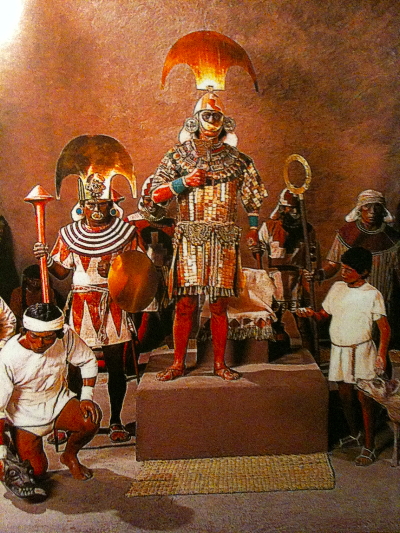
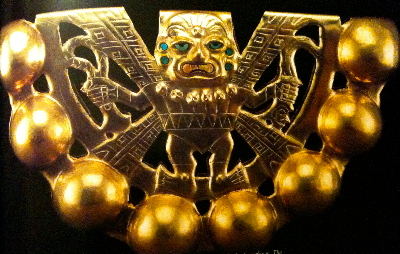
so I took no pictures. I did however buy the book, and have taken a
couple of snaps for you to get the idea…

Lords of Sipan museum


Reconstruction scene at Lords of Sipan museum


Belt bangle at Lords of Sipan museum

All in all an exhausting day – and time for the local specialty dish: duck and rice; washed down with a Chilean red methinks!

Peru Trip #1 – Arrival and Larco Museum

Chimu gold funerary ornaments Impressions of Peru so far? So many! As the KLM flight came in to land at Lima International Airport, the first impression was of a brown, low-rise, half-built town, with a glittering glass crown in the centre. My week in that centre, at an international conference, served to underline this. The ‘middle classes’ of Lima, if I can use such a term, are the wealthy, with, it seems, far, far below them, the very poor, and little if anything in between. The gap is evident in the gated business sector I have spent the last week in, like a Baghdad Green Zone, characterised by the profusion of security guards, high steel fences, the railings, broken-glass-topped walls, spikes and grilled up doors and windows that are ubiquitous here.

As a colleague of mine said to me yesterday, as we took a hotel taxi to the best private museum, we have earned the privilege of being among Lima’s wealthy, chaperoned, protected, looked after. There are poor in our countries, too, and we have worked hard to get where we are. Yet, in the UK at least, the welfare net is set so very much higher than the average level of the poor here, and prevents the worst excesses of poverty so visible in the faces of those desperate to sell us “anything” at the windows of the taxis when they stop at the lights. The driver presses the central locking switch, in a quiet, protective move, and then we are gone. The garish colours and busy-ness of the advertising hoardings and shop fronts are such a contrast to the dull brown, low-rise town seen from the air as you approach – the outskirts surely where the poor gather like (equally brown) moths to the city-centre flame, their (equally brown) faces pressed to the security gates, admiring the spectacle of transnational wealth.

And never before have I been given so many warnings about how dangerous a country is – what not to do, where not to go, what to be careful about. In Egypt the tour guides marshalled the hawkers, fair enough, but they were pleasant enough, just a little overwhelming. Here, apparently, it just isn’t safe to go out at night in many places, where ones tourist face is so clear to pick out. I don’t know if the tales are an exaggeration, but am I really that inclined to find out? What with this having been the worst year for my back in over a decade, and the orthotic strap holding me together the only reason I didn’t bring my stick, I don’t fancy my chances at running away from anything. But everyone I have met has been really pleasant, welcoming – albeit also protective. I am glad I have booked this entire trip through a travel agent, and that every step of my journey around Peru will be guided. My Spanish is non-existent, at any rate, and outside of the city-centre, so is the English of most people other than my guides.

Arriving in Chiclayo, today, after the short flight north from Lima, the impression is immediately one of being in a third world country. I am strongly reminded of southern Egypt. Although it is winter here now, and I arrive in the early evening, the warm air as I step off the plane is dry, slightly dusty, and faintly sweet. The view of the town during the descent was similar to the outskirts of Lima – half-built, (at best), and here the metalled roads are in the minority – the main thoroughfares, interspersed with broken concrete lanes near the centre, and simple flattened dirt in the outskirts. The taxi ride to the hotel reinforces this impression. I must say something about the driving here. It is terrifying. I am so glad I didn’t even consider hiring a car. Although the drivers (well, the one who spoke some English) tell me there are few accidents because of the driving style, just the usual accidents due to drink and speed, this is clearly because, as he says, all Peruvian drivers “have eight eyes and radar inside their heads”. The roads are a complete free-for-all with no rules at all. Terrifying for a well-behaved British road user.
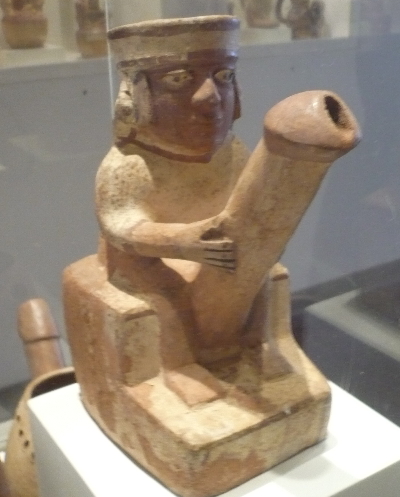
Moche Phallic Pot
Anyway. I am here principally, now that my conference is over, to see pre-Columbian Peru, and extremely fortunate to be able to do so. Like most tourists from the ‘rich’ world, I will simply have to deal with the poverty around me by getting into private cars, taking private tours, and, basically, not dealing with it, not looking at it. All I can hope is that by visiting some of the less well known sites, as I am doing this week, in the north of the country, I am bringing some desperately needed tourist dollars to the local economy, and that this is at least something, and all I can possibly be expected to do, in the face of so much need.

The Larco Herrera Museum, in Lima, is reputedly the best collection of pre-Columbian artefacts in the capital, if not the largest (The National Anthropological Museum) or the richest (the Central Bank’s Gold Museum). I have taken over 100 photos there, and confess to being completely enchanted by pre-Columbian history. The Moche, in particular, I am finding really fascinating – a culture that rose and fell through five stages from 1-800CE, and which has left some very striking artefacts, along with its own mark on the civilisations which followed it. Of particular note, (predictably) for me, is that the Moche left a great deal of erotic art and ceramics behind, of which there was a whole separate gallery at the Larco, and of which I am told there will be more at the Cassinelli Museum I am to visit during my stay up here in the north.
See flickr.com for all the photos.

Trip Downunder Sept 07 – Entry 15: Uluru

Uluru
So, at last, I have been to Uluru. To the Uluru Kata-Tjuta National Park, to be precise. It was a 24 hour stopover – the flights from and back to Sydney essentially free, included in the globe-trotter ticket I bought for this trip downunder. I arrived at about 1pm at the Voyages Resort, where there are hotels for all budgets, (and the cheapest is dear for a backpacker) all run by the one company that got the government concession here. The first thing you notice as you get off the plane is the heat. It is 36deg here. The Park is some 40km from
Uluru, outside the National Park, adjacent to the new airport. My room is basic, but I shall only be putting my head down in it so I am content.

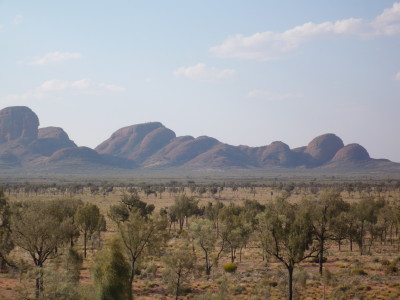
Kata-Tjuta

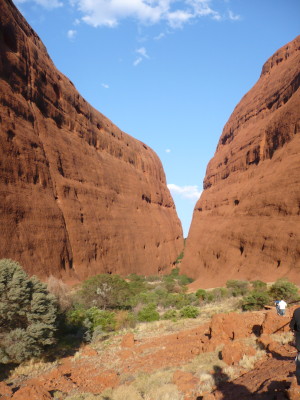
Kata-Tjuta gorge
At 4pm, I depart on my first tour – the Kata-Tjuta Dunes Sunset tour. Cherry, guide to the 20 tourists and driver of our mini-van on this Discovery Ecotours trip, is fresh, cheerful, and informative. We visit the large rock formations collectively known by the European name of The Olgas, their aboriginal name, Kata-Tjuta. The local peoples – a cluster of three dialect groupings, are known as the Anangu (pr. ‘ananoo’) but the stories of these lands include peoples from all over Australia. The Anangu have been living here for 22000 years, the deep red centre of this island continent – one of the last areas to be populated. We Europeans first sighted it in the 1870s. Tourism began in the 1950s, which was when the National Park was created – a slice taken out of the Aboriginal Reservation that covers the wider area. In 1985 the Land Rights Act returned ownership of the National Park to the Anangu, on condition that they lease it back to the Australian government for 99years. It was at this point that the resort and airport were relocated out of the Park, and the indigineous people began to have at least something of a say in the running of the land they had occupied for so long. None of them live a nomadic life anymore. They wear western clothes, live in houses, and are prey to the demon drink.
But their culture lives on through their ceremonies, rituals, social structure, language, mores. They have managed to restrict access to much of the park – with the voice of the conservationists on their side keen to preserve this unique environment. Everyone has to pay $25 at the entrance to the park, for a three day ticket. 25% of this goes to the local people. About $6. I spent about $400 here in 24 hours, on hotel room, food, wine, t-shirt, hat…. ..and $6 of it went to the indigenous people.

Kata-Tjuta sign
Kata-Tjuta is the ancient sacred site of the Men’s Mysteries for the aboriginal people, where their young men are initiated to this day, and it is to a carefully fenced-off area with clear walkways and viewing platforms that we are taken, into a gorge that is no longer used by the indigenous people, and their gorges are off limits. Here the trees from which the men make their spears and spear throwers grow, drinking up the rich water source at the foot of the rocks. Only yards away from the rock formations, the desert takes over again, with coarse grass the only greenery that breaks the surface. Somehow, on this tour, with the multi-national cohort and our Australian tour-guide, on the carefully managed paths, it is landscape that we have come to see, and the mystery of this place is carefully hidden from us. Cherry cannot know anything about the mysteries, for she is female, and there are female tourists with us. She explains that amongst local people, only men are allowed to come to Kata-Tjuta. It feels somehow as though sacrilege has been committed. Walking back out of the gorge, back onto the bus, we are taken to a viewing platform on the top of a sand dune, from which to watch the rocks gradually change colour as the sun sets behind us. Cherry gets out bread, oil and balsamic, and a seed mix which includes a local tree bark, and pours sparkling wine into champagne flutes for everyone, except the children who get orange juice. I, of course, tickled by the sheer decadence of this experience, have to mix the too, and soon several of us are quaffing bucks fizz, in the desert, watching the sunset over Kata-Tjuta. It is somehow fittingly colonial, distant and distinct from the true and ancient meaning of the place.

Bucks Fizz at Kata-Tjuta

Quite merry by the time we get back to the resort, after buying a better (kangaroo leather) sunhat and a flynet to keep off the extremely irritating desert flies, I bought a plate of raw kangaroo meet and barramundi fish and barbecued it myself on the backpacker-communal barbecues, washing it down with strong aussie wine. Then an early night, and up at 4.30am for the Uluru sunrise tour.

Sunrise over Uluru

Uluru Mala Face
There’s only five of us this morning, and our tour-guide, Jessie, is more experienced and more knowledgeable than Cherry was. Jessie takes us to the viewing area for sunrise, and we watch the colours change, drinking coffee and eating a light breakfast of cereal bars and muffins. Then he drives us around the base of the Uluru, telling us some of the tales of the aboriginal culture that tie aspects of this great rock into the history and mythology of both the local and many more distant peoples. It is quite fascinating. But the tension between landlord and leaseholder is so evident. All the literature from the Voyages Resort, and all the various tour-guide companies that operate here, include the statement from the Anangu that they would rather people did not climb the rock. Yet of course the climb is available and allowed and tour-guides take you up, and we watch the long line of tourists climbing the precarious path – with a steel rope to guide you – up onto the top of the rock. As Jessie explains to us, in the ancient tale of the Mala ancestors, it was a great wise elder who climbed the rock here, to plant the totem-pole announcing the beginning of the men’s mysteries ceremonies. The totem pole is echoed in one of the rock formations. The tourists tread this processional way, as if clambering up onto the High Altar in the Vatican, oblivious to all insult. I saw the request from the Anangu, and did not climb. I did not buy the postcard that said “I respected the wishes of the Anangu and did not climb,” but was amused to see it in the rack.
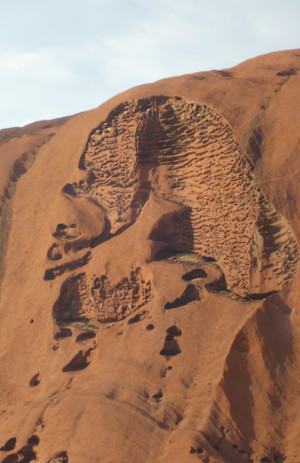
Uluru snake lair
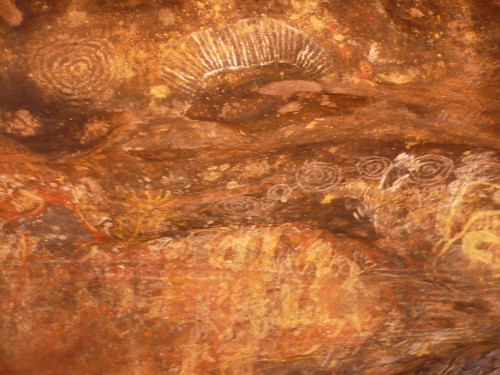
As we drive around the base Jessie tells us a fabulous story about a snake ancestor and her eggs, and the shapes on the sides of the rock that pick out moments of the tale. It is quite fascinating to the see the mythology mapped onto the geology in this way. We leave the bus at a car park and Jessie takes us to see one of the rock-paintings – barely more than a classroom blackboard, really, with a jumble of signs and symbols used to aid in passing on the oral tradition.

Uluru rock paintings

We go right up close to the rock and see into one of the pools of water that collect at its base – surrounded by lush vegetation, small lizards, and more tourists. Then its off to the Cultural Centre – the exhibition space of the National Park, where everything has been prepared by/on behalf of the the Anangnu, and there are shops selling local crafts and artworks. I buy a hand-crafted snake, to remember the story. There are aboriginal women, sitting cross legged on the floor in one of the shops, painting. They chat amongst themselves, in a world completely their own, oblivious to the tourists standing watching them, somehow in another time and place from us altogether. Even now, in their presence, in this shop, I feel that their mystery is hidden from us. It is carefully managed, and very effective. The storyboards in the exhibition tell a little, and then fall silent. Here and there it is mentioned that the true ending of a story is reserved for initiates only. Perhaps, in the end, it is a mark of the victory of the aboriginal people here, that outsiders do not know, cannot understand their ways, their mysteries. They have kept the strength of their magic by keeping silent. It is good.

Having completed the circumference we pull in for a last stop at a viewing platform for a good view of the rock, and Jessie and I take each others’ pictures.

Jessie - Uluru guide

Uluru

Then it’s back to the resort, for an hour wandering around the visitors centre, where I learn more about the geology and the natural history of the place, and at last back to the airport and back to Sydney.

I am glad to have been there at last, to have at least touched the surface of the mysteries of an ancient people, to have gained, at least, a knowledge of the power of its silence.

Trip Downunder Sept 07 – Entry 10: Te Papa Museum

New Zealand Forest after European settlement
The road from Tongariro to Whanganui, and on down from there to Wellington, takes the whole morning to drive, but past some very stunning scenery – including a wonderful waterfalls.

At Wellington itself – the capital, although a smaller city than Auckland, but similarly a harbour town – I went straight to the Te Papa (‘the People’) National Museum, which proved to be well worth it.

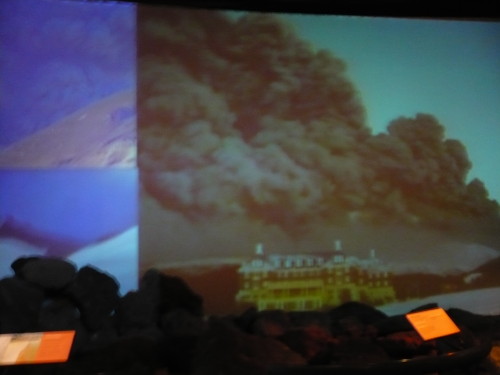
Here were a number of excellent exhibitions about the flora and fauna, the history of New Zealand, and the tectonic geology of the country – including audio-visual record of the 1995-96 eruptions at Ruapehu, over
the chateau where I stayed.

Grand Chateau under volcanic eruption in 1995

But all these were crowned, for me, by the permanent exhibition “Blood, Earth , Fire” which documents how the arrival of humanity has devastated The Land That Was – only 1000yrs ago an untouched island paradise.

New Zealand Forest before and after European settlement

It is quite stunning how, in the 700odd years that the Maori were here, humanity had already begun, inexorably to take its toll, for all that their ways trod more lightly upon the earth than ours. But the shere
orgy of destruction that the creation of the virtual England of grass, sheep and cows unleashed upon this land in the space of 80years from 1840 to 1920 is truly awesome to behold. The exhibition does not pull any punches, making it clear what impact the Maori had, but not pretending that the Europeans were anything but a million times worse. One of the most poignant parts of the exhibition was a memorial to the dozens of species known to have been lost in this process.

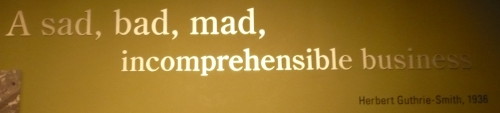
Testament, also, is given to those who, as early as the mid-1930s, began to question this savage repurposing of what was once ancient native New Zealand forest – with trees thousands of years old – into the short-term gain of introduced European grassland for introduced grazing animals bred mostly for export. Today’s New Zealand, it is clear, vehemently defends what is left of its natural heritage; the tide of destruction has been halted.

Herbert Guthrie-Smith quote on the destruction

Also documented here is the sad tale of how the European settlers signed the wonderful treaty of Waitangi and then proceeded to welch on every aspect of the deal, disenfranchising, disinheriting, and simply hoodwinking the Maori out of the lands. The full, formal apology for such treatment from none other than Queen Elizabeth II, quoted in full in the exhibition, is testament at least to the beginnings of reparation – the ‘Claims’ now being heard by Moari people for rights to their own land. Interesting too to note the large numbers of Scots – some refugees from the Highland clearances – Dalmatians, and Chinese, who helped to swell the numbers of English settlers. There were some 100,000 Maori on New Zealand before the Europeans arrived. Now some 4.1million people live here altogether – very very few of them pure-blood native Maori. The fourth floor of the Museum includes an enormous Meeting House for all the tribes and peoples and New Zealand – it gives a really good feeling that, for all the darker side of the colonial history, honesty and a willingness to make good past mistakes characterise the present.

Te Papa Meeting House

Trip Downunder Sept 07 – Entry 9: Three Worlds

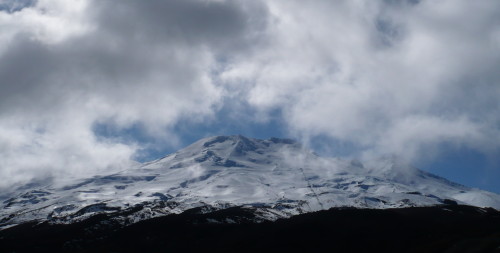
Mount Ruapehu Today, in the Tongariro National Park, I have been to three places: a Maori land of mountain gods Ruapehu, Tongariro, and Ngauruhoe; the area used for the filming of Mordor in Jackson’s Lord of the Rings, and some amazing volcanic landscape. All three map onto one another in a jumble of reality and virtuality that was at times slightly confusing. The Mountain Peaks were gifted to the New Zealand people by the chief of the tribe whose land the park now covers, in a bid to save them from the ravages of the encroaching farmers who now had the right to buy land from individual Maori – something which set against the old communal way of life was a legal
nonsense guaranteed to serve the interests of the settlers and not of the Maori. In 1887 it became one of the very first National Parks in the world, and grew in size over the coming century as the government bought out the holdings around the peaks.

I learnt this from a rather shabby audio-visual in the local visitors centre, where the whole thing was split into two, and the left-hand projection was some six inches lower than the right-hand projection, making everything rather weirdly disjointed; worse, some kind of degradation of the film meant that everything blurred jaggedly in the strangest fashion – I have never seen the like – and some of the audio seemed to be lost, such that important speeches were lost entirely against the backdrop of inane music and disjointed photographs, speech-silences that ended in new voices rounding off conclusively with summarising “and so”‘s. In short, it was dreadful, and detracted rather from the message it was trying to convey.

Mount Ruapehu

The other virtual world mapped onto this landscape, however – that of Mordor – whilst an incomparably better audio-visual experience, nonetheless fared little better for me, today, when weighed up against what I would consider to be the real star of the day – the landscape itself. This, of course, I viewed through an entirely more modern eye than that of the old Maori legend, or of the smorgasboard of European folklore that is shoehorned into Tolkein’s epic. This eye was a nineteenth century eye, the eye of the picaresque, the Victorian eye that delights in the wild and in natural landscape, and then returns to the 1929 champagne chateau for gourmet food and fine wine.

Sauron Loses his hand

My guide was a nice enough chap, and showed me all sorts of interesting places. He had been the environment Officer here in the Park for Jackson’s production, ensuring that the mosses and lichens were protected with carpet, and that walkways were built to minimise trampling, and that all the areas heavily churned by the trucks and other vehicles were lovingly returned to the wild with the minimum of disruption. Now he drives people around giving tours, telling stories, and takes people for walks and ski-ing trips. Seemed like a pretty nice life: good on yer Scotty.

Gollum Leaps Down on Frodo and Sam


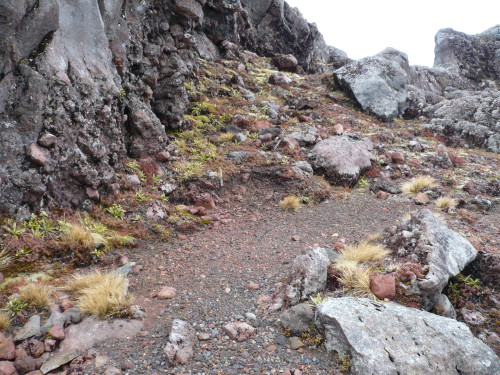
We collected some of the plastic rubbish left behind by the snowboarders and toboganists, as we wandered through the rocks and crags of Mordor, stopping to wonder at the spot where Sauron’s hand was cut off by Isildur’s father, at the spot in the Emin Muil where Gollum leaped down from the cliff to attack the sleeping Frodo and Sam, at the spot where Frodo and Sam rested on a spur of rock as the lava of Mount Doom flowed around them at the very end. Here where the great Ruapehu spake his Mannah to calm the young North Island freshly brought to the surface of the southern sea by Maui’s hook, the Great Battle at the end of the Second Age was fought, and the tourists ski down slopes of freshly machine-made snow, strewn across the volcanic landscape of the Tongariro National Park.

Rock where Frodo and Sam lie with lava flowing round them

Indeed, the landscape certainly won out for me today, particularly when, in true Kiwi style, I went ‘tramping’ as they call it here, (that’s hiking for the Brits) from the Hotel out to the Taranaki Falls – a lovely 2hour walk through countryside at times not dissimilar from the Yorkshire Dales, at times closer to North Wales, and other times somehow quite lunar, and at all times populated with the most fascinating flora and the calls of strange and wonderful birds. An absolute delight, from start to finish, and – as always for me when walking – a marvellous opportunity for reflection and meditative thought.

### sadly the tag-based slideshow I created in 2007 is no longer supported by Flickr ###
Please visit the Flickr album to see the Takanaki Falls photos.

Trip Downunder Sept 07 – Entry 3: Waitangi

Waitangi God carving
Success with the car, fortunately – courtesy of a nice young man at Auckland Central Police Station who stamped the print-outs of my scanned documents as corresponding with my passport, and allowing me to drive until next Saturday on this stamped photocopy. AVIS were satisfied, and I finally got away from Auckland in my automatic Mitsubishi Lancer at about 10am. I have to say it performs pretty well, and I am content with it.

The drive north from Auckland along State Highway 1 is blessed with stunning scenery, which ranges from the volcanic to the sub-tropical into the deciduous and quasi-savannah, descending finally to the delightfully tranquil Bay of Islands.

Here are the Waitangi Treaty Grounds, and the very experience of ancient, native New Zealand that I hoped for, and will treasure for a long time to come. Some 2-3 weeks before the main tourist season, I was fortunate enough to get all three Maori guides at once, practicing their ‘spiel’ together on the season’s first Guided Tour. There was a young man, brimful of enthusiasm and belief; an early 40s woman, wiry, earnest, at once worldly and mysterious; and an older man, in his late 50s or early 60s, wrinkled with wisdom, solid, knowing, both serene and simple. Their tour began with the young man walking backwards before me relating the creation myth of the Maori people, telling me the names of their gods and goddesses, and some of the foundational stories of their people. It was fascinating. They asked me questions and I had to confess my own genuine interest in the ancient peoples of the world and the oral tradition of native wisdom found the world over; my own interest in the Celtic oral tradition in Europe; my genuine interest in the Maori, more than in the settlers, on this, my first trip to New Zealand. Indeed, as I told them, since arriving in New Zealand yesterday evening, the Waitangi Treaty Grounds is my first stop, my first ‘tourist attraction’, the first place I wanted to see – three and a half hours non-stop drive north of Auckland.
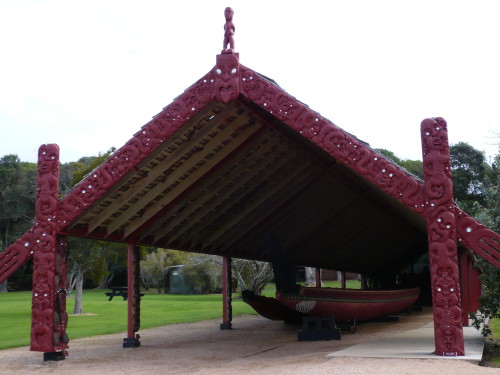
Largest war canoe in the world
The young man took me down to the shore and introduced me to the largest war canoe in the world, the tribes whose stories are carved pictorially into the sides of it, the wood and twine technology of its making, its annual 6th February launching into the sea where it soaks up water, doubling its 6 ton weight, and the joints seal as the wood expands. They dance the Haka on either side, chanting to the Gods of the Sea and of the Winds – that the water will keep it afloat, and the winds guide it in the right direction. The tall prow and stern act as lines of sight to the stars, sun and moon for direction, and it takes minimum 80, optimum 125 men to carry and row it.

Then we began to walk back up the hill to the lawn where the treaty was signed, and the woman took over, telling me about the Busby’s – the christian priest who was the first British resident here, the story of his house, how the australians didn’t like him and sent only half the materials he ordered to build it, such that he had to redesign it and build it half the size, how he was a good man to whom the Maori owe much, because he defended their way of life from the fate that befell so many others. He went back to England and died of an eye infection, but his wife and children remained and his wife taught the Maori people the ways of the pen – before this their wisdom was always spoken and sung, passed from generation to generation, but Mrs Busby taught them to read and write and this was an immense help to them in dealing with the onset of the future. She is so completely accepting of the inevitability of British rule, even proud of the flags that we gave to this country, yet her affection for the Busby’s is down to their protection of her ancestral inheritance. All through this I nod, make noises of understanding. My initial rather dismissive question “who was this Busby”, meant to say, “I am interested in the maori not in the invaders” has been answered very earnestly – the Busby’s, although in some sense the representatives of the invasion, were also its temperers, the careful supporters of the Maori way of life in the face of conquest, and clearly are held in high esteem to this day.
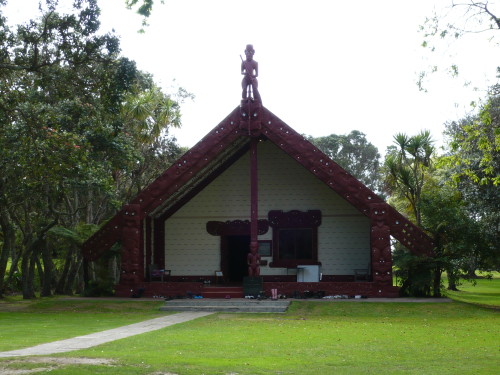
Waitangi Meeting House
At last, the old man takes over, and leads me towards the meeting house. His weight and gravitas, tempered with joviality, at once respect me as the paying tourist, and suss me out as the intriguing stranger who seems to have more understanding than most. He leads me up to the meeting house and tells me about the sculptured wooden frame – their great ancestor Kupe who was the first to come from Hawaiki (Land of the Ancients – about 950AD) stands proud at the apex of the frame. He left a small group here, returned to Hawaiki, and later (about 1350AD) his grandson arrived with a great migration of people on a huge flotilla of wakas (war canoes). The grandfather at the top, the grandson at the bottom, with the central beam running up between them. Then it is the grandfather’s outstretched and protecting arms that run down the sloping roof on either side. He leads me up onto the porch, where we take off our shoes, in respect. This is a meeting house where the community gather to worship, to discuss, for meetings, for funerals, for the important things of community life. Each tribe has such a house, and this is the house of all the tribes, here at the Waitangi Treaty grounds. Inside there is a meeting going on, people sat on rows of chairs, in modern dress, some with laptops, a few standing at the front, one talking, all in their wonderfully lyrical native tongue. He takes me in – this is a special moment – normally if there is a meeting the tourists don’t enter – but brought in by him I follow, honoured and a little awed. He whispers to me, telling me about the carvings on the beams, how each tell stories about one of the tribes of people who are here, or about their gods. Here is the carving of the story the young man told me about the creation of the first woman, and how she had trouble with her pregnancy and gave birth through her ribs under her armpit. Suddenly all the people in the meeting house stand up, and begin a communal song. It is uplifting and mournful at the same time, and deeply deeply spiritual. Yes, ‘spiritual’ is a word all three of my guides have used in almost every other sentence, when describing the Maori, and they maintain this spirituality to this day. Indeed as the gathered people sang I could feel my own spirit answer with both respect and humility amidst what was both an alien and an all too recognisable otherworld. Here the tales and the images are so strange, and yet the truths so familiar to one who has studied the Celtic, Norse and Vedic traditions. Yes these are not Indo-Europeans, and the similarities in the stories of the Celts and Indians will not extend to the Maori, but the sentiment and the human truths seem all too recognisable. I tell the old man I can feel it. I find myself using the kind of gestures I use with those I know in England who share my interest in Celtic mythology and the oral tradition of the druids. He seems to understand. He leads me behind the people as they sing, to the far end of the hall, where he introduces me to the central column, the Guardians who protect this house. I am honoured, nod my head in humility; I touch my fist to my solar plexus and then open it palm outwards to the column. It is a gesture meaning my heart and honour and strength are offered in recognition of your rule in this space. The old man seems to recognise, somehow, what I mean. He leads me back, behind the singing crowd, out onto the porch, where we rejoin the young man and the woman. He tells them, immediately, “He feels it” and they both smile warmly at me. It’s as if suddenly I am accepted by them in a way they did not expect of a tourist. We wander slowly away from the Meeting House, back towards the Busby’s house, and there is such a strange but warm feeling of togetherness, although necessarily so brief, and in all truth across the gulf of cultures and backgrounds necessarily all too shallow, a connection nonetheless that has my soul standing to attention. They seem almost sad that it is all over, and we all shake hands and wish each other well.

I walk away, utterly enchanted. Here, in New Zealand, is a culture still alive and well, literate, English speaking, with unbroken connections and continuity from the ancient past. I could learn so much from these people, if only I could find what I could usefully give in return. I promptly went into the shop and spent $400 on wood carvings and jade jewellery, like any good tourist should !!

I then went and checked in at the Copthorne Bay of Islands Hotel and was given Room 230 🙂

Portugal July 07

In July 07 I spent a week in Portugal with an old friend who has recently moved out there, staying with him and his young friend in their little flat near Sintra where they are living prior to my friend moving further south to the Algarve. We visited Sintra, and the Quinta de Regulare and Feather Palace there, and went for a drive in the lovely cabriolet beetle I hired out to the temple of Diana and the circle of Almendres – the greatest stone circle in the Iberian Peninsular. It was a lovely few days break, in baking weather (compared to the floods at home).

[FGAL id=1476]