Peru Trip #5 – Underwhelmed by the Nazca Lines

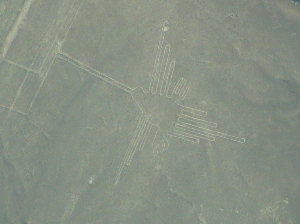
One of the shapes of the Nazca linesWell here’s a turn-up for the books. For the first time in my life, I have
suffered from air-sickness. I got up at 5.30am, grabbed some breakfast, got picked up at 6.15am and taken to the bus station for a 4hr 30m bus journey – again in one of the comfy airline style coaches – arriving in Ica at 11.30am, to find my Nazca trip delayed til 3pm. I could have got a later bus. Not particularly pleased, but acquiescent, I wandered about the gardens of the Las Dunas hotel, a sort of oasis in the desert here, where a big conference was taking place, and then ate a very light salad lunch in the restaurant. Finally taken to the airfield, I and four other passengers and the two pilots took off in the little Cessna at 3pm, for a 30min journey across the desert to the plain where the lines are carved into the ground, 30mins flying over them, and then the 30min return journey. The updrafts from the mountainous surroundings made conditions quite choppy on the journey out there, but nothing worse than my similar Cessna journey from Milford Sound to Queenstown in 2007. But once we got to the lines, the pilot very enthusiastically ensured both sides of the plane got a very good view of each and every one of the twelve big patterns amongst the lines, by turning steeply and sharply in both directions. By the fourth shape I was feeling very hot, sweaty, and uncomfortable, and spent the next 10mins vomiting my lunch into the plastic bag provided. Only by the last little group of shapes had I recovered sufficiently to doggedly point my camera at the ground. I closed my eyes and left my body for the trip home, feeling, as I told anyone who asked, “awful.”

So now I know: I can – and will – get air-sick, in a little Cessna doing wild manouvres. And now I am stuck in a small villa hotel in the middle of nowhere for the evening, where after a long nap recovering I am at last going to have a small dinner, and then a long sleep and lie-in, to get the bus back to Lima tomorrow lunchtime. All in all, I have to say, considering the huge discomfort incurred on the overflight itself, and the 9hrs of bus travel to get here and back, I am distinctly underwhelmed by my trip to the Nazca lines. What photos I did manage to take are not as good as the ones you see in books. One wouldn’t expect
them to be. So why be here to take them for oneself? For the experience? You can keep it.

Update 3/10/10 : “Britons killed in Peru aircrash”
==============================
So – for anyone in any doubt that this pilot was displaying typical macho bravado and not only making people feel sick but playing fast and loose with common-sense safety – here is the tragic truth. I count myself very lucky, indeed, and hope that Health & Safety crawl all over that little operation. I feel very sorry indeed for the families of those bereaved – I think it was an accident waiting to happen.
Peru Trip #4 – El Brujo, Huaca de La Luna, Chan Chan

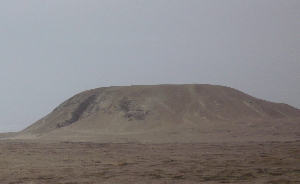
Huaca Prieta - 2500BCE Pyramid
Another long day with another punishing schedule, but SO worth it. Picked up from the hotel at 7am for a 90min journey to El Brujo, to visit the very celebrated Senora de Cao – the only Moche Queen discovered so far, clearly as powerful as the Lords of Sipan in her day (c250CE) with her own pyramid with all the usual Moche accompaniments.
But El Brujo is more than just her pyramid – here, too, is Huaca Prieta, the as yet unexcavated 2500BCE pyramid of the pre-ceramic originators of the El Brujo complex, followed later by the Cupisnique, and later still by the Moche, and the Chimu, and even a Dominican Church built by the Spanish. To this day, the local ‘brujo’s, (shamen) still practice their folk magic at the Moche Huaca El Brujo (named after them) facing the Huaca de Cao, the only part of the site so far excavated, opened to the public with an impressive museum, in April 2010.

There’s been 5000 years continuous sacred occupation of this same site,
overlooking the crashing waves of the pacific. A truly stunning site,
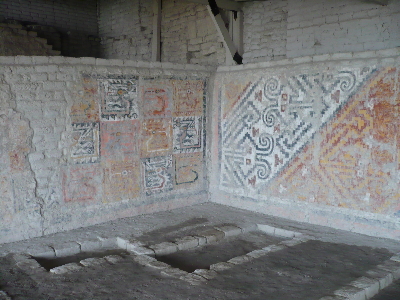
with my first sight of how the Moche ceramic style appears in
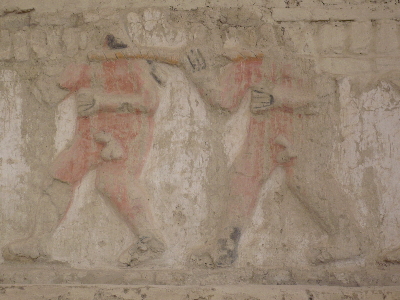
high-relief on the walls of their temples! In this warrior culture,
where soldiers paired off for ritual battle, the loser was stripped
naked, chained, and led to the top of the pyramid to be beheaded, where
his blood would sanctify the martial rite, and be presented in the
ceremonial cup to the Lord (or in this case Lady) to be drunk in
celebration of the life-death cycle epitomised in their primary deity,
Ai-Apaec: the beheading lord of death and creation.

Senora de Cao prisoners

Wall paintings at Huaca de Cao

But I was yet in for a real treat. For our next stop was Huaca de La
Luna. Two huge pyramids with a small town in between them, one slightly
larger than the other, named by the Spanish as the Temple of the Sun,
and then looted and destroyed, the other, smaller, named Temple of the
Moon, left alone for the archaeologists to discover, as late as 1990,
that there are five temples here, one built literally on top of the
other, like the top halves of Russian dolls. It seems after about a
century a particular ruling elite would simply completely renew, burying
the previous set wholesale by building directly on top of their temple –
a new temple for the new ruling elite, but all in essentially the same
cultural style – five times over, here at Huaca de La Luna. What has
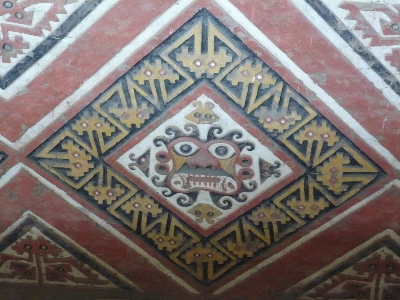
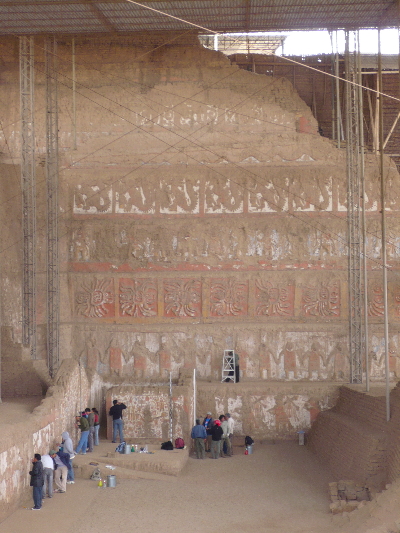
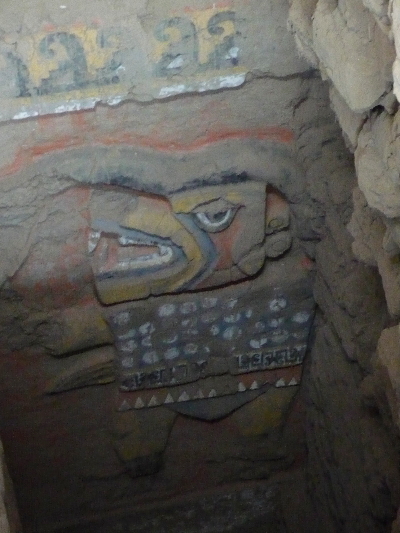
been revealed is just simply stunning! Here is taster – check out Flickr for the MANY photos I took of this site.

Ai-Apaec

The wall of the fifth temple with the sacred corner sanctuary

Glimpse of the fourth temple behind the walls of the 5th

This entire complex was just truly stunning and left me quite
gob-smacked. My guide told me, as we stood a little away from three
suited gentlemen in heated discussion, that they were the principal
archaeologists who had discovered and were managing the excavation of
the site, debating the need for and likelihood of getting substantial
new funding to continue the work. This is already a World Memorial Fund
site, but needs more help from the EU, the US, etc etc.

Last of the day, then, after a delightful seafood lunch overlooking the
waves crashing onto the pacific shore at Huanchaco Beach, nearby, was
the rather disappointing mud walls of the Chan Chan archaeological site.
This vast Chimu city, 14km square, was simply abandoned and looted
when the Spanish arrived, and not covered up like the Moche pyramids
that preceded it. No paint survives, therefore, and the reliefs are
barely distinguishable. What is on show is reconstructed, and
unremittingly brown. Alone, on a day without the glories of the Moche,
it might have been impressive, if only for its size and extent.

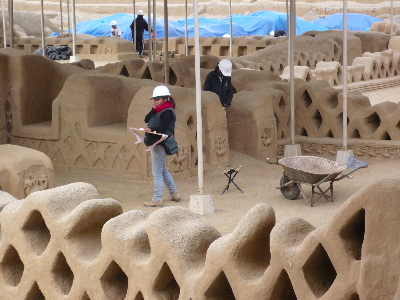
A view at Chan Chan

And then the flight from Trujillo back to Lima, a late dinner at the
Haiti Cafe near my hotel, and a very very welcome bed, after writing
this.

Peru Trip #3 – Trujillo and the Cassinelli Museum

Trujillo outskirtsCon-Air : Cameron Poe the honour-bound dominant dysfunctional male, somehow apposite here in Peru with its macho culture and all the crime and violence I have been warned about, where armed security men check bus passengers for weapons and video everyone’s face once all aboard, seated in our airline seats in this double-decker coach, watching the dubbed movie. I am grateful for the comfy seat on this 3hr drive, but listen to Anthony and the Johnsons, Rufus Wainwright, and Aqualung on shuffle on my iPhone – a much softer, more varied, more interesting selection of masculinities than those on Con-Air.

Seeing a bit more of northern Peru, from the bus, I take a few random
photos to try to capture the state of (un)development here. One thing I
will say, however, despite all the warnings, all the security, etc etc –
everyone I have met here in northern Peru has been very friendly, very
helpful, very warm. I know I’m in a bubble, chaperoned everywhere I go,
but I haven’t sensed any threat at all.

And so Trujillo! It’s a Spanish imperial town, in the centre at least,
and I am taken quickly around some of the grand houses they left behind,
and the ones built shortly after the start of the republic in the early
19th century. It is strange to see so much European architecture and
furnishings here. But what I am really looking forward to today, and
which we quickly move on to, is the Cassinelli Museum. Signor
Cassinelli, about 85yrs old now, is in the reception room, with his
young wife, when I get there, and personally greets me. He has been
buying ceramics from the haqueros (the grave robbers) for decades, and
is well known and liked for saving these ceramics for Peru, rather than
letting them go abroad where they could never be seen. The basement
where a third of the collection is on view, is under a petrol station,
and it is dearly hoped that this private collection will one day get a
better building! His son is downstairs, guarding their treasure, as my
guide and I look around. I took a LOT of photographs – all on Flickr
– but here are one or two to get a flavour. This is without doubt a
bigger and better collection than that at Larco Herrera, for all that it
is in such a tiny room in comparison.

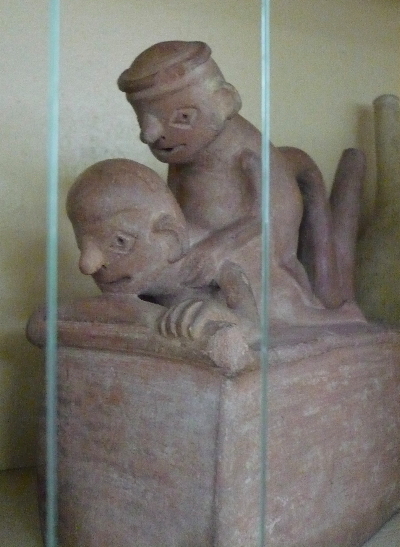
A gay couple ceramic in the Erotic Moche ceramics cupboard

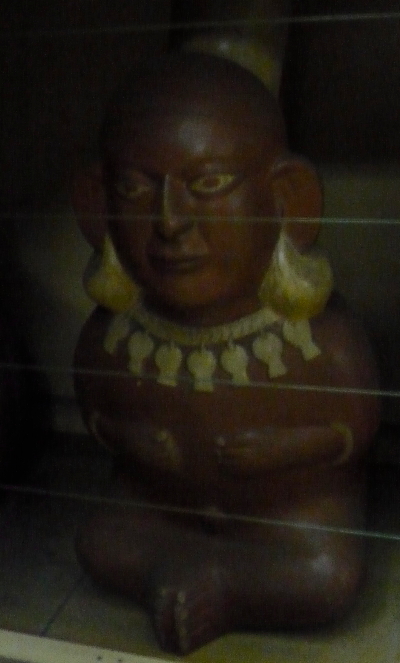
A shaven Moche priest?

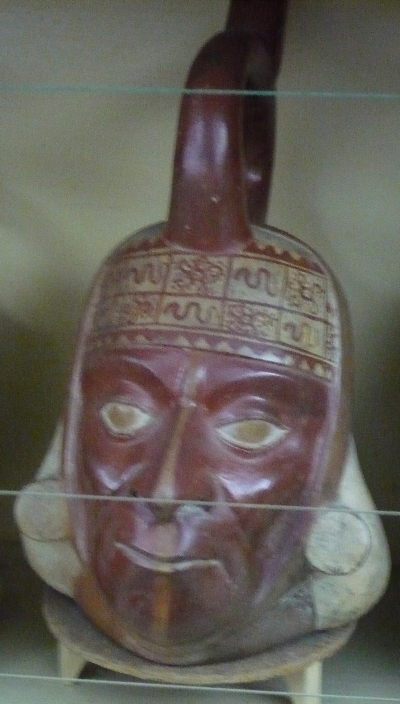
One of many Moche portrait ceramics

At the end of my visit, I am honoured to have further (interpreted)
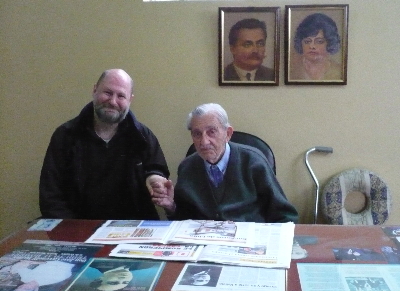
conversation with Signor Cassinelli, and even a picture with him. My
guide has made it clear to him how very much I was looking forward to
seeing his collection, and how with how much delight I have enjoyed it.
He, in return, is honoured to have me visit him, all the way from
England.

Me with Signor Cassinelli

Peru Trip #2 – The Lambayeque and the Moche Lords of Sipan

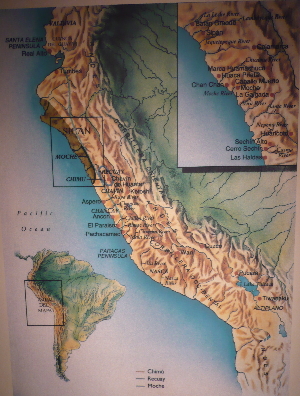
Map of Peru showing Moche civilisationWhat an epic day. Lying in bed late yesterday evening, reading myself to sleep, I noticed the bed suddenly wobbling strangely, I thought maybe it was a tremor – nothing as alarming as an earthquake – then maybe just a couple in the room next door having a rather good time. Then it was over before I could really work it out, and I forgot about it. Today, however, it was the small talk of the day amongst the Chiclayo guides and drivers who took me around to the tourist sites in my itinerary
today. It was a mini-earthquake; the first in quite some time, especially noticeable for someone, like me, on the sixth floor of my hotel. The joys of being so close to a continental plate subduction zone!

Anyway – up early to get breakfast in before meeting my guide for the
day at 8.45am, we headed straight off to the Tucume complex, a
Lambayeque (also known as Sican) site to the north of Chiclayo.
Following the Cupisnique culture 800-200BCE on the far north coast, the
Piera-based Vicus culture 1000BCE-300CE and the Moche civilisation
1-800CE over the whole of northern Peru, the Lambayeque/Sican culture
750-1375CE, contemporary with the Chimu in the southern half of northern
Peru, covered the northern half of what had been the Moche
civilisation. Facial reconstruction from royal skulls, along with
distinctive ceramic and architectural styles, set them apart from both
their Moche forebears, and their Chimu 900-1470CE neighbours, whose
culture represented more of a development from the earlier Moche. Both
were later taken over by the pan-Andean Inca’s, shortly before the
arrival of the Spanish. The only surviving written records of any
pre-Columbian cultures are of course, like Roman accounts of the Celts,
written by the Spanish conquerors, but include a monk’s retelling of the
Lambayeque origin myth, which claims that their first God-King arrived
from the sea, with a fleet. Thor Heyerdahl’s Kon-Tiki expedition proved
the practical possibility of the Lambayeque having originated from a
Polynesian invasion. Contemporary with the third stage of the
Lambayeque culture another group of Polynesians of course arrived in New
Zealand, establishing the Maori, and populating the islands for the
first time. Even if, after the manner of Francis Pryor’s anti-invasion
historical stance, this Polynesian invasion of northern Peru was little
more than a Norman-style invasion by a new ruling elite, it is still a
compelling theory. Mochica, the language of the Moche, was spoken all
over the north right up until the last Mochica speaker died 25 years
ago, and there is no record of any specific Lambayeque language.

The Tucume complex is from the third stage of the Lambayeque/Sican
culture, with its own distinctive style of ceramics. The first and
second stages, 750-900CE, and 900-1100CE, were characterised by a dark
grey ceramic style (the colour came from the smoke of the firing
process) that, at least in the second stage, was mainly focussed on
representations of their God-Kings. The second stage ended during a La
Nina – the 20-30year dry period that appears erratically in opposition
to the more common El Nino
wet periods that bring floods every half-decade or so to the Peruvian
coast. The 2nd stage Sican culture – and their 30 or more pyramids –
ended in flames, and they moved to Tucume, where a third stage Sican
culture 1100-1375CE, built another 26 new pyramids, but were no longer
led by God-Kings.

Tucume pyramids

Tucume is a vast site – a complex of 26 mud-brick pyramids –
clustered around an isolated pyramidal hill. The pre-columbian peruvian
pyramid is not like the Egyptian pyramid; in the north here,
especially. Here in the north they were made of mud-brick, and with wide
flat tops that act as platforms for royalty and priesthood to live on,
with all their various entourages. The largest of the pyramids here at
Tucume is the largest pyramid in the Americas. They have all suffered
somewhat from the last 1000 years of rain, but for mud-brick it is
remarkable how much has actually survived!

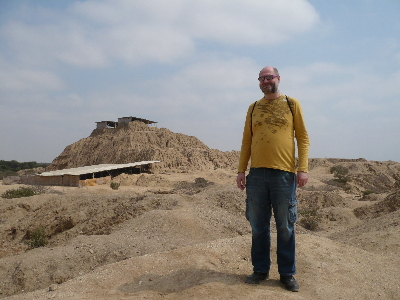
Me at the Tucume pyramids

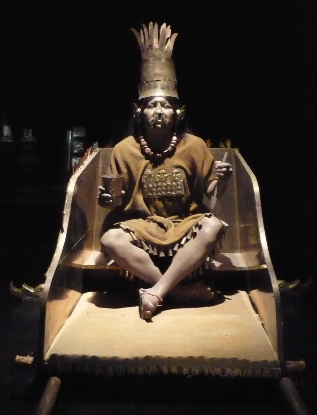
Further south the last museum of the day showcases the remains of two of
the Lords of the Sican/Lambayeque culture – from the second stage
900-1100CE, prior to Tucume.

Sican Lord from Huaca Loro Lambayeque II

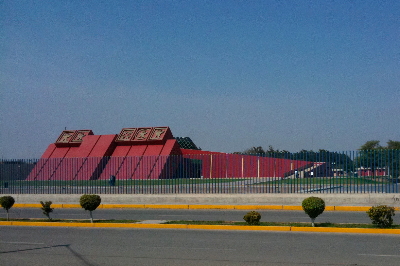
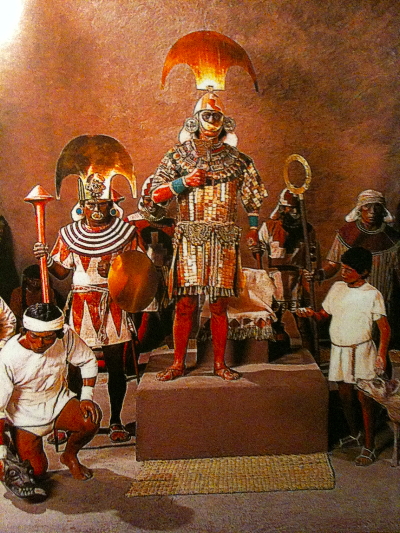
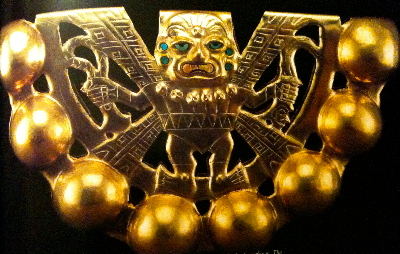
But by far the most amazing visit of the day has been to the Lords of
Sipan museum in the town of Lambayeque. Sipan, a pyramid site up to the
north east of the coastal area and unsupported by electricity and other
amenities, was one of the main burial tombs of the Moche kings, and the
museum here in Lambayeque houses two of them – everything from the gold
and silver clothing to their very skeletons, in a magnificent new
building built just like a pyramid. This is probably one of the finest
museums I have ever been to, and although everything was in spanish my
guide interpreted it all in excellent English for me and it was the
highlight of the day. Cameras and mobile phones are not allowed inside,
so I took no pictures. I did however buy the book, and have taken a
couple of snaps for you to get the idea…

Lords of Sipan museum


Reconstruction scene at Lords of Sipan museum


Belt bangle at Lords of Sipan museum

All in all an exhausting day – and time for the local specialty dish: duck and rice; washed down with a Chilean red methinks!

Peru Trip #1 – Arrival and Larco Museum

Chimu gold funerary ornaments Impressions of Peru so far? So many! As the KLM flight came in to land at Lima International Airport, the first impression was of a brown, low-rise, half-built town, with a glittering glass crown in the centre. My week in that centre, at an international conference, served to underline this. The ‘middle classes’ of Lima, if I can use such a term, are the wealthy, with, it seems, far, far below them, the very poor, and little if anything in between. The gap is evident in the gated business sector I have spent the last week in, like a Baghdad Green Zone, characterised by the profusion of security guards, high steel fences, the railings, broken-glass-topped walls, spikes and grilled up doors and windows that are ubiquitous here.

As a colleague of mine said to me yesterday, as we took a hotel taxi to the best private museum, we have earned the privilege of being among Lima’s wealthy, chaperoned, protected, looked after. There are poor in our countries, too, and we have worked hard to get where we are. Yet, in the UK at least, the welfare net is set so very much higher than the average level of the poor here, and prevents the worst excesses of poverty so visible in the faces of those desperate to sell us “anything” at the windows of the taxis when they stop at the lights. The driver presses the central locking switch, in a quiet, protective move, and then we are gone. The garish colours and busy-ness of the advertising hoardings and shop fronts are such a contrast to the dull brown, low-rise town seen from the air as you approach – the outskirts surely where the poor gather like (equally brown) moths to the city-centre flame, their (equally brown) faces pressed to the security gates, admiring the spectacle of transnational wealth.

And never before have I been given so many warnings about how dangerous a country is – what not to do, where not to go, what to be careful about. In Egypt the tour guides marshalled the hawkers, fair enough, but they were pleasant enough, just a little overwhelming. Here, apparently, it just isn’t safe to go out at night in many places, where ones tourist face is so clear to pick out. I don’t know if the tales are an exaggeration, but am I really that inclined to find out? What with this having been the worst year for my back in over a decade, and the orthotic strap holding me together the only reason I didn’t bring my stick, I don’t fancy my chances at running away from anything. But everyone I have met has been really pleasant, welcoming – albeit also protective. I am glad I have booked this entire trip through a travel agent, and that every step of my journey around Peru will be guided. My Spanish is non-existent, at any rate, and outside of the city-centre, so is the English of most people other than my guides.

Arriving in Chiclayo, today, after the short flight north from Lima, the impression is immediately one of being in a third world country. I am strongly reminded of southern Egypt. Although it is winter here now, and I arrive in the early evening, the warm air as I step off the plane is dry, slightly dusty, and faintly sweet. The view of the town during the descent was similar to the outskirts of Lima – half-built, (at best), and here the metalled roads are in the minority – the main thoroughfares, interspersed with broken concrete lanes near the centre, and simple flattened dirt in the outskirts. The taxi ride to the hotel reinforces this impression. I must say something about the driving here. It is terrifying. I am so glad I didn’t even consider hiring a car. Although the drivers (well, the one who spoke some English) tell me there are few accidents because of the driving style, just the usual accidents due to drink and speed, this is clearly because, as he says, all Peruvian drivers “have eight eyes and radar inside their heads”. The roads are a complete free-for-all with no rules at all. Terrifying for a well-behaved British road user.
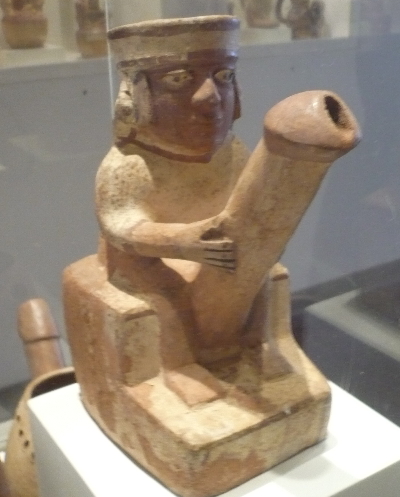
Moche Phallic Pot
Anyway. I am here principally, now that my conference is over, to see pre-Columbian Peru, and extremely fortunate to be able to do so. Like most tourists from the ‘rich’ world, I will simply have to deal with the poverty around me by getting into private cars, taking private tours, and, basically, not dealing with it, not looking at it. All I can hope is that by visiting some of the less well known sites, as I am doing this week, in the north of the country, I am bringing some desperately needed tourist dollars to the local economy, and that this is at least something, and all I can possibly be expected to do, in the face of so much need.

The Larco Herrera Museum, in Lima, is reputedly the best collection of pre-Columbian artefacts in the capital, if not the largest (The National Anthropological Museum) or the richest (the Central Bank’s Gold Museum). I have taken over 100 photos there, and confess to being completely enchanted by pre-Columbian history. The Moche, in particular, I am finding really fascinating – a culture that rose and fell through five stages from 1-800CE, and which has left some very striking artefacts, along with its own mark on the civilisations which followed it. Of particular note, (predictably) for me, is that the Moche left a great deal of erotic art and ceramics behind, of which there was a whole separate gallery at the Larco, and of which I am told there will be more at the Cassinelli Museum I am to visit during my stay up here in the north.
See flickr.com for all the photos.

Haiti’s Faults Failed As We Failed The Earth in Copenhagen

Haiti Earthquake By Carlos Latuff OK so Copenhagen was a failure, but there’s hope at least of some grassroots reaction to get on with it anyway. And then all eyes turn to Haiti. And yes despite silly actors queering the pitch for serious debate there is considerable support for the idea that global warming science links climate change with increased incidence of earthquakes. At this crucial time of fundamental change, our nerve fails at our peril.