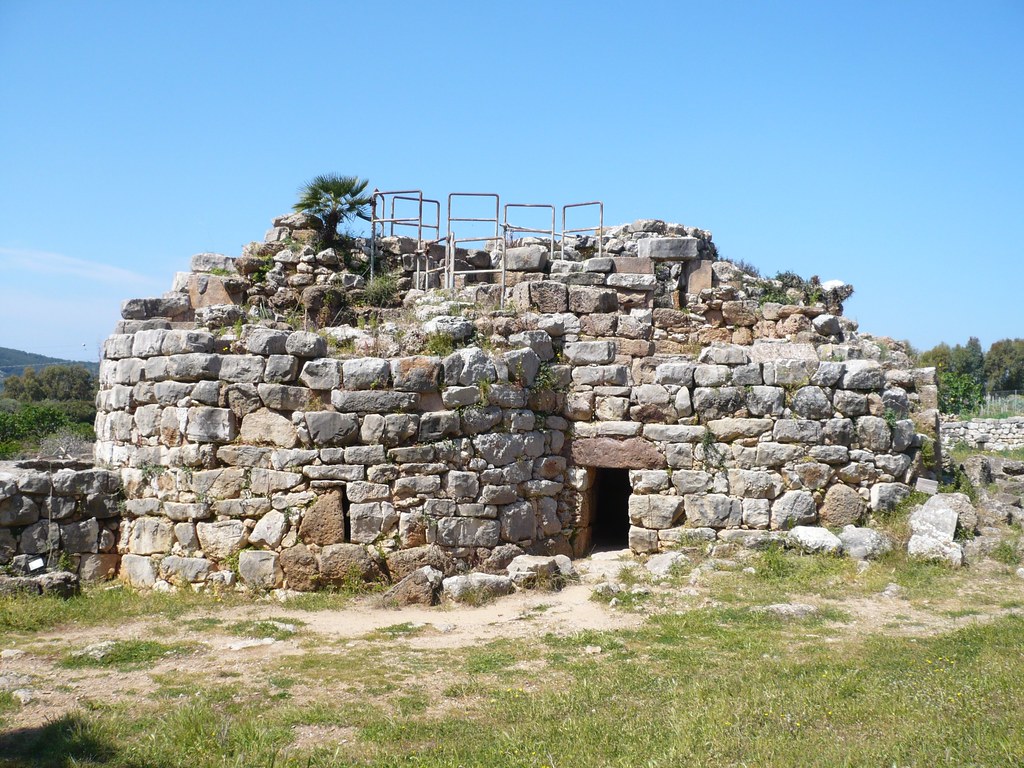
Nuraghe

Palmavera Nuraghe, Alghero, Sardinia
Visited a Nuragic tower and settlement today – Palmavera.  Fascinating.  In occupation roughly 1500BC to 900BC.  There are all the hallmarks of the typical Sardinian Nuragic tower, surrounded by huts.  This is a Class II example, with a double central tower rather than the simpler single tower, or the more complex (Class III) multiple tower examples – most of which are in the south.  As usual I have acquired a rather academic archaeological book in advance to read up on the culture in advance, as well as purchasing, today, the book on the site available at the ticket office. The guides seem to assume that the towers were the dwelling places of chiefs, surrounded by the lesser people in their huts.  Even in the article criticising previous attempts to suggest colonisation from the Eastern meditteranean must have been the origin of such comlpex architecture, supporting instead the idea of a developed local megalithic culture, the assumption remains that these towers are the dwellings of chiefs.  Yet everywhere, unexplained, and glossed over, there are miniature models of these towers.  In the huge round ‘meeting hut’ here at Palmavera, (as found elsewhere), where there is a bench all the way round the inside of this largest of all the huts, and a central pedestal, the item on the pedestal, the focus of the meeting, is a model of the tower – yes the one that is just outside this meeting hut.  In all the archaeological digs, little hand-held or window-sill size models of the tower are found from the period.  It strikes me, I have to say, that one hypothesis archaeologists might do well to investigate would be that these towers were not dwelling places at all – at least not of the living!  It strikes me that these towers were ceremonial places, and if utensils have been found there then they may have been offerings, or there may have been feasts in these towers.  Inside, the conical corbelled roof reminded me of Newgrange.

After Palmavera, I cycled on to Anghelu Ruju, an older – pre-Nuragic necropolis with more than twenty tombs, and evidence of multiple burials from the end of the Mesolithic right through the early Neolithic and up to the Nuragic period.  They were hollowed out from what seemed like a limestone shelf, eerie, ancient, sometimes square, sometimes circular, covering many centuries of use and reuse.  In one, there was a doorway at the end of the entrance passage, flanked clearly by crescent-moon like bulls-horn reliefs.  It was a very potent image of the deepest past, and struck me that perhaps these dark, enclosed spaces where the spirits dwelled might indeed, in the Nuragic, have become the heart of the new-style settlements : no longer perhaps specifically burial sites, but the dwelling places of spirits whose cults had begun in the necropolises.  Idle speculation perhaps.  Amateur archaeology, certainly.  But what delightful weather to do it in 🙂

Interesting Update:
See this for some news on the Nuragic culture!

Alghero Limoncello

Interesting day.  Got pulled over last December and fined for speeding on the M60. Had to surrender my licence to be amended and reissued.  Only rememebered on the plane that I hadn’t received the replacement yet – four months later!  So I’m not able to hire the car I reserved with Hertz, and, after a brief warning chat with the Tourist Info point here in Alghero about daring to speak to the Italian police, I am clearly grounded in Alghero, reliant on the scant bus services.  Ah well.  Lots of excellent food and wine shops and an opportunity to cook a pasta di frutti di mare. Yum! Sauteed the polpo (octopus) until tender while I ate the fresh local aspargus – lightly steamed – with garlic butter.  *licks lips*

After dinner I heard a band outside the window of my little studio apartment in the old town and leant out the window to see what was going on.  It was a parade of some sort – with candles, and therefore probably religious. I put my coat on to go downstairs and follow.  The procession, led by the band, included a tall effigy draped in a black cloak – it had to be the Madonna – and was followed by what was clearly mostly local people with a few tourists at the edges.  I joined the locals, and followed them down through the winding streets of the old town and eventually into the church.  I followed two young lads, taller than all their elderly relatives, but seemingly just as devout, right up until they joined some of their peers in a side chapel of the church – I guessed they were teenagers who had been choirboys.

I stood off to one side in the shadows at the side of the church, as the main congregation clustered around the effigy of the Madonna, resplendant in a magnificent cloak, but somehow not that dissimilar from a shop-window dummy in a white dress and black cloak.  As the Latin and the Italian chants around me played themselves out, I thought about Italy as the home of the Roman Catholic Church, of the pride of the Italians in leading a billion or more christians around the world.  I thought of the golden idols that Moses threw down and how he might view the worship of this shop-window dummy of the Madonna.

As the ceremony came to a close I turned, but before leaving picked up a tea-light at one of the many candle-stations and lit it, tracing the pentacle with my finger on my forehead, and saying a little prayer to the (local Sardinian) Goddess, knowing that She was here, thousands of years in the making, regardless of what the priests might say in a language long dead, of a man who died thousands of miles away…

I returned to my little studio, stopping off on the way to buy a bottle of Limoncello, and as it chilled in the freezer, enjoyed the single MonteCristo I bought at the same time, delighting in the joy of being stuck in a little town on a little island in the Med, with nothing to do.  What luxury!

BTW: Despite Sardinia being the home of Tiscali (its President is Tiscali’s CEO or smthg) there is no WiFi anywhere in Alghero, and only 90s style pay-for-10mins access to the internet on slow-as-tractors ancient XP machines in photocopy shops.  So blogging is going to be strictly an iPhone affair. And what a bloody pallaver that is!  Text is easy, but an image???!! Running my own installation of WordPress on my own server, (and I’m not sure that that is the problem, just saying) I cannot add (using my iphone) an image to WordPress from my iPhone (it requires Flash) or, via the URL option, from my me.com gallery OR my flickr gallery (just get a red X – presumably these galleries require signup of some kind.)  Where to put a free access photo then?  Couldn’t FTP anywhere it on international data connection.  Stumped.  So much for Web 2.0!!!

02 fortunately can’t charge me more than £35 for data roaming – up to 50Mb.  Good job considering how many pics of my dinner I’ver sent from my iPhone to various so-called Web2 spaces.  So if I go quiet – you’ll know why!  Any advice welcome!!

[FGAL id=1480]

Western Powers Go To War Over Oil AGAIN

French (?) jet over LibyaI am pretty annoyed. Quite aside from the current arguments about humanitarian help for the beleaguered rebels, in my opinion this is Cameron and Sarkozy’s war, and its about Libyan oil. (The biggest reserves in North Africa). Italy’s ENI are the biggest players, followed by Germany’s Wintershall, and France’s Total. The US have only started getting back into Libya since 2005 – the famous Blair handshake. The UK government has been working behind the scenes trying to get Shell and BP into this market for over a decade – Blair and Major before him (Major representing US company Carlyle).

The UK want the rebels to grant us oil rights in gratitude. The French are in there protecting Total’s investment.  The Germans and Italians know better what war is all about and don’t want to be a part of it.  What’s going on is all about the oil, just dressed up in humanitarian/democratic arguments: if it was really about the latter we’d be enforcing NFZs over Yemen, Syria and Bahrain, and there’d be more than just Qatar and UAE on the UN ticket sanctioning action.

Tomahawks – the US navy’s cruise missiles (which they only sell to the UK navy), of course, are made by Raytheon – a US/UK arms company, and have control systems made by BAE.  The Brits bought a load of the new ones in 2004 and have just used up a load of their old ones on Libya.  A little googling turns up some really quite wild conspiracy stuff!

Funnily enough – the Turkish Prime Minister agrees “Using incendiary language directed at France in a speech in Istanbul, Erdogan said: “I wish that those who only see oil, gold mines and underground treasures when they look in [Libya’s] direction, would see the region through glasses of conscience from now on.”

STOP PRESS:
26th August 2011

Sept 1st Update:

And so the bidding begins, with French and British companies set to do well.

Feb 10th 2012 Update:


http://www.cartoonmovement.com/cartoon/2196

http://www.cartoonmovement.com/cartoon/2196

How times change

Some People Are Gay.  Get Over It.I went to school at Eltham College in the 1970s, where the Headmaster and Chaplin gave lectures in morning assembly against the ‘evil sin of homosexuality’. I suffered some pretty horrific homophobic bullying from my peers, too. As a result I failed my A-levels, and didn’t get to University til 10yrs after leaving school. Now I head-up the leading Research Centre at the University of Salford, and Peter Tatchell is giving a guest lecture to the sixth form College Society, today.

A moderate beginning the road back to radicalism?

What with :

  • the Tea-Party – the Taliban of the American Right – gaining power in the US Republican Party
  • the Tories finishing what Thatcher started, wearing a dapper LibDem hat to confuse us
  • Darth Ratzinger landing the Death Star on British Soil spitting hate at women and gays, with an army of paedo’s hidden in his skirts…

…it feels like the world is still going to pot since Bush stole the White House, despite the blip of hope when Obama got there to weather the wake…

We seem to be staring at least a decade of austerity and right wing rule in the face, and I have to say, I for one, with memories of my 80s radicalism stirring in my heart, am finding it increasingly necessary to ‘take sides’ in the debate – to radicalise my own thinking in the general drift toward polarisation: the usual effect of right wing rule.

As John le Carre put it, once the Cold War against the failings of Communism had been won it was time to focus on the failings of capitalism. Instead there are those who still believe they should be able to get away with being better off than everyone else at everyone else’s expense, and happily deploy the most insidious strategies to ensure we gleefully beg for them to take more. With bread (in the form of palatial supermarkets) and circuses (yes those theatres of dreams) our ‘owners’ marshal their populations carefully to avoid unrest, driving engines of mass slavery to keep us too occupied to realise who we are, let alone why on earth we are playing this deadly game for people we don’t even know…

I guess one outcome of becoming more radicalised by a political environment shifting to the right, is that I am likely to become more outspoken.

Blog Rebirth

Thumb of the old blog I have spent the last five hours, after three and half years with Pivot, completely migrating my entire blog from March 2007 to September 2010, into a new WordPress installation. Why? Because I wanted to create a page with all of the Peru entries, and found it not only difficult, but ended up screwing up the entries in Pivot, almost losing one, and mucking up the date sequence. So I exported the lot into Movable Type format, installed WordPress on my server, imported the lot into the installation, sorted out all the dates, and hey presto. It was quite time-consuming get it all sorted out, unfortunately – the export/import mucked up ALL the dates (US vs British dating) which required amending them all – BUT WordPress, unlike Pivot, lets you do that 🙂 AND now I have a lovely page all about Peru. And all the wonderful advantages of WordPress. I have been thinking about migrating for, oh, at least a year. I tried in fact, over a year ago, but the installation process was a nightmare. This time it took 5 minutes – they’ve got it sorted now 🙂
So welcome to the New Blog, just like the Old Blog, but with a new engine!

Peru Trip #12 – Final Thoughts

My Peruvian adventure has been both fascinating and – strangely enough – restful. A change is as good as a rest, so they say, and I have to say that perutourism.com have really done well in escorting me around the country – meeting me everywhere and ensuring I get the buses, trains and planes in my itinerary, picking me up from hotels to take me to train stations, bus stations, and airports, and collecting me from them to transfer me to my new hotel, each time. It has meant the entire holiday has been stress free, as far as making arrangements is concerned – all of that is taken care of. The fact that the vast majority of the time I have had ‘private service’ – a driver, a guide, and me, either in a small minivan or private car – has meant that I’ve had a more personal experience than the description ‘guided tour’ usually implies, able to have a one-to-one with each guide, getting the most out of each place I have visited. Worth every penny – and the exchange rate has really been in my favour: Peru is cheap. And, of course, as my conversations with fellow travellers in the Cusco restaurant and at Intipunku proved, this is the surest way to insulate oneself from the potential downsides of being in a very poor country.

Highlights
Me at Machu Picchu
The highlights of the trip include, of course, the Lords of Sipan
Museum, which was an extremely well thought out, brilliantly executed,
and fascinating museum, which taught me more about the Moche people than
any other visit; and Machu Picchu, the deserved crown of Peruvian
ancient architecture, unmolested by anything but the jungle for 500
years since it was abandoned, an absolute jewel set in some of the most
stunning scenery I have been fortunate enough to discover. These two
really stand out as the most amazing visits of my trip. But also of
course Huaca de la Luna was an eye-opening masterpiece, too, showing
that the Moche produced all the stunning artwork known so well from
their ceramics, in relief on the walls of their temples, too. I really
enjoyed the extensive collection of Moche ceramics at the Casinelli
Museum, and the Lady of Cao pyramid and museum at El Brujo proved the
Moche had great Queens as well as Kings. I was suitably awe-struck by
the megalithic scale of the Inca architecture at Saqsaywaman, despite
only the foundations remaining, and only 20% of the site open to
tourists, and I really enjoyed the stunning Inca palace at
Ollantaytambo, with its technical wizardry, wonderful location, and
still living streets and squares.

Lowpoints
One of the shapes of the Nazca lines
Lowpoints, if there were any, were principally Nazca – I’d say ‘not to
be recommended’, in the end: the discomfort of the experience outweighs
the opportunity to take poorer photographs than one is able to google at
a moment’s notice.

Perhaps to be considered a lowpoint, but also a welcome rest, was my day in bed in Puno trying to breathe at 13000ft!

But probably the only real ‘lowpoint’ as such, was, certainly during my
first few days, that my hip was still giving me grief, and the
associated inability to do much walking, or, later, any serious climbs.
The damage done to my hip through compensation issues related to my
congenital back problem, came about as a result of my ThomasCook
sardine-can trip to Vancouver and back, in June. [KLM to Lima were much
better, and I paid extra for a good seat.] Having been using a stick
as recently as days before departure, and wearing a strap daily right
through the holiday, I am nonetheless grateful that, in the end, this
really did not overly impact upon my Peruvian trip. I was restrained,
cautious, and careful, and it paid off. Only on a couple of occasions
(including the walk to Intipunku) did I really feel I was pushing it,
and, towards the end of this three week adventure (especially on the
walk to Intipunku) my general caution and care seemed to have nurtured
enough healing for me to achieve the things I really wanted. All I
would say that it has cost me (apart from the nuisances associated with
the strap) were: I didn’t climb the pyramid at Tucume; not wanting to
climb Amantani contributed to my decision to stay in bed on my first day
in Puno; and of course Wayna Pichu, the mountain peak overlooking Machu
Picchu, was out of the question, even though, by that point, I was
actually feeling not bad. But only 400 people are allowed up it each
day, and it’s apparently a seriously taxing climb, an absolute no-no for
anyone in my condition. But going to Intipunku, the Sun Gate, instead,
was lovely! The Inca Trail, four days for 20 year olds on gap years or
Uni summer breaks, was clearly exhausting even for those I saw arriving
at Machu Picchu for the dawn, and it’s more than 20 years since I last
walked a long distance for several days in a row.

Irrelevancies
The Church at the village near Chucuito.  The cross out front is the marker of the Inquisition. The dancers are on day four of a wedding celebration
On my New Zealand holiday in 2007 there were quite a few stops arranged
by my travel agent that I really found superfluous (at best) or simply
spurious. I think I had greater control over this tour, with
PeruTourism.com, and managed to keep silly stuff to a minimum.
Nonetheless there were a few things I could’ve foregone on a tour of
ancient Peru: the horse show was definitely the most irrelevant – even
tiresome – hence this being its only mention; the brief stop at the Inca
Bar to drink Chicha was charming but unnecessary; and the half dozen or
so churches I visited that I haven’t even mentioned in this blog. Most
were actually ok, even quite interesting, but only for the syncretistic
incorporation of pre-Columbian symbols and motifs into Peru’s unique
brand of Baroque Catholicism. I have to say that I concur with the
long-held English tradition of anti-papism, and have been struck more
than ever before by how (to use one of their favourite words) ‘evil’ an
institution the Catholic Church is. [Do see Stephen Fry’s wonderful critique of the Catholic Church.]
OK, so the British (with help from the Germans, Irish, French, Belgians
and Dutch) exterminated much of the indigenous population of North
America, and left a poisonous legacy in Africa, the Middle East, and
elsewhere. But the surviving First Nations, in Canada at least, have
managed to keep an unbroken line of tradition going, there; Africa is
proudly reasserting its own culture, and flexing its muscle in the
Anglican family. India is returning to her former glory after the brief
period of colonial nuisance. Here, in South America, following the
vile practices of the Inquisition, 90% of the people are still Catholic,
speak Spanish, and view the darker skinned, more purely indigenous
people who still speak Runisamy (the Quechua language) or Aymara, with
distaste. I knew the British had a lot to answer for around the world.
Now I have seen how much the Spanish have to answer for, too.

Final Thoughts

Machu Picchu from Intipunku

Finally, in a sort of sad, geeky kind of way, for a solo traveller in a
foreign country, I have to say that my Mac is my friend. It has given
me Facebook; enabled me to do all this blogging; iPhoto and access to
Flickr have enabled me to process and display all my holiday pics as I
go along; and Hoyles games has wiled away the odd hour of an evening in a
hotel room before sleep. The iPhone of course is the compliment – and I
am very glad of the new EU cap on data roaming charges introduced in
July: I have spent more than in the past, it’s true, because I simply
didn’t do data roaming in the past. But the cap means I now know what
the max cost will be, and I have spent that: ergo the new rules are good
for the telecomms companies. Foursquare
I have to say has been lots of fun, on my iPhone, and I have become
Mayor of two hotels in Peru, and, amazingly, became Mayor of Machu
Picchu, on Foursquare, too! How cool is that?!

Peru Trip #11 – Machu Picchu

Classic view of Machu Picchu - click to see more on FlickrMachu Picchu. Superlatives fail me. Just the train journey (much better than the famous Inca Trail, which is a four-to-six-day walk) was fairly spectacular, bringing home how deep and winding the gorge is here. It is made by a river that almost completely encloses the mountain upon the top of which the sanctuary of Macchu Picchu was built. The town was constructed from the huge rocks that were already there, some of which are still scattered about the summit in the few areas that have not been built on. Here and there the huge stones have been left in place, and the houses and temples built around them, using them as platforms.

The place was started probably around 1400CE, and was still ongoing and unfinished in parts, when it was mysteriously abandoned around 1500CE, abandoned to such an extent that later Incas – including the one overthrown by the Spanish, did not even know of its existence. Which of course means that neither did the Spanish. Of all the Inca ruins, this one is untouched, untainted by the Spanish. This site was not destroyed by them, there is no church built on top of it. It was lost to the jungle before Pisaro even set foot in South America, in 1533. The Quechua people, and their king, the Inca, the Son of the Sun, had abandoned this place long before.
View of the mountains at Machu Picchu

The mountain territory, and the fact that here, at 2400m above sea
level, and towards the east of Cuzco, we are almost in the Amazonian
jungle – at its gate, in fact – all make this already an incredibly
special place, the awesome beauty of the natural surroundings surely a
big part of why it was chosen as a royal sanctuary. The town is built
on the summit, and surrounded by a wall, and includes, typical of other
Inca settlements, especially of the high empire period, a ritual sector
with temples and astronomical stone artefacts, a royal compound where
the royal family and probably the main priests lived or stayed, a
‘commons’ sector where the people who built and maintained the town
lived, and an agricultural area of terraces.

View of Machu Picchu

Temple of the Sun at Machu Picchu
The Temple of the Sun here, as Hiram Bingham called it (most of the
names of the buildings came from him, and his guesswork, as he cut back
the jungle from this place in the years following his discovery of it in
1911), is perhaps the most interesting, to me. There are two main
windows in this semi-circular temple. One faces the point on the
horizon where the Winter Solstice, on June 21st, rises, the other the
point where the Summer Solstice, on December 22nd, rises, over a small
temple on the top of an overlooking mountain called, Intipunku – ‘The
Sun Gate’.

The Sun Gate temple - Intipunku, from Machu Picchu

On these Solstice mornings, the first rays of the sun shine into the
temple through these windows and light up the altar stone in its heart.
The masonry – especially of the royal compound and the temples – is
simply awesome. This place seems in many ways, certainly as it has come
down to us molested not by the Spanish, but only by time, bushes, and
trees, perhaps the finest example of Inca High Empire architecture,
hydraulic mastery and urban planning. Almost in the jungle here,
drainage of the buildings and the terraces is of paramount importance,
and provision of fresh spring water for the populace without the need to
climb down the mountain to the river, absolutely essential. The
drainage remains perfect. To this day, a fresh spring from a mountain
on the other side of the river runs through complex buried channels down
to the bottom of the valley, the pressure making it rise again up to
the summit of Machu Picchu where it flows gently, unceasingly, with
unchanging flow and temperature, all year round, still to this day, five
hundred years after it was built.
The place is simply amazing.

The top fountain at Machu Picchu

The astronomical observatory at Machu Picchu
At the highest point of the main area of the town is the astronomical
observatory, a carved rock with its corners pointing North, South, East,
and West, and to the four mountain peaks around Machu Picchu, crowned
with a sundial obtrusion that casts its shadows with precision around
the year, allowing precise calculations of Solstices and Equinoxes. It
is famed to have power within it, and all the tourists hold their hands
an inch above it, trying to feel the power. I’m sure if that were
possible it would have been sucked dry long ago by now – there are only
1000 tourists here today: it’s a quiet day.

Llactapata, from the Western tower at Machu Picchu

The Western tower at Machu Picchu facing Llactapata
To the west, in the distance, is Llactapata – another Inca temple that
is aligned to the East and where the Sun can be seen rising over Machu
Picchu at one of the Solstices, precisely over where, here at Machu
Picchu, there is a viewing tower overlooking Llactapata.

Me at Machu Picchu

My guide takes several good pics of me here, and I am grateful. He is
knowlegeable, polite, friendly – as they have all been – and my morning
tour is a great introduction to the place. After another big tourist
buffet lunch at the Sanctuary Lodge, I return alone to take a few more
pics of the Temple of the Sun, and make a last climb to the astronomical
observatory, and then head down on the bus to the delightful El Mapi
hotel, for a shower, and a dry Martini, and a light supper. First thing
in the morning, I am on the 5.30am bus to see the dawn rise over Machu
Picchu. And what an experience this is!

I have ‘seen in the dawn’ on a number of occasions, and got up for the
dawn as often, but this has to be one of the finest of them all.
Climbing to the highest point of Machu Picchu where the ‘watchman’s
house,’ as it is known, looks out over the summit town, one gets an
amazing view of the moment of sunrise, as it crests the tops of the
mountains surrounding the site. Some short distance on its journey from
the the Winter Solstice point, in June, towards the Summer Solstice
point, at Intipunku (Sun Gate), in December, the appearance of the sun’s
orb above the mountain peaks is an awesome sight.
Sunrise at Machu Picchu

The top fountain at Machu Picchu
From the watchman’s house I went down to where the first fountain
produces the flow of spring water that runs in its channels and from
other fountains down through the centre of the royal compound and into
the commons sector. Here, where the royals themselves would have got
their water, I washed the silver, serpentine, smokey quartz and obsidian
jewelry I had bought in Pisak, in the hope that I might take some of
the blessing of Pacha Mama and Pacha Tata back to my home land.

Intipunku

Then the walk up to Intipunku. It’s about an hour each way, said the
guide, but I managed it a little quicker on the way down. On the way up
it was a good 50 minutes, and a hot and sweaty journey with frequent
panting stops. Glad of the strap around my hips, I took it easy, but I
am definitely on the mend, it seems, and the walk was worth the risk!
The reward was absolutely fantastic. Gobsmacking is about the best word
I can think of. From Intipunku the view over Machu Picchu is
incredible. I sat there for over an hour, just drinking in the view. I
met an English girl doing a good bit more of South America, there, and
we agreed on many things. I recommended the Lords of Sipan museum and
Huaca de la Luna to her. It was so peaceful, sitting up at Intipunku –
about five of us at one point, three Dutch half asleep on the terraces,
and us two English types. Absolutely peaceful, at the Gate of the Sun,
with the great orb high in the sky behind us, shining down over one of
the most amazing views I have ever seen in my life, bathing perhaps one
of the greatest pre-Christian temple complexes in the world.

Machu Picchu from Intipunku

And then, from the wall of the terrace at Intipunku where I sat, I stood
up to begin my journey home. It will take me three days – journeying
this afternoon to Cusco, overnight there at the Don Carlos again,
collecting my suitcase, then flying Monday to Lima, overnight there
before finally the intercontinental flight on Tuesday back to Amsterdam.
I will bring home with me some incredible memories. And I will be
back.

Peru Trip #10 – Cuzco to Ollantaytambo

Condors at the Animal Rescue Centre, near Cuzco - click to see more on Flickr
So last night I decided to throw caution to the wind and try out one of the posh restaurants of Cusco – with my credit card. Bistrot was recommended by my Cusco tour guide so I got the hotel to book me a table, and went up for dinner there at 8pm. The food was excellent – clearly a properly trained, imaginative chef. The service was worse than amateur – embarrassing. Once I had got past the language difficulty of wanting a decent bottle from the reasonably good list, rather than just a glass of the local Peruvian Tacama white wine – not bad, but not appropriate for a posh dinner – I had to offer to take over opening the expensive bottle of wine, wincing as the waitress struggled with it, with all the promise of bits of cork ending up in the wine. A nice enough girl, friendly, willing, but with barely any English and barely any training as a waitress. My Jumbo River Prawns were cooked to perfection in a delicious sauce, but again I had quite a struggle (and an empty side plate delivered) before managing to get a small bowl of warm water to wash my fingers. Hopefully they’ll serve one with the prawns to future guests. I realised this was quite a new venture, only open a short time, with much to learn. The best thing about the dining experience, however, was the other two diners in the restaurant, a couple from London in their ‘gap year’ between work and retirement, touring the world. Had a really nice chat with them. Bolivia, they say, is even cheaper than Peru, Argentina about the same, but Brazil as expensive as Europe. Like me, they have found everyone they’ve met to be very friendly, and felt no threat at all, despite all the warnings. We conclude that it must be backpacking poor student travellers in cheap hostels that tend to experience the underside we have been warned of, and that we are cushioned by the reach of our wallets. Having to buy a bottle to get a nice wine with my delicious River and ShellFish ‘Parihuela,’ which came with the lovely Peruvian garlic rice I already enjoyed in the north, I of course was pretty happy by the end of the meal, chatting with the other diners. It was a shame that the service was so poor, and that, in the end, despite the signs, they seemed incapable of making their EFTPOS handheld work, either with MasterCard or VISA, and I had to part with half of my remaining cash for this lovely dinner – money well spent, but which I had wanted to put on the credit card to pay later, not pay for out of the rest of my holiday cash. I made no bones about ensuring they knew my displeasure. My fellow guests were equally put out by this, though perhaps less surprised than I that the signs turned out to be misleading, at best. I still made sure they complimented the chef though !

Me drinking Chicha in an Inca bar

So this morning I awoke somewhat hungover – from wine rather than
altitude, for a change – and was treated as a first stop to an animal
rescue centre, caring for exotic Andean creatures with injuries, or
saved from the black market, and returning them, when ready, to the
wild. I met three condors – huge carrion birds – a couple of pumas, and
some large parrots. On the road away from here, the devastation caused
by the flooding in the last rainy season becomes all too apparent, with
the road washed away in places down to a single carriageway. Six months
ago, this area experienced twice the normal rainfall and, among other
things, the railway up to Macchu Picchu was severely damaged (and
repaired by June, thankfully!) The next stop was a traditional Inca bar,
a homely pub where they make their own ‘chicha’ – a maize corn beer,
served straight to the men and brewed with strawberries and served with a
sprinkling of herbs on top to the women. Very nice, I’d say!

Silversmith grinding semi-precious stones and shells into small pieces and gluing them into silver jewelry with tree resin

Third was Pisak, and its famous market, where I was able to use the
credit card to stock up on Peruvian silver (95% alloy with copper, like
Britannia Silver, better than Sterling Silver which is only 92.5%)
beautifully worked by local craftsmen, with the famous Macchu Picchu
serpentine (flecked with iron-pyrites and haematite), Peruvian smokey
quartz, local obsidian, and a particularly lovely skyblue local
sodalite, worked into the silver casings with local tree resin for glue.
Very lovely. I also parted with some dollars for the rug I have been
looking for ever since I arrived in Peru, and had a sneaking suspicion I
might find here. Natural dyes and hand-woven, I got one with the Inca
calendar in red, black, and blue. Very nice. I feel like a good
tourist now, with my souvenirs and gifts for friends back home.

Ollantaytambo - click to see more on Flickr


So the main event of the morning, and I am thankfully quite awake by now
(parting with money often has that effect). Ollantaytambo sits at the
junction of three valleys, including the Cusco valley, and the Sacred
Valley where Macchu Picchu lies. The winds combine here and the Incas,
great technicians that they were, built their storage houses just where
the winds meet and keep the temperature a good 3-4deg lower than on the
valley floor. Either side of the river in the middle of the valley they
built houses for the common people on one side, and the royal compound
on the other. A tambo is literally that – a staging post for the royal
household on its journeys around the empire.

The Terraces at Ollantaytambo - click to see more on Flickr


The terraces here are extremely cleverly formed, with different clays
and soils and at different altitudes to create a series of
micro-climates perfect for potatoes, beans, fruits, and coca leaves –
yes jungle coca leaves growing in the corner of the Sacred Valley,
rather than imported like pretty much everywhere else.
The Profile in the Mountain overlooking Ollantaytambo - click to see more on Flickr
The mountain with the cold storage houses also sports a carved human
profile near its peak, as viewed from the Temple of the Sun at the top
of the terraces behind the royal compound. On the winter solstice on
June 21st the sun rises over distant mountains right at the third eye of
this profile, and shines directly across the valley hitting the Temple
of the Sun first before anywhere else. Coming from sources unknown,
pure mountain spring water at constant temperature and flow appears from
spouts into channels to snake around the terraces as irrigation, and –
most beautifully of all – to create a series of pleasure garden channels
through the royal compound. One wonders if they maybe even had
fountains, after the moorish fashion of contemporary buildings across
the Atlantic like the Alhambra. The whole place is like a holiday
resort in that sense, with the old Inca town square with its flowing
water channel today’s tourist market at the entrance to the
archaeological site: the royal compound, terraces, and what remains of
the Temples the Spanish left behind, when they broke them down to use
the stone to build their churches. The common people’s side of town is
still lived in, Inca streets running up the hills from the main street
into town.

Water feature with tap at Ollantaytambo - click to see more on Flickr


Last stop is at Tunupa, a fantastic buffet restaurant for tourist buses,
with excellent food, and a delightful riverside garden, where I eat
heartily before being dropped at my hotel prior to tomorrow’s early
morning trip to Macchu Picchu.

The river at the bottom of the gardens at Tunupa Restaurant - click to see more on Flickr

Peru Trip #9 – Saqsaywaman, Cuzco

Me and one of the megaliths at Saqsaywaman, Cuzco - click to see more on Flickr
Well, the Incas were truly extraordinary masons. For all that this was – in European chronology – a medieval culture, in the 15th and 16th centuries CE, it was a megalithic culture. Not the megalithic culture of thousands of years BCE, on the Atlantic fringe of Europe and the Mediterranean, but a megalithic culture that had mastered building with stone in an extraordinary way. There are mortice and tendon joints, and metallic rings sunk into carved grooves between stones, inside these huge walls, and carefully graded horizontals that incorporate subtle ratchets at strategic points. The basic shape is trapezoidal: walls and doorways and niches that stand with legs apart. All this makes Inca buildings effectively earthquake proof – both supremely stable and protected from horizontal movement.
Example of masonry techniques at Qoricancha, Cuzco - click to see more on Flickr

Churches built by the Spanish on top of Inca temples (Christianity,
after all, built on top of pagan sites the world over, to cancel out the
old gods with their new religion) fell in the earthquakes of 1650 and
1950 and 1986. The Inca temples are only ruined by deliberate Spanish
destruction, and by having been treated as quarries right up until legal
protection in 1936. Cusco city is an image of the Puma, with the
Temple of the Sun at its phallus, and the complex of Saqsaywaman at its
head (the name Saqsaywaman literally means, Puma’s head).
Our guide shows us the Puma on the map and satellite photo - his finger on the phallus, Saqsaywayan the head
A drawing of the Cuzco puma

The layout of the Saqsaywaman site

The zigzag walls of Saqsaywaman main temple site

The zigzag construction is the hair on the lower jaw of the Puma, the
three tiers the three levels of the cosmos – underworld (snake), earth
(puma), and sky (condor). All that is left now is the foundations – you
can see the drainage holes that kept the place dry during the rainy
season. There were three towers on top of Saqsaywaman – one 160km
square, and one circular with three concentric rings of stone, that was
an enormous water tank. The hydraulic mastery of these genius
stonemasons, furthermore, continues to work perfectly where these
temples still stand, serving water at constant temperature and flow
regardless of season, from sources modern archaeologists have simply not
found.

The ritual cleansing site

There is ample evidence of how they were able to take water from high
places, channel it through carefully carved stones down into valleys and
back up to high places on the other side of valleys, using the pressure
created by shrinking the bore of the grooves they forced the water
through. These technologies, moreover, were sacred – stone and water,
and the knowledge of their manipulation, were pure. There is no mortar
holding any of these stones together. The water flows through holes
bored through stone, along channels paved with stone tiles, never
through clay pipes. Sand, clay and ramps were used, but only to
transport the stone: the quarry for the main temples at Cuzco is 17km
away, and it is estimated that it took 20,000 people working every day
77 years to build just the one large temple as Saqsaywaman on the hill
overlooking the city. They did not have the wheel. Yep, that’s right,
they did all this without using wheels. The Incas were truly
extraordinary masons.

A doorway from one level to the next of the zigzag surround of the main temple site at Saqsaywaman